
Latest in Political News
Get up-to-date political news from our reporters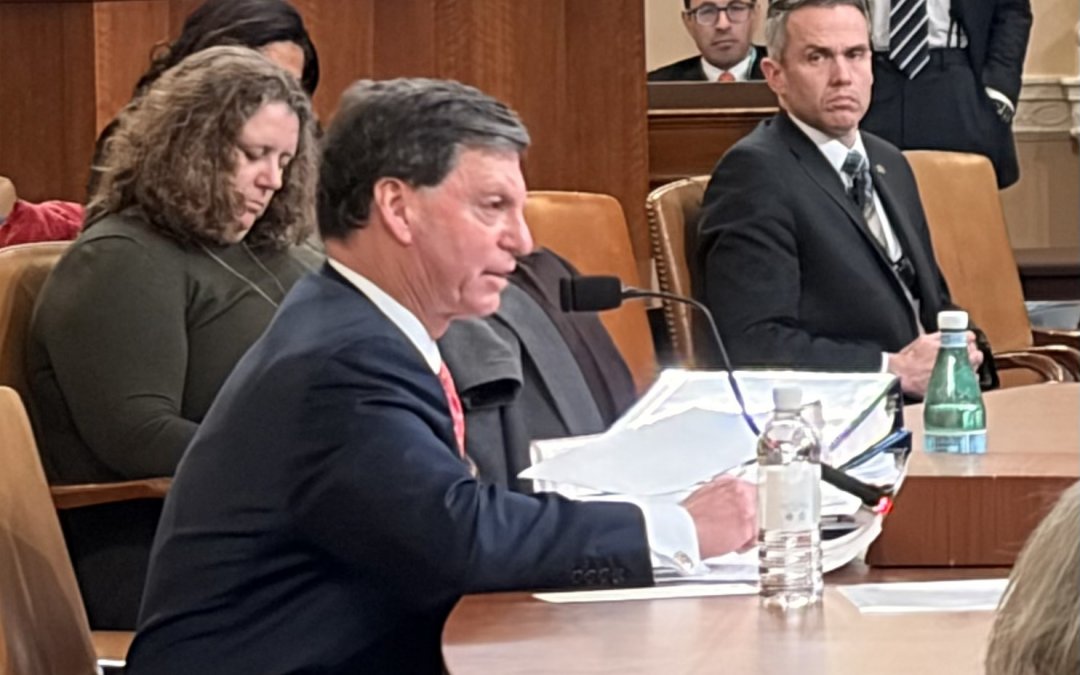
IRS chief touts bigger refunds as lawmakers grill him on privacy violations
IRS CEO Frank Bisignano testified before Congress as lawmakers criticized him for digitalization, tax gap and privacy violations.
read more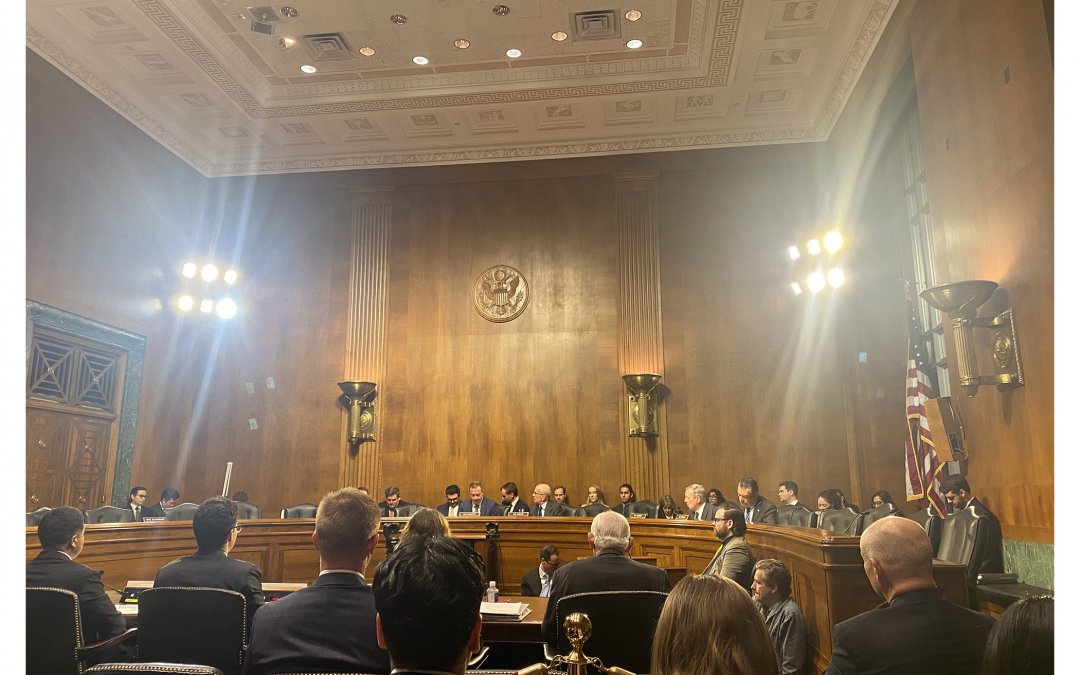
Senate Judiciary weighs legality of Trump’s order targeting birthright citizenship
Lawmakers and legal experts debated President Donald Trump’s executive order seeking to end birthright citizenship for children born to undocumented immigrants.
read more
Republicans want to see Iran’s nuclear program destroyed. Democrats are asking if an end to the war is in sight.
Lawmakers are clashing over the war’s timeline, congressional authorization and whether Congress should fund the ongoing military campaign.
read more
Democratic senators vow to force debate, testimony from top officials on Iran War
WASHINGTON — Six Democratic senators on Monday pledged to fight to bring Defense Secretary Pete Hegseth and Secretary of State Marco Rubio to testify on Iran before Congress and to force more debate over the war on the Senate floor. Democratic Senators held the...
read more
In Photos: Camelot lives on at JFK Jr. lookalike contest
Hundreds gathered to vote for D.C.’s JFK Jr. doppelganger, with single women in search of the JFK Jr. to their Carolyn Bessette.
read moreSupreme Court weighs pipeline deadline fight with stakes far beyond the Straits of Mackinac
Published in conjunction with 
Senate Dems. bash former DHS deputy secretary Troy Edgar at nomination hearing to be ambassador to El Salvador
WASHINGTON — Democratic senators on the Foreign Relations Committee have sharply criticized Troy Edgar, the nominee for ambassador to El Salvador, over his actions as Department of Homeland Security deputy secretary under President Donald Trump.
At Edgar’s nomination hearing, Democrats questioned his role in violent DHS activity, including the two fatal shootings of Renee Good and Alex Prettii by ICE, and CBP agents and the repeated obstacles for Congress to conduct visits to ICE facilities.
“Unfortunately, you’ve been part of an administration that’s taking away Americans’ rights to freedom here at home, due process rights as well as First Amendment rights, and it is hard to trust you there that you’ll stand up for important American principles as our American Ambassador to El Salvador, if confirmed,” said Sen. Chris Van Hollen, D-Md.
Edgar’s nomination was part of a major shift in the DHS leadership structure, as Trump announced on Truth Social Thursday afternoon that he was firing DHS Secretary Kristi Noem just hours after the nomination hearing. Trump said he would replace Noem with Sen. Markwayne Mullin, R-Okla., pending confirmation.
Van Hollen pressed Edgar to disagree with Noem’s statements that Renee Good and Alex Pretti were involved in domestic terrorism. Before congressional committees this week, Noem refused to retract those comments.
Van Hollen said he found it “absolutely astounding” that Edgar also refused to say that Good and Pretti were not domestic terrorists.
The top Democrat on the panel, Sen. Chris Coons, D-Del., questioned Edgar on last year’s deportation of more than 200 Venezuelan immigrants without criminal convictions to El Salvador’s maximum security Terrorism Confinement Center.
Multiple human rights organizations have documented the megaprisons’ poor conditions and violations of human rights, including torture.
“It sends a message to the rest of the world, what we stand for when we forcibly deport hundreds of people, many with no criminal record, to a country that has a demonstrated human rights record that is abysmal.” Coons said.
“I’m gravely concerned by the significant human rights in El Salvador and frankly by your answer that what matters is meeting the president’s campaign promises and it’s popular, so who cares about the consequences for the people who were sent there.”
Edgar responded that he did not have concerns over human rights violations by the government of El Salvador under President Nayib Bukele in relation to the more than 200 people sent to the country’s Terrorism Confinement Center.
Democrats and Republicans fundamentally disagreed over human rights violations in El Salvador under Bukele, who authorized widespread abuses, including mass arbitrary detention, enforced disappearance, torture, and ill-treatment of detainees and due process violations, according to the Human Rights Watch.
Some Republicans commended the decline of gang violence under Bukele.
“I think about President Bukele’s leadership that’s allowed El Salvador to dramatically reduce violent crime in that country, including the establishment of a maximum security facility that detains very high-risk criminal offenders,” Sen. Bill Hagerty, R-Tenn., said.
Hagerty said Edgar will make an excellent ambassador to El Salvador.
“Our two governments have found a way to coordinate on the return of Salvadorian nationals that are involved in criminal activity, and we’ve done that in a way that’s reinforced public safety right here in the United States,” Hagerty said.
The committee also questioned Frank Garcia, assistant secretary of State for African affairs nominee; Lee Lipton, ambassador to the Philippines nominee; Asel Roberts, ambassador to Slovenia nominee; and Jared Novelly, ambassador to New Zealand nominee.
Since Edgar had captured most of the committee’s attention, Coons conducted a second round of questions at the end of the hearing for the remaining nominees.
Senate Foreign Relations Democrats criticized the number of vacant ambassadorial posts under the Trump administration and Trump’s nominees for lacking sufficient diplomatic experience.
The Senate was expected to vote to confirm ambassador nominees, including Edgar, in the coming months.
Senate candidate interrupts Joint Force meeting to criticize Israel
WASHINGTON — At the beginning of a Senate subcommittee hearing, a member of the public audience stood up and shouted, “Israel is the reason for this war!” The protestor, who was roughly removed from the hearing room, was later identified as Brian McGinnis, who is running to be the Green Party’s candidate for Senate in North Carolina.
“This is wrong!” he shouted as security dragged him out of the hearing room. “Nobody wants to fight for Israel!”
The protest and the hearing’s proceedings reflected high national tension over the Iran war as the White House struggles with messaging. The senators presiding over the hearing seemed divided over the current conflict, but high-ranking military witnesses affirmed the joint force’s current readiness and asked for more investment as the war continued into its first week.

A Capitol police officer inspects McGinnis’ hand, which was damaged as he was removed from the hearing chamber. (Isabel Papp/MNS)
Sen. Dan Sullivan, R-Alaska, began by recognizing the six confirmed deaths of U.S. soldiers as part of Operation Epic Fury and affirmed the longstanding goal of the United States government to prevent the Iranian government, the “largest state sponsor of terrorism,” from obtaining nuclear capabilities.
These concerns, however, have been raised since the 1990s. Several presidents, including Presidents Clinton, Bush, Obama and Biden, have stated that Iran was “weeks” or “months” away from achieving nuclear capabilities, and Prime Minister Benjamin Netanyahu had been echoing these claims for 30 years.
“Iran will be capable of producing alone, without importing anything, nuclear bombs within three to five years,” Netanyahu said in a 1995 interview. In 2012, the prime minister told the United Nations “It’s only a few months, possibly a few weeks, before they get enough enriched uranium for the first bomb.”
The White House announced Operation Epic Fury’s goal was to end the Iranian regime. U.S. forces killed Ayatollah Ali Khamenei, supreme leader of Iran. President Trump indicated that the candidates he would have liked to replace Khamenei may already be dead.
“Most of the people we had in mind are dead. And now we have another group. They may be dead also, based on reports,” Trump said on Tuesday.
In the hearing, Sen. Mazie Hirono, D-Hawaii, pressed military witnesses on the length of the war and the resources it would require.
“How do you determine impact and readiness if we don’t know the extent of this war?” asked Hirono. “Be frank with us. If you can’t gauge the impact on readiness, at this moment because you’re not told how long this is going to go, you can just tell us.”

Senator Hirono criticized the United States’ involvement in Iran during a Wednesday hearing about the readiness of the joint forces. (Isabel Papp/MNS)
The military officials affirmed that they did not know how long the conflict would last. “It’s a little too early to tell exactly what kind of impact it’s going to have just based on where we are in the conflict,” said Gen. John LaMontagne, vice chief of staff of the Air Force.
The hearing wasn’t limited to discussions of Iran, as senators and military witnesses presented their concerns regarding the threat that Russia and China pose to national security, as well as Ukraine’s ongoing dependence on U.S. arms production.
Secretary of State Marco Rubio said in a closed-door briefing Tuesday that Iran still communicates with terrorist organizations and plans to attack the United States, according to Sullivan. A terrorist threat would be particularly significant now, considering the partial shutdown currently affecting the Department of Homeland Security.
“Every day DHS is not funded is another day the U.S. is vulnerable,” Sullivan said.
The top generals on the panel affirmed the readiness of their combat operations and the abundance of recruits. They also mentioned efforts to improve the quality of life for service members, such as ensuring that Marines have housing onshore, and addressing military suicide rates. Though the Pentagon has not released its yearly suicide report, officials mentioned that the rate of suicides in the military had increased.
“Any loss of a sailor is a tragedy. It’s doubly tragic when it’s a loss to suicide,” said Adm. James W. Kilby, Vice Chief of Naval Operations. “So, we take this seriously and regrettably, last year our numbers increased.”
Still, Hirono expressed her apprehension about the impact of Operation Epic Fury, which was reportedly launched with short notice, on military readiness.
“These impulsive decisions have a great consequence on readiness,” said Hirono. She encouraged her fellow legislators to vote “yes” on the War Powers Resolution proposed Wednesday evening. The resolution was later rejected.
“It is Congress that declares war, not the president,” she said.
IRS chief touts bigger refunds as lawmakers grill him on privacy violations
WASHINGTON – Chief Executive Officer of the Internal Revenue Service Frank Bisignano on Wednesday celebrated bigger refunds for American taxpayers, while lawmakers criticized Bisignano’s for exposing tens of thousands of U.S. taxpayers’ private information.
“This is a catastrophic leadership failure and a huge hit on the public’s confidence in your integrity,” said Rep. Suzan DelBene, D-Wash.
During the House Means and Ways committee hearing, legislators confronted him on mishandling private information and the fairness gap between how the tax system treats the richest Americans and working‑class taxpayers. However, Bisignano bragged about lowering taxes for families by $220 billion under the Working Families Tax Cuts Act, mentioning that the average refund is currently up $775. “The average American family is already seeing greater benefits than ever before. This is thanks to the signature provisions of the Act — no tax on tips, no tax on overtime, no tax on auto‑loan interest, and a special tax deduction for seniors,” said Bisignano.
Rep. Mike Thompson, D-Calif., pressed Bisignano on the IRS’s transmission of confidential taxpayer data to the U.S. Immigration and Customs Enforcement without proper authorization.
“The IRS violated the law 42,695 times,” said Thompson. “This isn’t a paperwork error. It’s a breakdown in leadership.”
Federal court found the IRS violated the Internal Revenue Code by disclosing confidential taxpayer addresses to ICE on Feb. 26.
Bisignano said that nobody had been fired or disciplined, mentioning that everyone was held accountable. He refused to publicly acknowledge the violations, saying “I don’t want to debate the numbers.”
Rep. John Larson, D‑Conn., pressed the committee to subpoena Justice Department records and call a whistleblower to testify about government employees allegedly funneling sensitive Social Security and tax data to outside political groups. He said his constituents “want to know what has been done with their information” and whether it is sitting “in a cloud” that may not be secure.
“What happened and why is it that we can’t get the names?” asked Larson.
Bisignano largely declined to delve into the specifics, pointing back to ongoing reviews and reiterating that safeguarding personal data is a core responsibility of the IRS under his leadership.
Lawmakers also questioned whether the IRS has administered the tax system fairly.
Rep. Richard Neal, D-Mass., criticized the IRS for tilting the tax system away from ordinary Americans. He accused the Trump administration of turning the IRS into a political tool while simultaneously starving it of resources, arguing that working‑ and middle‑class taxpayers were left to deal with service breakdowns and shrinking enforcement at the top. Neal warned that a voluntary tax system cannot function if people believe “the referee” has been undermined and wealthy people have different rules than for everyone else.
“Meanwhile, wealthy tax evaders are celebrating as investigations into abusive schemes this month plunged by 65% when refunds do come with more fractured, broken promises,” said Neal.
Where Neal described the IRS as a system being weaponized against ordinary taxpayers, Rep. Adrian Smith, R-Neb., saw it as a bloated bureaucracy threatening the middle class.
Smith warned that expanding the IRS bureaucracy would leave middle-class taxpayers more vulnerable, arguing that a proposed $1 billion infusion for the agency would mean more staff and more audits that “squeeze a lot of dollars… out of the middle class.”
“The American people deserve better, and it makes me think about various federal workers who work hard to do the right thing, and the bureaucracy stands in the way,” Smith said.
Bisignano pushed back on the idea that the IRS has burdened the middle class. He repeatedly said his top objectives are higher service, higher compliance and stronger privacy.
“We’re going to increase compliance. We’re going to have an easier way to operate with us. And we have, we have 30,000 people working on compliance,” said Bisignano.
Lawmakers warn China is exploiting Russia’s war to expand influence in Europe
WASHINGTON –– Lawmakers warned Wednesday that China has quietly expanded its political and economic influence across Europe while the continent remained focused on countering Russia’s war in Ukraine.
“China and Russia share a vision for the world where the strong do what they can and the weak suffer what they must,” said Rep. Joe Wilson, R-S.C., chairman of the Commission on Security and Cooperation in Europe, also known as the United States Helsinki Commission.
The commission met to examine how China has been gaining access to key economic sectors across Europe through economic investments and political pressure. Experts argued that China’s activities could undermine NATO cohesion, as could Russia’s geopolitical ambitions, if European governments fail to respond by reducing reliance on Chinese technologies and products.
Wilson said China’s strategy benefits directly from Russia’s military aggression in Ukraine.
“Russia’s patron, China, is only becoming the true winner in this war,” Wilson said. “Xi Jinping has complemented Putin’s brute force with a patient, persistent approach to establishing his global dominance.”
Experts testified that China’s influence campaign in Europe goes far beyond traditional diplomacy and often relies on economic leverage and political pressure to shape government decisions. Audrye Wong, a nonresident senior fellow at the American Enterprise Institute, said China’s strategy includes building political support while discouraging criticism of Beijing’s policies.
“One (strategy) is to bolster friends and silence critics of the Chinese Communist Party and its policies,” Wong said. “China seeks to undermine transatlantic cooperation and European unity through a divide-and-conquer strategy.”
Valbona Zeneli, a nonresident senior fellow at the Atlantic Council, said China’s growing alignment with Russia has changed how many European policymakers view Beijing.
“China and Russia are strange bedfellows, however, they have shared strategic alignment,” said Zeneli. “One of the main trends that has changed perceptions in Europe has been the support that Beijing has given to Russia for its war in Ukraine.”
The commission also heard testimony from Vidmantas Verbickas, Lithuania’s vice minister of foreign affairs, who described how China used economic pressure against his country after Lithuania expanded ties with Taiwan.
“Exports to China fell by 99.7 percent, essentially near zero,” Verbickas said. “This was not a commercial dispute. It was political pressure designed to change a sovereign policy decision.”
Lithuania mainly exported products like dairy, beef, and grain to China, as well as laser technologies. The drop in exports came after the country opened a representative office for Taiwan in its capital city, Vilnius.
Lawmakers also raised concerns about China’s growing influence in technology and infrastructure across Europe, warning that reliance on Chinese companies could create long-term security risks.
Several Western governments, including the U.S., have long restricted or banned Huawei equipment from their national networks over espionage-related national security concerns. Huawei became a major point of contention between the U.S. and its allies during the rollout of 5G networks. U.S. officials like Ellzey warned that allowing Chinese companies to build critical telecommunications infrastructure in Europe could give China potential access to sensitive data networks.
“(Europe) might be repeating the same mistake when it comes to 6G,” said Rep. Jake Ellzey, R-Texas, referring to security debates surrounding Chinese telecom company Huawei.
Ellzey said similar concerns could arise as countries begin developing next-generation technologies such as 6G. Currently, 11 European Union countries depend on Huawei 5G networks including Germany, Austria, Hungary, and Bulgaria, according to EuroNews.
Witnesses urged stronger coordination between the U.S. and European allies to counter China’s growing influence in technology and other industries and to strengthen democratic institutions.
“China’s rise is a defining geopolitical challenge of the century,” Zeneli said.
Supreme Court weighs freight broker liability in negligent hiring case
WASHINGTON — The Supreme Court on Wednesday considered whether the brokers who connect shippers with truck companies can be held liable for irresponsible drivers.
The case, Montgomery v. Caribe Transport II, LLC, stems from a 2017 incident in which Shawn Montgomery, the petitioner, suffered significant injuries after a tractor-trailer hit his parked truck on the side of an Illinois highway.
A key part of the case is the interpretation of part of the Federal Aviation Administration Authorization Act of 1994. It prevents state laws “related to a price, route, or service” of trucking companies or brokers that connect them to shippers.
However, the statute also provides an exception, stating that it will “not restrict the safety regulatory authority of a State with respect to motor vehicles.”
The outcome could redefine liability standards for freight brokers and impact the broader transportation industry and interstate commerce landscape.
The driver of the tractor-trailer, Yosniel Varela-Mojena, had been involved in a crash months earlier but was still employed by Caribe Transport II, an interstate trucking company. Freight broker C.H. Robinson recruited Caribe II to deliver a cross-country shipment. Montgomery sued the broker for negligent hiring under Illinois state laws.
During the arguments, the two sides disagreed about whether the phrase “with respect to motor vehicles” includes brokers.
“We do believe that ‘with respect to motor vehicles’ is the crucial question here,” Theodore Boutrous Jr., Caribe II’s counsel, said. He argued Congress did not intend for brokers to be included.
The attorney for the U.S. agreed the two different sections of the law being discussed should, in context, be taken altogether to mean that brokers are not included in the realm of “motor vehicles.”
“Paragraph one uses the phrase ‘with respect to the transportation of property,’ (and) paragraph two (says) ‘with respect to motor vehicles,’” said Sopan Joshi, assistant to the U.S. solicitor general. “That seems like a conscious choice that Congress made to parallel the language but change the noun to a much narrower noun.”
Associate Justice Brett Kavanaugh questioned Paul Clement, Montgomery’s counsel, on how brokers would address safety concerns if the Court were to rule in favor of Montgomery and say that brokers are liable for consequences of negligent hiring.
For instance, Kavanaugh suggested drivers should be proficient in English to ensure safety. In April 2025, President Donald Trump signed an executive order to enforce English-language requirements for commercial motor vehicle drivers.
“If you’re hiring drivers who can’t read the signs, that seems like a safety issue,” Kavanaugh said.
Clement said brokers could work with larger trucking companies with deeper pockets and check that they have adequate programs in place to test drivers for drug use, prior accidents and other potential concerns.
“One of the reasons, I think, that you do want (brokers) to have some duty of care in these circumstances is this is a margin business,” Clement said. “If they don’t have any sort of incentive to internalize any of the cost of not asking the question, they really have no good reason to ask the question. They want the cheapest carrier.”
Associate Justice Ketanji Brown Jackson asked the government’s attorney, Joshi, to explain why he thought Congress did not think brokers should share responsibility for safety given the language in the 1994 law.
“The problem, I think, with the argument in the way that you’ve set it up is that you are assuming away any responsibility that a broker might have for safety,” Jackson said.
Joshi argued that Congress did not intend for brokers to have responsibility regarding safety and could have worded the law differently if it did.
“Congress has an entire chapter, several chapters, of the U.S. Code in Title 49 that deal with safety addressing carriers, safety of motor vehicles, driver qualifications, and they’re all addressed at carriers,” Joshi said. “Not a single one is addressed at brokers.”
Joshi acknowledged that the Federal Motor Carrier Safety Administration is “understaffed,” “overworked” and unable to review all of the federally registered carriers. However, he said Congress has provided ways of bringing consequences against carriers who violate federal requirements and regulations.
In his closing rebuttal, Clement told the court that 94% of registered carriers on the road do not have meaningful federal safety inspections, a number derived from 2021 Federal Motor Carrier Safety Administration data.
He said state tort law could provide a “backstop to the federal system.”
“This case doesn’t have to be that hard. The thing that triggers state tort liability is an 80,000-pound motor vehicle. That’s what devastatingly injured my client,” Clement said.
The Court is expected to have a ruling by the summer.
Published in conjunction with 
Senators express support, criticism of future military action in Iran
WASHINGTON — Senators seemed split along party lines over future military action in the Middle East after a classified intelligence briefing on Tuesday afternoon. Democrats called for increased clarity on the objectives and justifications for attacks, while Republicans supported the Trump administration’s current plan.
The conflicting reactions came as both the House and the Senate are scheduled to vote on a war powers resolution on Wednesday and Thursday, respectively. If passed, the resolution would limit further military actions in Iran without congressional approval.
Most Republicans criticized the measure and said that Congress should not take authority away from the president.
“We don’t need 535 commander in chiefs,” Sen. Markwayne Mullin, R-Okla., told reporters in the Capitol Tuesday. “The commander in chief is the president of the United States and he has a duty in Article Two to be able to protect American interests and he is initiating that and doing that with great authority and great effect.”
Democrats criticized the president for striking without congressional approval.
The Constitution grants Congress the sole power to declare war, but dictates that the president is the commander in chief of the armed forces.
“Nobody gets to hide and give the President an easy pass or an end run around the Constitution,” Sen. Tim Kaine, D-Va. said in regards to the war powers resolution. “Everybody’s got to declare whether they’re for this war or against it.”
President Donald Trump launched strikes on Iran early Saturday morning. As of Wednesday morning, over 1000 people, including six U.S. service members, have been killed in the conflict, reported CBS News. Trump and members of his administration, including Secretary of State Marco Rubio, offered conflicting justifications for the war and different estimates for how the war may last.
Democrats expressed worry over the lack of clarity from the Trump administration.
“They have shifting goals, different goals all the time, different answers every day,” Senate Minority Leader Chuck Schumer, D-N.Y., told reporters Tuesday. “And I’m truly worried about the mission. There’s no set plan being here day after day. ‘We’re going to do this, this, this and this,’ and these are the reasons why you end up with an endless war.”
Schumer added that the answers given during Tuesday’s intelligence briefing were “unsatisfying.”
Sen. Richard Blumenthal, D-Conn., echoed Schumer’s concerns about the unclear objectives.
“I am more fearful than ever after that briefing that we may be putting boots on the ground and that troops in the United States may be necessary to accomplish objectives that the administration seems to have,” said Blumenthal. “But I also am no more clear on what priorities are going to be of the administration going forward, whether it is destroying the nuclear capacity of the missiles or regime change or stopping terrorist activities.”
Blumenthal added that the “administration owes it” to the American people to release information about the Iran war.
Republicans came out of Tuesday’s briefing praising the administration and its objectives.
“They want to make sure that the ability for them to strike us anywhere at any time is gone,” said Mullin. “No way they’ll be able to make a nuclear weapon or enrich uranium again. To take out their navy so they can’t disrupt commerce in the shipping lanes, and to take out their ability to restock and rebuild their missiles and drones. That’s the objective here.”
Mullin added that the U.S is “going to eliminate the threat that’s been threatening us for 47 years” which “no other president was willing to stand up against Iran and eliminate it like President Trump.”
Others, like Sen. Lindsey Graham, R-S.C., expressed similar confidence in U.S. military powers.
“Who’s going to win a war between the Iranian regime and the United States? We are. We’re going to win this conflict,” Graham said.
House Agriculture Committee weighs GOP proposal for the next farm bill
WASHINGTON — Lawmakers on the House Agriculture Committee debated a sweeping proposal to reshape U.S. agricultural policy late on Tuesday as Republicans advanced the Farm, Food, and National Security Act of 2026, a bill intended to serve as the House framework for the next farm bill.
The full committee markup began at 6 p.m. and stretched until nearly midnight before resuming Wednesday at 8 a.m., with lawmakers clashing over agricultural subsidies, conservation programs and food assistance.
“This so-called farm bill is problematic because it screws over a lot of poor people in this country,” said Rep. Jim McGovern, D-Mass., during the markup debate. “We have millions and millions of people in this country, the richest country in the history of the world, who are hungry.”
The debate carried broad national implications because the farm bill governs major parts of U.S. agricultural and nutrition policy. Congress typically renews the legislation every five years, combining funding for farmers with nutrition assistance programs that support millions of Americans. The current farm bill, passed in 2018, has been extended multiple times since expiring in 2023.
One of the largest programs affected is the Supplemental Nutrition Assistance Program (SNAP), which helped about 41.7 million Americans afford food in May 2025, according to an analysis by the Pew Research Center based on federal data.
According to a summary released by the House Agriculture Committee, the new farm bill will expand producers’ access to credit, promote precision agriculture, and enhance conservation programs for working lands. Republicans defended the proposal as a necessary update to agricultural policy, arguing it reflects economic pressures facing farmers.
“The policies of 2018 are no match for the challenges of 2026,” said House Agriculture Committee Chairman Glenn “GT” Thompson, R-Pa. “An update to the farm bill is long overdue.”
Democrats countered that the legislation fails to protect nutrition programs. Instead, they pushed the Farm and Family Relief Act, a bill Democrats introduced in January that proposes $56 billion to help farmers and fund SNAP.
“We could move forward with the Farm and Family Relief Act,” said Ranking Member Angie Craig, D-Minn. “Sadly, Republicans seem determined to continue down the partisan path.”
Republicans pushed back on that criticism. Rep. Brad Finstad, R-Minn., argued the legislation includes provisions originally introduced by Democratic lawmakers. Finstad condemned the posture of Democrats.
“This is political theater,” he said.
Some lawmakers said the proposal still faces obstacles in building the bipartisan coalition that historically helps farm bills pass Congress.
Rep. John W. Mannion, D-N.Y., told Medill News Service that major policy disagreements remain.
“We all recognize farmers’ importance,” Mannion said. “But historically farm bills succeed because they bring everyone together, and this proposal does not get us there yet.”
Agricultural industry groups have welcomed parts of the proposal. According to the USA Rice Federation, the legislation could help provide long-term certainty for agricultural producers and maintain U.S. commodities as a core component of international food assistance programs.
The current debate follows a similar legislative effort in 2024, when the committee held a full markup of the Farm, Food, and National Security Act of 2024. Committee leaders at the time described that proposal as the result of extensive feedback from agricultural stakeholders and lawmakers. However, Congress struggled to finalize the proposal, extending the 2018 version while negotiations continue.
As the markup continues, lawmakers are expected to consider additional amendments before the committee votes on whether to send the bill to the House floor.
Even if the House advances its version, lawmakers would still need to negotiate with the Senate before Congress can finalize the next farm bill.
In Photos: ‘Jeffrey Epstein Walk of Shame’ appears in public park near White House
WASHINGTON — A “Jeffrey Epstein Walk of Shame” was installed last weekend in Farragut Square, a public park close to the White House, naming and shaming public figures associated with the late child sex offender and trafficker.
The display comes amid intense scrutiny of the Epstein files, following the Department of Justice’s release of more than 3 million pages on Jan. 30 detailing the activities of Epstein and his network of associates.
Sidewalk stickers posted at each corner of the park welcomed commuters and visitors to the exhibition. The installation, inspired by the Hollywood Walk of Fame, displayed stickers shaped like stars featuring prominent politicians, billionaires and celebrities tied to Epstein.
Each star carried a QR code that directed visitors to specific entries in the Epstein files or news articles detailing their connection to him. Instead of an emblem representing their field of work, the center of each star depicted Epstein’s headshot.
While being named in the Epstein files does not necessarily imply wrongdoing, it could suggest involvement in or enabling Epstein’s crimes. Except for Ghislaine Maxwell, none of Epstein’s friends or associates have been criminally prosecuted in the United States, fueling outrage over the lack of accountability.
It remains unclear who created the installation and when it will be removed.

A “Jeffrey Epstein Walk of Shame” appeared in Farragut Square on March 1, 2026, naming prominent public figures with ties to the late sex trafficker. (David Sun/MNS)

One visitor lingers before former Barclays CEO Jes Staley’s star. These stars around the park included celebrities, industry executives and politicians. (David Sun/MNS)

One passerby scans the QR code on New York Giants co-owner Steve Tisch’s star. Tisch appears in the Epstein Files more than 440 times. (David Sun/MNS)

One passerby scans the QR code on former Harvard University President Larry Summers’s star. Summers recently resigned from teaching at Harvard after the Epstein Files detailed his close relationship with the sex offender. (David Sun/MNS)

Elon Musk’s star is the only one whose sticker has been torn off, though the QR code remains intact. (David Sun/MNS)

One visitor looks down at former President Bill Clinton’s star. Clinton testified before Congress on Feb. 27 about his connections to Epstein. (David Sun/MNS)

A passerby photographs his two dogs beside the “Jeffrey Epstein Walk of Shame” sign during an afternoon walk. (David Sun/MNS)
Supreme Court justices seem skeptical about banning guns for marijuana users
WASHINGTON – The Supreme Court heard oral arguments Monday in United States v. Hemani, and a majority of the justices appeared deeply skeptical that the federal government should prosecute a Texas man for owning a gun, simply because he regularly used marijuana.
The case has forced the nation’s highest court to grapple with a constitutional puzzle. If James Madison reportedly drank a pint of whiskey every day and was not considered a “habitual drunkard,” what does that say about Ali Danial Hemani, who smokes marijuana every other day? Justice Neil Gorsuch posed that question directly to the federal government’s attorney, but nobody in the courtroom had a clean answer.
In 2022, FBI agents investigating the Hemani family’s alleged ties to the Iranian Revolutionary Guard Corps searched his Denton County home and found a legally purchased Glock 9mm pistol, 60 grams of marijuana, and 4.7 grams of cocaine. Hemani told agents he used marijuana almost every other day.
He was not charged with terrorism. He was not charged with drug dealing. But he was charged under 18 U.S.C. 922(g)(3), a provision of the 1968 Gun Control Act that makes it a felony, punishable by up to 15 years in prison, for anyone who “is an unlawful user of or addicted to any controlled substance” to possess a firearm.
The government’s case rests on an analogy to founding-era laws against “habitual drunkards.” Gorsuch was unpersuaded. “John Adams took a tankard of hard cider with his breakfast every day. James Madison reportedly drank a pint of whiskey every day. Thomas Jefferson said he only had three or four glasses of wine a night,” he told Sarah Harris, the principal deputy solicitor general. “Are they all habitual drunkards who would be properly disarmed for life under your theory?” The only thing the record shows about Hemani, Gorsuch noted, is that he used marijuana roughly every other day, with no specifics on quantity.
Justice Amy Coney Barrett pushed further, asking whether someone who takes their spouse’s sleeping medicine Ambien without a prescription would also lose their right to have a gun. “It’s not the drug itself that’s causing the dangerousness. If my husband has a prescription and I don’t, what is it about Ambien that would make one of us more likely to be dangerous? It’s not. It’s the lawfulness.” She pressed the same logic onto Adderall, a medication for ADHD, Robitussin, a cough syrup, and testosterone. “None of those drugs strike me as drugs for which it is obvious that a risk of violence would ensue,” she added.
Justice Ketanji Brown Jackson identified a deeper structural problem. The 2022 New York State Rifle & Pistol Association Inc. v. Bruen protected the right to carry a handgun in public for self-defense. Under that case, she argued, a modern legislature must follow founding-era judgments about dangerousness. It cannot substitute its own.
“You have to have a policy judgment at the founding that matches the policy judgment today,” she said. “And if we don’t see that, then the fact that today’s Congress thinks that person is dangerous is irrelevant.”
Hayley Lawrence, executive director of the Duke Center for Firearms Law, called Jackson’s interpretation of Bruen the most consequential moment of the oral argument.
“We’re operating in this legal fiction where we’re forced to ask whether Congress considered dangerousness determinations in relation to historical analogs when we know that’s not what Congress did,” she said. “You’re asking the government to go back and do homework for an assignment that was due 50 years ago.”
Gorsuch also pressed Harris on why the administration chose this case to test the principle while simultaneously moving to reclassify marijuana as a less dangerous drug, from Schedule I to Schedule III.
“It’s an odd case to have chosen,” he said. Matthew Cavedon of the Cato Institute, who authored an amicus brief for Hemani, noted the contradiction:
“The chaos is even within the administration, it appears, about how dangerous marijuana is,” he said. “On one hand, it has approved medical uses… On the other hand, it’s this thing that, by golly, if you’re doing it, you’re so dangerous you can’t be trusted with a gun.”
Carissa Hessick, a criminal law professor at the University of North Carolina, compared the case to the federal government charging Al Capone for tax evasion prosecution. Prosecutors often pursue the case they believe they can win.
“As long as we think these are appropriate penalties for the crimes people are actually being convicted of, as opposed to the ones we just suspect them of committing, then we should be okay with it,” she said.
The case has drawn an unusual alignment of advocacy groups. The NRA, ACLU, Gun Owners of America, and Cato all filed briefs for Hemani. Everytown, the Brady Center, and 19 states, including California and Illinois, backed the Trump administration.
“This puts the decriminalization crowd and the gun violence prevention folks on opposite sides, and those two camps are often comprised of a lot of the same people,” Lawrence said.
The ruling will land amid significant legal uncertainty about marijuana. The federal government is moving to lessen penalties for marijuana, while 40 states have some form of legalization, and hundreds of lower-court challenges to the federal statute that makes it a felony to illegally use drugs while possessing a gun.
Hemani could face a maximum of 15 years if convicted. The Supreme Court was expected to rule by summer.
Supreme Court considers unconstitutional exceptions when defendants waive their right to appeal
WASHINGTON — The Supreme Court heard arguments Tuesday on what limitations there should be for defendants who waived their right to appeal if their sentence would otherwise be deemed illegal.
Courts generally uphold two exceptions to appellate waivers: either the defendant claims ineffective assistance of counsel or the sentence exceeds the statutory maximum. The outcome of Hunter v. U.S. will determine if there will be more flexibility for defendants to appeal unreasonable sentences even if they had previously waived that right.
Munson P. Hunter III pleaded guilty to aiding and abetting wire fraud in 2024 and was sentenced to more than four years in prison, followed by three years of supervised release. As part of the deal, Hunter waived his right to appeal the sentence, which is extremely common – according to the Suarez Law Firm, appeal waivers are “nearly universal” in plea deals.
During sentencing, the court ordered Hunter to take mental health medication while in supervised release. Hunter objected to this mandate, but the court rejected his arguments. The judge then misinformed Hunter that he could appeal his sentence.
In his appeal, Hunter argued that the court’s mandate for him to take mental health medication while on supervised release violated his due process rights. The district court ruled against Hunter and said the written waiver overrode the judge’s spoken statements in court.
During oral arguments on Tuesday, Chief Justice John Roberts expressed concern over treating plea agreements like a typical binding contract. He pressed both counsels on what wording could be used to allow for more flexibility, but the court did not land on a catch-all term for unreasonable sentencing.
“Plea agreements have some attributes of a contract, but they’re not, they’re not like ordinary contracts,” Roberts said. “Imposing the entire law of contracts here seems to me rather open-ended.”
Hunter’s counsel Lisa Blatt argued that there needs to be more exceptions to appeal waivers if defendants receive unconstitutional sentences.
“It is inconceivable and hypocritical and embarrassing to say a criminal defendant has no contract defense at least when the government is seeking to enforce the contract,” Blatt said.
Ruling in Hunter’s favor could change how criminal cases conclude, which is usually final since most defendants entering a guilty plea have waived their right to contest the sentence.
Waiving one’s right to appeal saves the government time and litigation costs, since they do not have to entertain the possibility that a defendant’s case will return to the court.
Associate Justice Neil Gorsuch expressed concerns to Department of Justice lawyer Zoe Jacoby that defendants may face prejudice from judges and receive sentences influenced by racism or sexism.
Gorsuch also said the case is a public policy issue because contractual agreements should not change the fundamental court system. He posed a hypothetical to Jacoby that a court of orangutans could issue a sentence and under the government’s strict interpretation of appellate waivers, the defendant would not be able to take action.
“It’s a district court who says, I’m going to let an orangutan pick a sentence out of a hat,” Gorsuch said. “And you would say no, no right to appeal that.”
Associate Justice Ketanji Brown Jackson raised the issue of the government’s stake in plea deals. She argued that the Sentence Reforming Act of 1984 is proof that appeals incentivize courts to follow the law and impose reasonable sentences.
Waiving one’s right to appeal saves the government time and litigation costs, since they do not have to entertain the possibility that a defendant’s case will return to the court. Jackson said if the outcome of Hunter v. U.S. sides with the government, it could pose issues in public policy.
“We have a congressional policy that, in fact, revamps the entire sentencing system to allow for appeals,” she said. “To suggest that an appeal waiver is not against public policy, I think, runs up against all of that.”
Director of the Cato Institute’s Project on Criminal Justice Matthew Cavedon published an amicus brief in support of Hunter, and also challenged the notion that this case should fall under contract law.
Cavedon said a contract is defined as two consenting parties acting in their best interests, while a plea bargain is a surrender from one party that cannot walk away.
“It’s really hard to say that most plea bargains can qualify as a genuine contract in the first place,” Cavedon said. “That said, even contracting law would not put up with the sort of wide open uncertainty that’s reflected in a plea like the one that was at issue today.”
After hearing Tuesday’s oral arguments, Cavedon said he is confident that the Supreme Court will rule in favor of Hunter and give more flexibility with appeal waivers.
“It’s a good sign that the court certainly wasn’t willing to indulge the government’s argument here that an appellate waiver prevents all abuses,” he said. “From there to a ruling in favor of Mr. Hunter is a pretty short distance.”
A decision on the case will be released by the end of the court’s term in the summer.
Published in conjunction with
Dems boycott SOTU at ‘People’s’ State of the Union Address
WASHINGTON – In freezing temperatures, lawmakers, activists, and protesters gathered on the National Mall to oppose the president’s State of the Union address by holding their own “People’s” State of the Union on Tuesday night.
“I’m not at the State of the Union because there, you won’t hear about the State of the Union,” said Sen. Chris Murphy, D-Conn. “You’ll hear lies.”
More than 80 Democratic lawmakers chose to boycott the State of the Union this year to protest President Trump’s initiatives and what they expected his speech would contain. While some simply stayed home, several spoke on the National Mall. The boycott comes amid a partial government shutdown brought about by the Democrats’ refusal to fund the Department of Homeland Security without imposing restrictions on ICE.
The event was hosted by independent journalists Joy Reid and Katie Phang, both of whom regularly criticize the president on their podcasts.

Joy Reid, host of the Joy Reid show, co-hosted the event with Katie Phang of the Katie Phang Show. (Isabel Papp/MNS)
“We are going to hear about the state of our union from the people who are being impacted by policies taking place at the hands of someone who has demonstrated no love for the Constitution,” Reid said at the start of the night.
Lawmakers gave their remarks and presented their guests, who ranged from political activists to ordinary Americans who emphasized the impact of President Trump’s policies on their day-to-day lives.

Dr. Jenna Norton has been a long-time critic of the president’s health policies and was put on administrative leave from the National Institute of Health in 2025, which she said is because of her comments against the administration. (Isabel Papp/MNS)
Among the guests was Dr. Jenna Norton, who organized the Bethesda Declaration, a public letter to protest the Trump administration’s health policies and funding cuts. According to her, last year’s research funding cuts put Americans at risk and wasted more money than they saved.
“When you halt a five-year study, a $5 million study, four years in, you don’t save $1 million, you waste $4 million,” Dr. Norton told the crowd. “They continue to this day to censor research in violation of the courts, erasing people from science who don’t fit their vision.”
However, the night did not go without interruption. While Sen. Murphy took the stage speaking on the struggles of immigrants, a heckler broke through the barricade and took the stage. Despite carrying a sign that read “No money for ICE,” he shouted “Go Trump!” into the microphone before being escorted off the stage. Later, another heckler called out from the audience.

During Sen. Chris Murphy’s speech, a man broke through the barricade and approached the stage, shouting, before security escorted him away with some difficulty. (Isabel Papp/MNS)
The event’s message was a stark contrast to President Trump’s State of the Union address, which centered on the success of his immigration policy and his administration’s efforts to grow the American economy.
“And now I’m bringing them way down on health care and everything else,” the president said. “I’m also confronting one of the biggest rip-offs of our times, the crushing cost of health care, caused by you, since the passage of the Affordable Care Act (ACA).”
Rep. Greg Casar’s (D-Texas) guest, Jill Kordick, an Iowa resident, had a different story. “Honestly, I am making choices to defer health care, just all in, you know, great fiscal caution. There are millions of Americans that are affected by the loss of the ACA credits,” she said.
The last government shutdown ended without an extension of ACA tax credits, which led to significant increases in health insurance costs for Americans and was a significant point of contention for Democrats. Roughly 22 million people saw their health care premiums increase in 2026, with many dropping their coverage.
“This isn’t abstract. These are real policy choices, errant policy choices, and they’re harming real people like me,” Kordick said.

One protester arrived with the Straw Hat flag, a symbol from the popular anime One Piece that has been co-opted by protests around the world to symbolize the fight against tyranny. (Isabel Papp/MNS)
Attendees seemed optimistic ahead of November’s midterm elections, predicting that a decline in Trump’s approval rating would be reflected in the polls.
Attendees seemed optimistic ahead of November’s midterm elections, predicting that a decline in Trump’s approval rating would be reflected in the polls.
“The People’s State of the Union starts tonight and we’re going to keep it going every day of the week through November and to the end of this man’s term until we get the country that we deserve,” said Rep. Sydney Kamlager-Dove, D-Calif.
Protesters’ signs echoed the speakers’ calls for change, an end to the redaction of the Epstein files, and for ICE to cease its operations.
“But if the only way out is through, then the only way through is together. As one people, fighting for the ones we don’t know yet,” said Nedia Morsy, director of Make the Road New Jersey, a community initiative to empower Latino immigrants in New Jersey.
“Presidents can come and go, but we are here to stay,” Morsy said.

(Isabel Papp/MNS)

Medill Today | Tuesday, March 10, 2026