
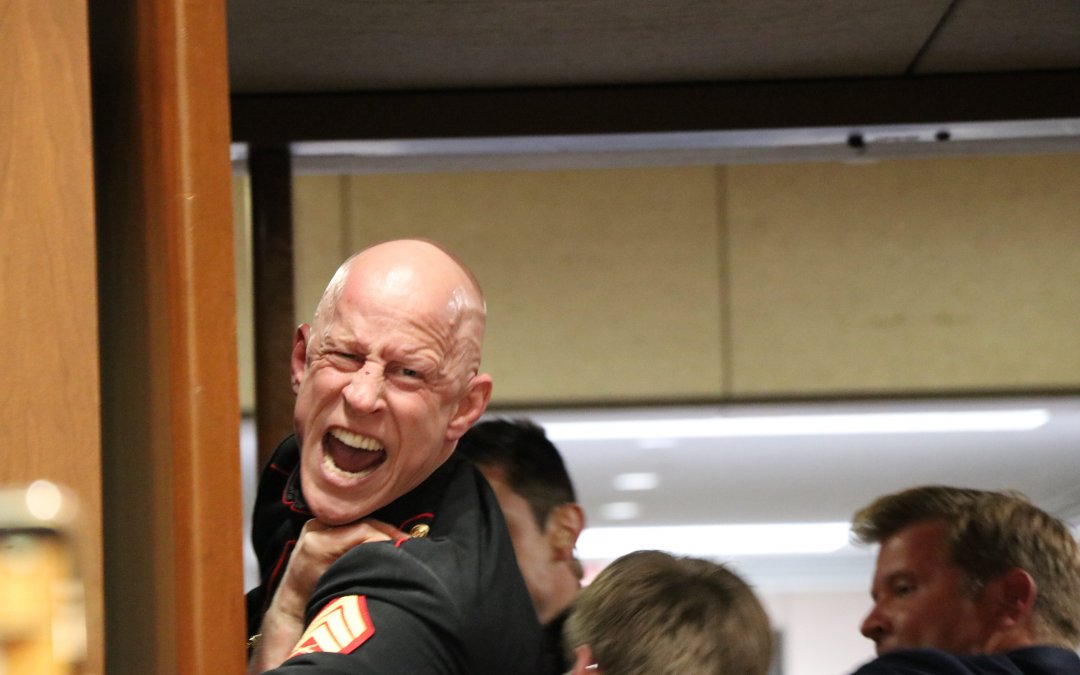
WASHINGTON — At the beginning of a Senate subcommittee hearing, a member of the public audience stood up and shouted, “Israel is the reason for this war!” The protestor, who was roughly removed from the hearing room, was later identified as Brian McGinnis, who is running to be the Green Party’s candidate for Senate in North Carolina.
“This is wrong!” he shouted as security dragged him out of the hearing room. “Nobody wants to fight for Israel!”
The protest and the hearing’s proceedings reflected high national tension over the Iran war as the White House struggles with messaging. The senators presiding over the hearing seemed divided over the current conflict, but high-ranking military witnesses affirmed the joint force’s current readiness and asked for more investment as the war continued into its first week.

A Capitol police officer inspects McGinnis’ hand, which was damaged as he was removed from the hearing chamber. (Isabel Papp/MNS)
Sen. Dan Sullivan, R-Alaska, began by recognizing the six confirmed deaths of U.S. soldiers as part of Operation Epic Fury and affirmed the longstanding goal of the United States government to prevent the Iranian government, the “largest state sponsor of terrorism,” from obtaining nuclear capabilities.
These concerns, however, have been raised since the 1990s. Several presidents, including Presidents Clinton, Bush, Obama and Biden, have stated that Iran was “weeks” or “months” away from achieving nuclear capabilities, and Prime Minister Benjamin Netanyahu had been echoing these claims for 30 years.
“Iran will be capable of producing alone, without importing anything, nuclear bombs within three to five years,” Netanyahu said in a 1995 interview. In 2012, the prime minister told the United Nations “It’s only a few months, possibly a few weeks, before they get enough enriched uranium for the first bomb.”
The White House announced Operation Epic Fury’s goal was to end the Iranian regime. U.S. forces killed Ayatollah Ali Khamenei, supreme leader of Iran. President Trump indicated that the candidates he would have liked to replace Khamenei may already be dead.
“Most of the people we had in mind are dead. And now we have another group. They may be dead also, based on reports,” Trump said on Tuesday.
In the hearing, Sen. Mazie Hirono, D-Hawaii, pressed military witnesses on the length of the war and the resources it would require.
“How do you determine impact and readiness if we don’t know the extent of this war?” asked Hirono. “Be frank with us. If you can’t gauge the impact on readiness, at this moment because you’re not told how long this is going to go, you can just tell us.”

Senator Hirono criticized the United States’ involvement in Iran during a Wednesday hearing about the readiness of the joint forces. (Isabel Papp/MNS)
The military officials affirmed that they did not know how long the conflict would last. “It’s a little too early to tell exactly what kind of impact it’s going to have just based on where we are in the conflict,” said Gen. John LaMontagne, vice chief of staff of the Air Force.
The hearing wasn’t limited to discussions of Iran, as senators and military witnesses presented their concerns regarding the threat that Russia and China pose to national security, as well as Ukraine’s ongoing dependence on U.S. arms production.
Secretary of State Marco Rubio said in a closed-door briefing Tuesday that Iran still communicates with terrorist organizations and plans to attack the United States, according to Sullivan. A terrorist threat would be particularly significant now, considering the partial shutdown currently affecting the Department of Homeland Security.
“Every day DHS is not funded is another day the U.S. is vulnerable,” Sullivan said.
The top generals on the panel affirmed the readiness of their combat operations and the abundance of recruits. They also mentioned efforts to improve the quality of life for service members, such as ensuring that Marines have housing onshore, and addressing military suicide rates. Though the Pentagon has not released its yearly suicide report, officials mentioned that the rate of suicides in the military had increased.
“Any loss of a sailor is a tragedy. It’s doubly tragic when it’s a loss to suicide,” said Adm. James W. Kilby, Vice Chief of Naval Operations. “So, we take this seriously and regrettably, last year our numbers increased.”
Still, Hirono expressed her apprehension about the impact of Operation Epic Fury, which was reportedly launched with short notice, on military readiness.
“These impulsive decisions have a great consequence on readiness,” said Hirono. She encouraged her fellow legislators to vote “yes” on the War Powers Resolution proposed Wednesday evening. The resolution was later rejected.
“It is Congress that declares war, not the president,” she said.