
Latest in National Security News
Get up-to-date national security news from our reporters
Senate candidate interrupts Joint Force meeting to criticize Israel
In the hearing, high-ranking military witnesses were questioned on the extent of the Iran war and the military’s readiness for it.
read more
Lawmakers warn China is exploiting Russia’s war to expand influence in Europe
WASHINGTON –– Lawmakers warned Wednesday that China has quietly expanded its political and economic influence across Europe while the continent remained focused on countering Russia’s war in Ukraine. “China and Russia share a vision for the world where the strong do...
read more
Noem back in hot seat as House Democrats press on immigration policies
Homeland Security Secretary Kristi Noem appears before the House Judiciary Committee for a second day of testimony as the DHS shutdown continues.
read more
New defense strategy prioritizes China as lawmakers question Middle East operations
A new U.S. defense strategy prioritizes deterring China in the Indo-Pacific and increasing allied military responsibility, while lawmakers question whether recent Middle East operations contradict that shift.
read more
In photos: Former USAID employees rally one year after shutdown
Former USAID employees rallied outside the agency’s headquarters at the Ronald Reagan Building on Friday to mark the one-year anniversary of the shutdown.
read moreLawmakers call for stronger export enforcement to stop China from smuggling American AI chips
WASHINGTON — Lawmakers at a House of Foreign Affairs hearing on Tuesday called for stronger export enforcement mechanisms to stop China from smuggling American AI chips for Chinese technological development.
The Bureau of Industry and Security declared in January that chip exports to China will be reviewed on a case-by-case basis “to ensure the national security benefits” by maintaining U.S. leadership in the AI arms race.
Republican and Democrat lawmakers agree with the need to protect America’s advanced chips but disagreed about strategies to secure America’s AI leadership.
Rep. Gabe Amo, D-R.I., argued that the Bureau of Industry and Security’s enforcement changes in January significantly loosened export controls and allowed China to purchase Nvidia H200 chips more easily. Nvidia H200 chips are critical to the AI race.
Amo said that President Donald Trump had already put U.S. national security at risk after his decision late last year to approve chip exports to Saudi Arabia and the United Arab Emirates, two countries that have close ties with China and Trump’s family businesses.
“We now know a UAE sovereign wealth fund made a $500 million deal with the Trump family to purchase a 49% stake in that same cryptocurrency company,” Amo said. “These overlapping financial interests raise serious questions about how Trump is abusing our export controls and whether they are being used to enrich government officials and their families.”
Nvidia H200 exports, along with other chips China needs to train its AI software, must meet criteria like the “No Prohibited Use” requirement, where barred individuals or companies cannot use U.S.-exported chips.
However, the Trump administration recently found that China’s DeepSeek AI platform used American chips to train its latest model. This raised concerns about whether the bureau’s enforcements adequately protect U.S. technological leadership and military superiority.
Republican lawmakers focused on making sure that domestic tech companies and employees do not leak valuable information to China and other foreign adversaries.
Rep. James Moylan, R-Guam, referenced a case last month involving a former Google engineer who stole thousands of documents on Google’s AI trade secrets. Witness David Peters, the Assistant Secretary of Commerce for Export Enforcement at the Bureau of Industry and Security, said the bureau is “in regular communication with companies.”
“We seek to go out and educate our partners in the business community because, truly, it’s through them that we tend to identify a lot of these potential violations,” Peters said.
However, some Republican lawmakers were concerned if U.S. companies were aware of the consequences of violating export controls.
When Rep. Keith Self, R-Texas, asked whether companies “price in the cost of violations into the cost of doing business,” Peters said that the Bureau of Industry and Security does not know. He instead blamed companies’ “underinvestment in [their] compliance and due diligence” departments.
Some Democratic lawmakers drew attention to whether overseas companies were on the same page in enforcing strong export controls.
“We want to make sure that our partners in other countries are working in tandem with us and have the resources that we need them to have to be able to identify and prosecute illegal activity,” Rep. Sydney Kamlager-Dove, D-Calif., said.
When Kamlager-Dove asked if the bureau “is willing to commit to more training and capacity building in companies overseas,” Peters said that they plan to expand their export control officer program, which is for U.S. officials at U.S. embassies abroad who monitor international compliance with U.S. export control laws.
At the end of the session, Rep. Bill Huizenga, R-Mich., the Chairman of the House of Foreign Affairs Committee, asked how many checks on exports to China were conducted last year. Peters said that he does not have the exact number of end use checks performed last year and would follow up with the bureau.
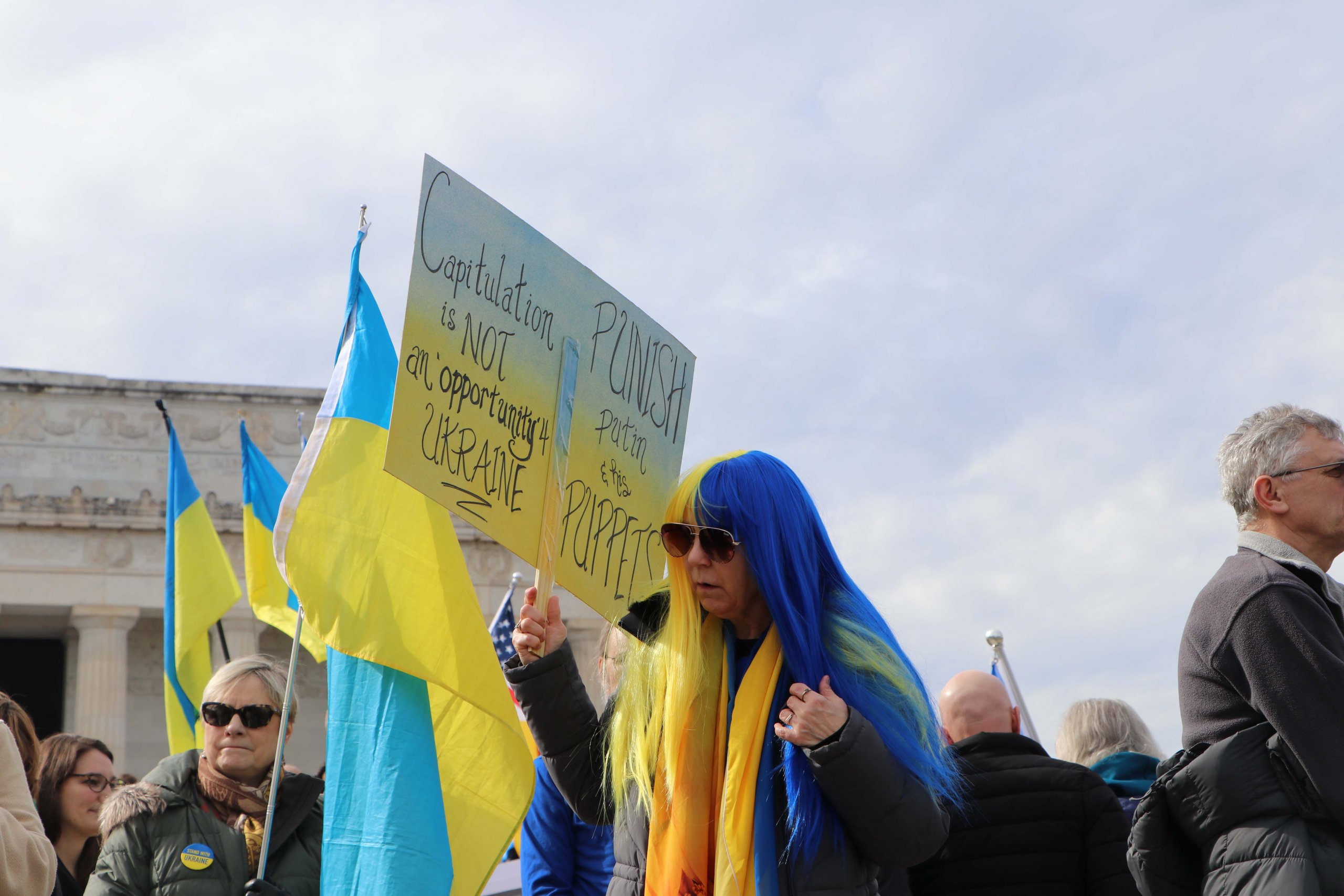
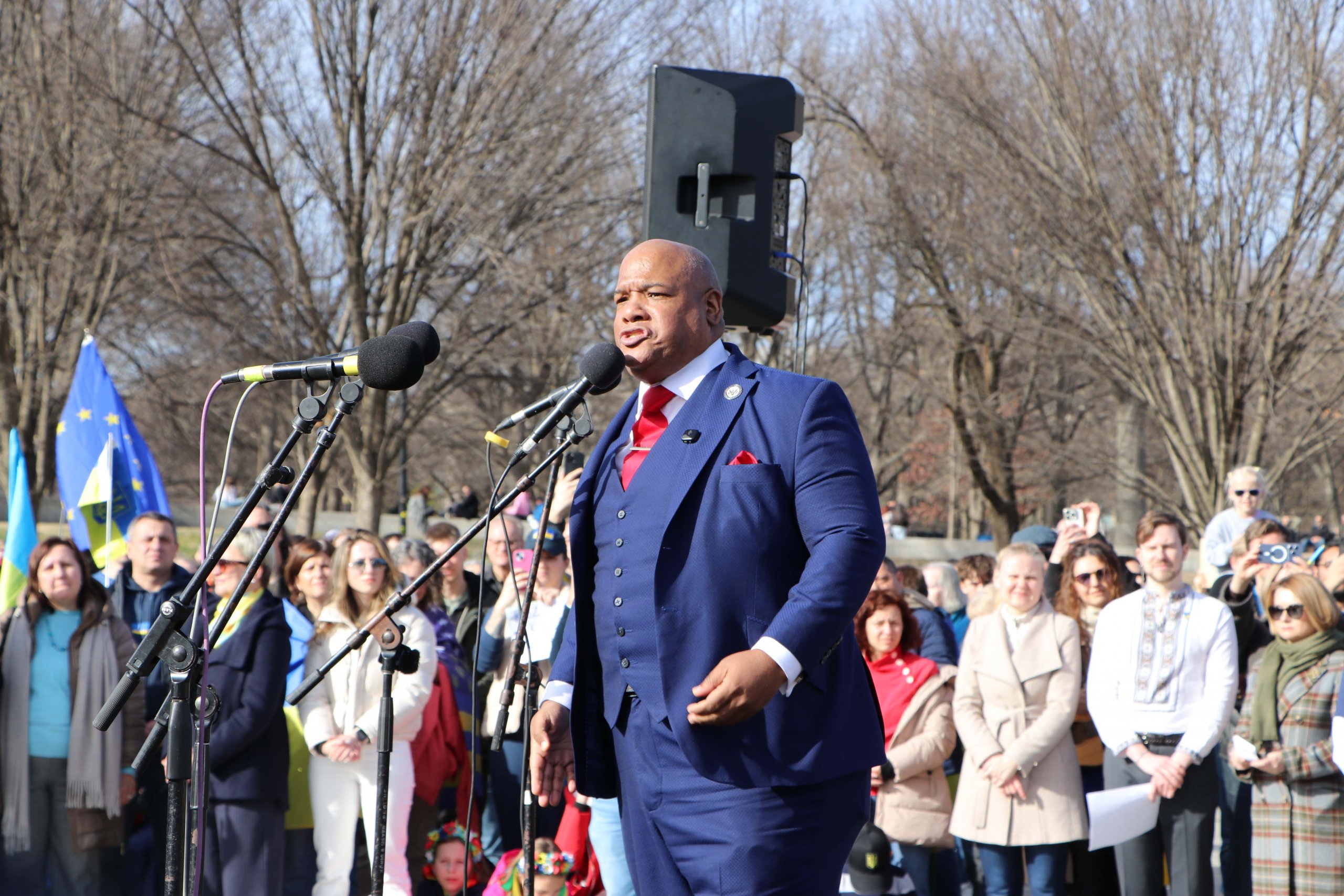
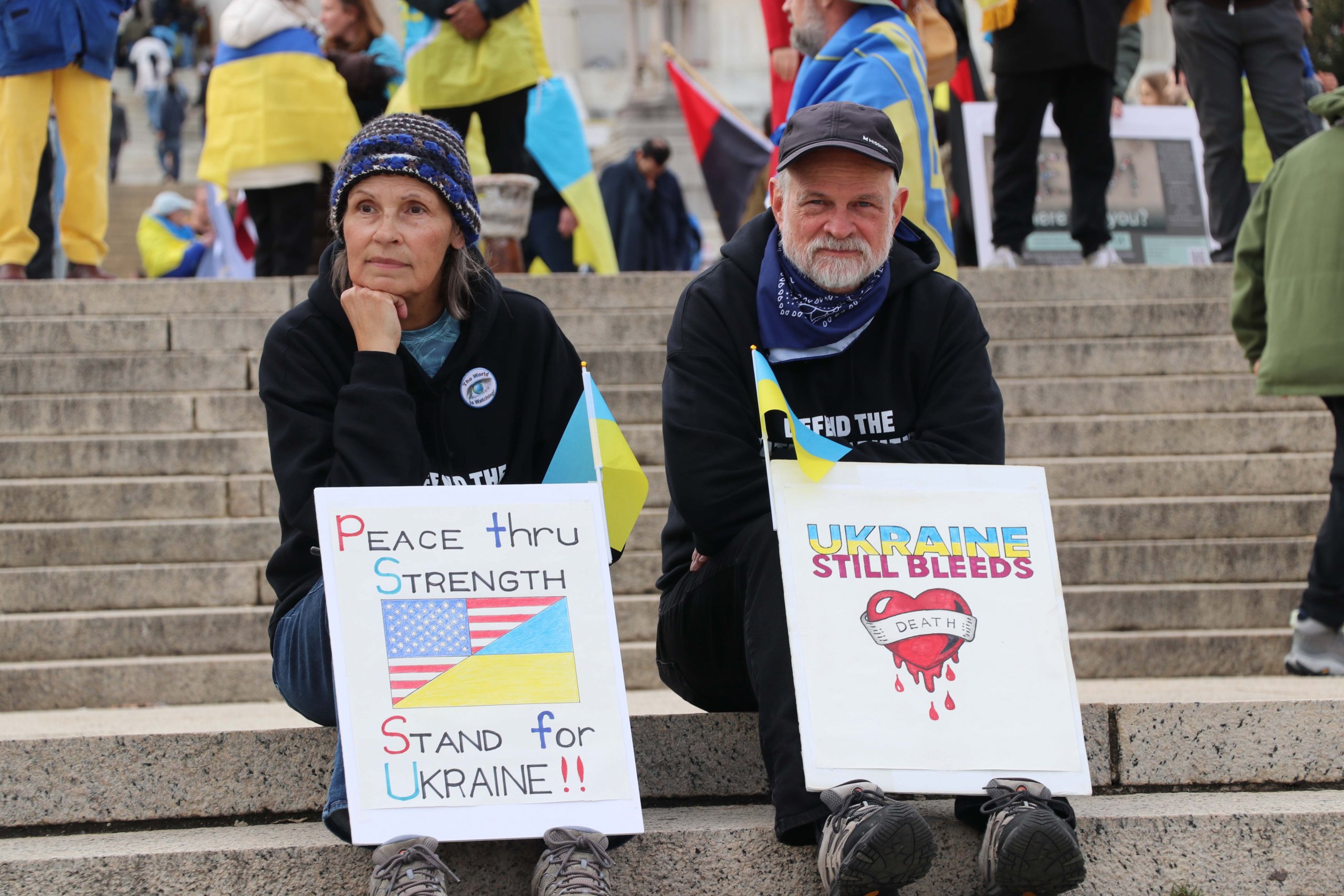
In Photos: Four years after Russia’s invasion, chants for Ukraine echo at Lincoln Memorial
WASHINGTON — Draped in blue and yellow of the Ukrainian flag, hundreds of protesters filled the steps of Lincoln Memorial on Saturday ahead of the fourth anniversary of Russia’s invasion of Ukraine.
Russian President Vladimir Putin initially expected to seize Ukraine within 10 days, according to a 2022 report by Royal United Services Institute. Instead, the war has stretched into its fourth year as of Tuesday’s anniversary. The milestone comes as Russia launched another major missile and drone strike against Ukraine on Sunday, adding to the war’s toll of nearly two million deaths on both sides.
Many demonstrators held signs criticizing Putin for prolonging the war and demanding he take responsibility for the casualties and destruction.

A female protester held a “Wanted Putin” sign to condemn the Russian president for continuing the war for four years. (Sarah Han/MNS)
Others denounced President Donald Trump for what they described as a shift in U.S. policy toward Ukraine since he took office. Nancy Feldman, who attended the rally, said “America could have ended this war sooner” and that Ukraine has been “suffering for four years needlessly.”

Feldman held a double-sided sign. One side read, “Free D.C., free Ukraine from evil dictators Trump and Putin!” The other read, “Stop Trump’s retribution against Zelenskyy!” (Chloe Park/MNS)
“The only reason Trump is not supporting Ukraine more in this war against Russia’s aggression is because everything Trump does is about retribution against his enemies, and he does not like Zelenskyy,” she said.








Despite ongoing violence, Israel-Syria relations ease under U.S. involvement
WASHINGTON — Improving security ties between Israel and Syria may offer a rare opportunity to reduce regional tensions, witnesses told a House panel Tuesday morning, however lawmakers were concerned over violence and the targeting of minorities inside Syria.
“Having the United States bringing the Israelis and the Syrians together is a good thing, and there’s no other country with the credibility to actually make that happen,” Dr. Mara Karlin,
Brookings Institution Fellow and Johns Hopkins University professor, said.
The hearing came weeks after the U.S. mediated talks in Paris last month between Israeli and Syrian officials. Participants agreed to a “joint fusion mechanism,” a dedicated communication channel for intelligence sharing, security coordination and military de-escalation, following the collapse of Bashar al-Assad’s government in late 2024.
The U.S. mediation came as President Donald Trump only recently began engaging in diplomatic relations with the Syrian president, after a long suspension of U.S-Syrian relations during the civil war.
Committee Chairman Rep. Brian Mast, R-Fla., said he met with Syria’s new president Ahmed al-Sharaa in November, and was “not happy” with the progress al-Sharaa has made since taking power in Jan. 2025.
“We need President al-Sharaa to do better,” Mast said. “These are not easy things to deal with, but recent actions against Druze, Kurds and Alawites are all steps in the wrong direction. They do not create confidence for the United States.”
During the hearing, Rep. Scott Perry, R-Pa., played a video he said showed alleged ISIS fighters killing three women. He said extremist violence remains a threat to Syria’s minority communities and opposed the U.S. giving its leverage to Syria.
“I’m hopeful that something great can happen with Syria and the United States ought to be part of that, but giving all our leverage in advance, to me, doesn’t seem like a good idea,” Perry said.
As a solution, the U.S. should speak with “one voice” with other Arab states, James F. Jeffrey, a Philip Solondz Fellow at the Washington Institute for Near East Policy, said in his testimony.
“Do not oppress minorities, do not exclude them, do not do things like not allow them to use their language,” Jeffrey said.
However, Karlin said improved Israel-Syria coordination, supported by U.S. policy, can still help stabilize the region, such as by limiting Hezbollah’s influence and building Israeli confidence in Damascus as a reliable security partner.
Rep. Gregory Meeks, D-N.Y., said the US should help Syria build its electric and water systems, to help the government succeed.
“All of these are extremely important, because you have to reach the people that’s on the ground,” Meeks said. “That makes a difference, and that gives a feeling of a huge difference from the Assad administration.”
Meeks asked the witnesses to assess the humanitarian conditions in Syria, and advise Congress on what issues it should prioritize to help the Syrian population.
“The humanitarian situation is pretty devastating,” Karlin said. “It’s just skeletons of buildings, unexploded ordinance, and folks trying to figure out what is their livelihood in this new Syria.”
However, Karlin said the USAID’s Office of Transition Initiatives, which the Trump administration disbanded, has historically helped stabilize fragile states during political transitions.
She said that Washington could coordinate with the State Department and international partners to prioritize Syria’s stabilization and encourage broader regional and European support.
“It is in our interest for a country like Syria to be secure and to be stable so it doesn’t export its problems the way that we have seen,” Karlin said.
China’s “lawfare” campaign threatens to marginalize Taiwan
WASHINGTON –– Experts on China-United States relations warned Wednesday that the U.S. had failed to respond to Beijing’s escalating campaign of “lawfare” and political coercion to marginalize Taiwan.
Lawfare refers to legal action taken as part of a hostile strategy against a country or group.
“The People’s Republic of China is using law not merely to justify force, but to substitute for it through legal and quasi-legal means,” said Julian Ku, a professor of constitutional law at Hofstra University.
The House Select Committee on the Strategic Competition Between the Chinese Communist Party highlighted a bipartisan concern that China’s campaign against Taiwan goes beyond military threats and that legal efforts like economic coercion and targeted propaganda isolate Taiwan diplomatically. Witnesses cautioned that if Congress and the administration focus only on preventing armed invasions, Taiwan risks losing its sovereignty and legitimacy before any military conflict even occurs.
“If U.S. policy focuses only on deterring invasion, it will miss how Beijing is already changing the status quo against Taiwan and in its favor,” Ku said.
Witnesses discussed how Beijing has persistently distorted United Nations General Assembly Resolution 2758, which transferred China’s seat at the UN from the Republic of China government in Taipei to the People’s Republic of China in Beijing. This resolution recognized the mainland as the only legitimate representative of China. However, witnesses argued that the resolution addressed representation, not sovereignty. It did not explicitly state that Taiwan is part of the PRC, nor did it determine Taiwan’s international legal status.
“Resolution 2758 did not determine Taiwan’s international legal status,” said Ku. He warned that repeated bureaucratic references to Taiwan as a “province of China” from Beijing in legal documents and state media have normalized this claim.
Shirley Kun, an independent Indo-Pacific security specialist and former Congressional Research Service analyst, described the effort as political warfare.
“This distortion of reality is political warfare,” Kun said. “It’s more than just a diplomatic annoyance.”
Kun said Beijing has paired its lawfare strategy with economic and informational pressure, including export bans and targeted sanctions often timed around elections. She warned that U.S. defense planning must account for sustained coercion and not just a potential 2027 military timeline.
Dr. Mira Rapp-Hooper, a visiting senior fellow at the Brookings Institution, testified that Beijing’s lawfare tactics have accelerated.
“The PRC’s use of peacetime coercion against Taiwan is vastly increasing in scope and scale,” Rapp-Hooper said. “[Its purpose] is to demoralize the people on Taiwan so that they conclude that their status quo is untenable and they must submit to the PRC.”
Several lawmakers pointed to the Trump administration’s December approval of an $11 billion arms sale to Taiwan (the largest in history) as evidence of continued U.S. commitment. The package includes advanced systems such as rocket launchers and drones. Republican lawmakers especially described the arms sale as a clear effort of deterrence and protection to Taiwan’s sovereignty.
“I commend the president for approving this historical sale and sending a clear message to China that the United States and this administration stands against their coercion and backs the people of Taiwan,” said Rep. Andy Barr, R-Ky.
However, Ku cautioned that military assistance alone does not counter what he says is a “parallel erosion” of Taiwan’s standing in legal and institutional areas.
“I don’t think the United States in any administration has sided with Taiwan,” Ku said. “Effective deterrence must deny not only invasion but coercive success below the threshold of armed conflict.”
Witnesses urged Congress to reaffirm the Taiwan Relations Act, an agreement that defined unofficial relations between Taiwan and guarantees U.S. protection, to reduce the risk of misinterpretation and reinforce longstanding bipartisan policy foundations. They argued that countering Beijing’s campaign would require attention not only to missiles and military drills but also to language and institutional practices.
“Taiwan has a single threat and adversary, and that is the People’s Republic of China,” Rapp-Hooper said. “Taiwan’s most important partner is the United States.”
Lawmakers urge engagement with Turkey to remove Russian forces in Syria
WASHINGTON — Lawmakers at a U.S. Helsinki Commission hearing Tuesday spotlighted Turkey as a key regional partner in efforts to remove Russian forces in Syria.
“An increased military presence by Turkey and northern Syria naturally puts the Russian presence under pressure and on path for total removal,” said Rep. Joe Wilson, R-S.C., chairman of the Helsinki Commission.
Turkey has controlled the northern part of Syria since 2016 through its Armed Forces and the Turkish-backed Syrian National Army. It has interfered with several Russian operations, including plans to target Idlib, a city in Syria, aimed at eliminating groups opposed to former Syrian President Bashar al-Assad. Lawmakers said the U.S. must cooperate with Turkey to counter Russian aggression and restore American credibility in the region.
However, the U.S. alliance with Israel complicates foreseeable cooperation with Turkey, given ongoing tensions between the two Middle Eastern countries. Turkey repeatedly criticized Israel for its assault on Gaza, with President Recep Tayyip calling Israel a “terror state” in 2023, while Israel has said it wants to keep Syria as a buffer zone. This leaves the U.S. with two options — side with one country or find a way to maintain both alliances.
Lawmakers discussed solutions to maintain both alliances with experts calling for engagement-based policies rather than maximum-pressure tactics like sanctions.
“If, in fact, by enticing and engaging our allies like Turkey and the Gulf to come in… we can get economic investment and economic stabilization and reconstruction going,” said Richard Outzen, a nonresident senior fellow at the Atlantic Council. “We start a virtuous cycle that actually lowers the tension among the different Syrian groups but also among our occasionally fractious allies.”
Tensions may not subside with all allies, however. Rep. Chrissy Houlahan, D-Pa., pointed to ongoing U.S. tensions with NATO, which she said could help the U.S. coordinate with Turkey. Michael Doran, senior fellow and director at the Hudson Institute’s Center for Peace and Security in the Middle East, responded that NATO does not play a large role in Middle Eastern conflicts.
“The European allies in this scenario are going to play a secondary role,” Doran said. “There’s been a pretty clear distinction since the Suez Crisis — the Europeans take care of European security, and the United States and its Middle Eastern allies take care of Middle Eastern security.”
Beyond partnering with regional allies, the committee emphasized that the U.S.’s main focus should be on internal reform to Syria’s military and economy. Following the fall of Assad in 2024, Syrian President Ahmed al-Sharaa initiated numerous projects to stabilize Syria, including the construction of the Damascus Towers City, the expansion of the Damascus airport and the development of a subway system.
However, the committee addressed issues regarding Syria’s dependence on Russia for resources used for al-Sharaa’s projects. Rep. Jake Ellzey, R-Texas, focused on Russian wheat and oil, asking how the U.S. can provide a stable supply chain.
Anna Borschevskaya, the Harold Grinspoon senior fellow at the Washington Institute for Near East Policy, said that much of the Russian resources are “stolen from Ukraine to begin with.”
A few lawmakers raised concerns about whether Syria’s new regime will not fall into the same predicament seen during Assad’s time in office. Ellzey asked whether Al-Sharaa could be trusted, to which Outzen responded that “no trust should come into play when talking about the Middle East.”
“The quickest way to protect all of them is to institutionalize and reform the Syrian military,” Outzen said. “…Then we can trust.”
Experts warn window to weaken Hezbollah is closing
WASHINGTON –– National security experts cautioned Tuesday that Lebanon faces a narrow opportunity to permanently curb Hezbollah, but only if U.S. policy focuses on dismantling the group’s financial and political networks, not just its weapons.
“Lebanon today presents a historic and time-limited opportunity for U.S. and regional engagement,” said Dana Stroul, director of research at the Washington Institute for Near East Policy. “This Iran-backed terrorist group’s continued unwillingness to give up its arms is what has been holding Lebanon back from stabilization and recovery.”
The House Foreign Affairs Subcommittee on the Middle East and North Africa examined policy options at a hearing as Lebanon approaches parliamentary elections in May. Experts and lawmakers warned that disarmament will fail without aggressive economic reform and tighter controls on the cash-based systems that allowed the group to rebuild.
“Lebanon is at a crossroads,” said Rep. Mike Lawler, R-N.Y., chairman of the subcommittee. “The November 2024 ceasefire agreement that brought conflict between Israel and Iran to an end has provided the international community with an unprecedented opportunity for Lebanon.”
Stroul said Hezbollah’s military losses, Iran’s weakened regional position and new leadership in Beirut have combined to create conditions that did not exist before, but warned that U.S. policy has not fully adjusted.
Hanin Ghaddar, a senior fellow at the Washington Institute for Near East Policy, told lawmakers that while Hezbollah suffered heavy losses during Israel’s military campaign in late 2024, the group did not collapse. Instead, she said it adapted. Hezbollah has shifted its focus away from confrontation and toward protecting its financial and political infrastructure, according to her.
“(Hezbollah) has redirected its efforts toward protecting the systems that generate money and immunity,” Ghaddar said. “Weapons can be collected, but money keeps flowing.”
That economic ecosystem includes influence over key state institutions, access to cash and informal financial networks, and the ability to rebuild military capabilities quietly. Ghaddar warned that without disrupting these foundations, any disarmament effort would be temporary at best.
David Schenker, another senior fellow at the Washington Institute and former assistant secretary of state for Near Eastern Affairs, said that disarmament progress by the Lebanese Armed Forces has been slow and uneven since the 2024 ceasefire agreement.
“(The Lebanese Armed Forces) are present, but they are not in control,” Schenker said. “Hezbollah still controls the region.”
Beyond military issues, witnesses emphasized Hezbollah’s reliance on Lebanon’s growing cash economy, which expanded after the country’s financial collapse in 2020. Schenker said that without economic reform, disarmament alone would fail to weaken Hezbollah’s grip on the country.
“Disarmament is necessary but insufficient,” Schenker said. “Hezbollah thrives with its leverage amongst a financial crisis that benefits from the state’s systemic corruption.”
Hezbollah uses informal transfer systems and front companies to move funds, including money sent from Iran, despite U.S. sanctions. Witnesses said this financial resilience allows the group to continue funding political operations and rebuilding military capabilities.
Lawmakers raised concerns about whether U.S. security assistance is being used effectively, questioning whether continued funding is reasonable when enforcement and accountability are absent.
“If we can’t even get Lebanon comfortable with securing the border, it’s really hard for me to say, let’s put additional American taxpayer dollars into the country,” said Rep. Michael Baumgartner, R-Wash.
Stroul reemphasized the need for U.S. intervention, stating that policy must extend beyond security assistance to include economic reform and election reconstruction, especially as parliamentary elections are coming up in May. Absent U.S. leadership would mean that other regional actors will step in without conditions that reinforce disarmament or reform.
“Without something tangible on the table, the United States is ceding much of its influence to others,” Stroul said.
Analysts cautioned that stalled electoral reforms and voter intimidation could entrench Hezbollah further, even as its military power has declined. Weakening Hezbollah will require sustained pressure across military, financial, and political fronts.
“This is not a policy opportunity that has existed before,” Stroul said. “But it will close if the United States does not act.”
Trump’s NSA nominee calls 9/11 surveillance law “critical,” as Congress debates renewing it
WASHINGTON — As Congress considers whether to renew surveillance legislation enacted after Sept. 11, 2001, President Donald Trump’s nominee to head the National Security Agency and U.S. Cyber Command told senators that authority is “indispensable.”
“I know it’s critical to mission outcomes. It’s forced protection of our men and women in harm’s way, and I know it saved lives here in the homeland,” said Lt. Gen. Joshua Rudd.
Rudd’s endorsement came during his confirmation hearing to lead the NSA and Cyber Command, two agencies responsible for collecting intelligence and protecting American cyber interests from a barrage of digital threats.
Lawmakers grilled Rudd on what he would do as NSA Director under Section 702 of the Foreign Intelligence Surveillance Act. The law, which would expire if it is not renewed in April, authorized the intelligence community to conduct targeted surveillance of non-Americans located outside the U.S. by monitoring emails and phone calls through U.S. service providers without individual court warrants for each target.
“This (law) provides the war fighter, the decision maker, the ability to have critical insight into threats that enables decision making,” Rudd said.
Democrats seemed concerned with how the law affects American citizens’ privacy, and whether it denies them due process without a warrant.
Sen. Ron Wyden, D-Ore., said the Trump administration has neglected Americans’ constitutional rights to privacy with this law and pressed Rudd about what he would do if confirmed.
“If you are directed to target people in the United States for surveillance, will you insist that there be a judicial warrant?” Wyden asked.
Rudd said he will commit to executing the foreign intelligence mission of the NSA “in accordance with the authorities.”
“That, respectfully, though, doesn’t get even close to what I’m talking about,” Wyden said. “That is about as vague as anything I’ve heard. That unfamiliarity based on constitutional rights is not something that can be accepted.”
Republicans expressed support for reauthorizingSection 702, and emphasized its importance in safeguarding people. Sen. John Cornyn, R-Texas, said no intelligence agency can target U.S. persons without a warrant.
Sen. Mike Rounds, R-S.D., said he’d like to see the NSA involve the private sector in the foreign intelligence efforts when executing Section 702. He said the pace at which the U.S. acquired information on adversaries is crucial.
“Speed can make the difference between a life and death situation,” Rounds said.
Russ said his background prepared him for these important jobs.
“I spent over 25 years leading our nation’s Special Operations missions, integrating high consequence capabilities, which has given me a deep, practical understanding on how to use intelligence to drive operational success,” Rudd said.
In 2022, Rudd relinquished command of the U.S. Special Operations Command Pacific, where he oversaw all special operations missions across the Indo-Pacific. He has served as deputy commander for Indo-Pacific Command for a little over a year. Rudd also fought in Iraq across multiple deployments supporting Operation Iraqi Freedom, Operation New Dawn and Operation Inherent Resolve.
Trump nominated Rudd after he abruptly fired two top officials at the NSA in April. Air Force Gen. Timothy Haugh, head of both the NSA and Cyber Command, and NSA deputy director Wendy Noble, were both well-respected on Capitol Hill, current and former officials said to Military.com.
“I remain deeply concerned about the politically motivated firings of career civilian and military leaders across our national security enterprise that includes the firing of your predecessor,” Sen. Mark R. Warner, D-Va., said to Rudd.
Rubio hearing heats up over US role in Venezuela
WASHINGTON — Secretary of State Marco Rubio and Sen. Tammy Duckworth, D-Ill., clashed at a Senate Foreign Relations Committee hearing Wednesday over whether U.S. actions could spark international conflict after the capture of Venezuelan President Nicolás Maduro.
Duckworth argued that invoking the Alien Enemies Act, which gives the president authority to deport citizens of an adversarial country, could escalate into a “forever war” with Venezuela. This stands in stark contrast to Rubio and President Donald Trump’s assertions that the United States is not at war with Venezuela, nor does it intend to be.
The debate comes amid rising concerns over what critics describe as an increasingly aggressive U.S. foreign policy stance, following not only Maduro’s capture but also recent threats to seize Greenland and comments from the president regarding possible military action in Iran. Heightened tensions with both adversaries and allies paint a picture of the U.S. as a geopolitical aggressor, hinting at the possibility of broader conflicts to come.
The hearing focused on the White House’s ‘fuzzy messaging’ regarding its relationship with NATO after Trump labelled allies as incapable without U.S. support.
“[Trump’s] rhetoric is undermining NATO and our partnerships with our allies,” Sen. Jeanne Shaheen, D-N.H., said. “That’s a problem.”
Lawmakers also debated the role of Congress in acts of war and foreign policy. Senator Chris Coons, D-Del., said that despite Operation Absolute Resolve reportedly requiring months of preparation, senators were not notified before the operation was implemented. Rather, he said, they were explicitly told that military action against Maduro was not under consideration.
“If there was time to practice, there was time to consult,” said Coons. “Our democracy depends on consultation of Congress that is truthful and timely and the confidence of our allies.”
Nevertheless, Rubio said U.S. actions in Venezuela did not constitute an act of war. “It’s a quarantine — not a blockade,” he said, referring to U.S. sanctioning of Venezuelan oil tankers, which the UN has labelled a blockade. “A blockade is an act of war.”
Sen. Rand Paul, R-Ky., asked if it would be considered an act of war if a foreign country captured an elected official within the U.S.
“We’re in violation of both the spirit and the law of the Constitution by bombing a capital, blocking a country and removing elected officials,” Paul said.
Rubio responded that Maduro was not elected and thus the U.S. did not capture an elected official.
Moreover, Rubio framed the U.S.’s current role in Venezuela as ushering in a period of stabilization and, eventually, transition. Though he seemed open to working with Delaney Rodriguez, Maduro’s Vice President, who assumed power after his removal. He added the U.S. planned to begin a nationwide audit on the recent $500 million obtained from the sale of Venezuelan oil.
“At the front end, we’ll say ‘this is what the allowable expenses are,’ and then they will agree to fund, as part of the overall cost, … an audit system acceptable to us to ensure that that’s how the money was spent,” Rubio said.
Rubio was more reluctant to comment on the continued human rights abuses that the Venezuelan regime has continued to perpetuate after Maduro’s capture, which have grown more severe according to the Washington Post.
“We’re seeing extraordinary examples that the constant oppression of people is continuing,” said Sen. Cory Booker, D-N.J., who argued the U.S. is complicit by working with Rodriguez and funding the Venezuelan government.
Absent from the discussion was major commentary regarding potential U.S. military action following Iran’s violent crackdown on protesters. Despite speaking to the violence of the Iranian government, Secretary Rubio did not clarify comments from White House officials alluding to an intervention.
“I think regimes, including that one in Iran, have learned that when you start shooting people in the head with snipers, it’s effective,” he said.
This morning, Trump seemed to threaten the use of force on Iran over TruthSocial. “A massive Armada is heading to Iran. It is moving quickly, with great power, enthusiasm, and purpose,” he wrote. “Like with Venezuela, it is, ready, willing, and able to rapidly fulfill its mission, with speed and violence, if necessary.”
However, Rubio said that Trump’s actions towards Venezuela, Iran and other adversaries opens up the chance for them to align with the U.S., improve their country and encourage ‘normalcy’ in government and industry.
“In the case of Venezuela, we have a glimmer of hope now, the opportunity to change the dynamic,” he said.
Quantum science experts fail to address concerns on training Chinese students at “massive scale”
WASHINGTON — Quantum science experts failed to address a Republican lawmaker’s concern over U.S. institutions training students from competing countries at “a massive scale” at a House Committee on Science, Space, and Technology hearing Thursday morning.
Rep. Rich McCormick, R-Ga., asked witnesses how to solve the security problem of educating students from competing countries who intend to leave the U.S. upon graduation. He expressed that even though these students are unable to bring back the research they conducted in the U.S., they can apply what they have learned in their home country.
“You have two AI columns being researched at Georgia Tech right now with a tremendous number of foreign students, who then graduate, don’t stay here [the U.S.], go back to their countries, whether it be China, or India, or wherever else,” McCormick said. “How do we protect our technologies? What are we going to do to make sure that we are not basically putting other countries at a peer-level, if not, ahead of us in the near future?”
Dr. Saul Gonzalez, the Deputy Directorate Head for the Directorate for Mathematical and Physical Sciences at the National Science Foundation, said that the question was “outside his jurisdiction.” Other witnesses from the National Aeronautics and Space Administration, the National Institute of Standards and Technology and Department of Energy did not comment.
This surfaced during the committee’s discussion on the extent of U.S. investments in quantum education, research and development. Quantum science and technology are crucial to American defense operations, from inspecting satellite communications to decrypting credit card information. Falling behind global competitors, including China, Russia and the European Union, would not only allow competitors to find loopholes but also deter the U.S.’s strategic advantage in military operations.
Democrats argued that international students are crucial in keeping federal agencies, such as NASA and NSF, fully staffed and resourced. However, they also noted the challenges of sourcing international talent with Trump’s recent budget cuts to research institutions, VISA restrictions on several foreign countries and ongoing tensions with China.
“We need to open up those doors of opportunity to higher education, and that is something this administration has not made a priority,” Rep. Suzanne Bonamici, D-Ore, said. “ … We know that quantum leadership grows from classrooms, and laboratories, and a workforce that can trust the federal government to show up consistently, and if we cut that funding, if we shove the expertise and if we destabilize educational pipelines, talent will leave and competitors will surge ahead.”
Like McCormick, Republicans expressed security concerns over training students from competing countries, particularly China, due to its early investments in quantum communications and massive advancements in quantum technology.
Although China is the U.S.’s chief competitor, lawmakers also discussed the need to rely on China and other nations to get materials for creating quantum technology. Yet, they addressed how President Donald Trump’s recent tariffs complicate global supply chains.
“Quantum supply chains are thin, and oftentimes the only suppliers of critical equipment and critical materials are offshore,” Rep. Zoe Lofgren, D-Ca., said. “My staff talked to one quantum company last year that had to pay a seven-figure tariff on a single piece of equipment from Europe.”
Dr. Tanner Crowder, the Quantum Information Science Lead at the Office of Science at the Department of Energy, added that it is important to understand “what technologies and what materials we need to work hard to onshore and frontshore.”
Some lawmakers agreed that the numerous challenges surrounding education and tariffs raised in the hearing pose a challenge to U.S. leadership in quantum science.
“U.S. leadership in quantum technologies stands at an inflection point,” Lofgren said. “We can renew our commitment to leadership through actions — not just words — or be left behind.”
Republicans, Democrats clash over causes of November National Guard shooting
WASHINGTON — Senators from two subcommittees Wednesday disagreed on the effectiveness of former president Joe Biden’s Afghan parolee program and whether it contributed to a November shooting of two National Guard members in Washington D.C.
The alleged shooter, Afghan national Rahmanullah Lakanwal, entered the U.S. through Biden’s Operation Allies Welcome program. He has been charged with killing Army Specialist Sarah Beckstrom, 20, and injuring Air Force Staff Sgt. Andrew Wolfe, 24.
The shooting shook up Washington and Wednesday’s hearing gave senators a chance to avoid a repeat of violence. Yet senators from both sides of the aisle differed on the causes of the shooting and what steps to take moving forward.
Republicans blamed Biden’s program for having insufficient vetting process for parolees and creating a public safety problem.
“The Biden Administration did, at best, half-assed vetting,” Sen. Ted Cruz, R-Texas, said.
Democrats, however, defended the program and said the shooting was caused by a lack of mental health and relocation resources.
“Mental health is not an Afghan problem, it’s an American problem,” said Sen. Blumenthal, D-Conn.
Under the parolee program, over 190,000 Afghan nationals received humanitarian parole since 2021 which allowed them to legally stay in the U.S., according to a 2026 report by the U.S. State Department.
“Under Operation Allies Welcome, President Biden essentially gave an easy pass to hundreds of thousands of aliens who otherwise were not eligible to come,” said Sen. John Cornyn, R-Texas, chair of one of two subcommittees that hosted the hearing.
Parole is a form of entry specifically for people who otherwise might be inadmissible in the U.S., and was only supposed to be used on a case by case basis, Cornyn said.
Craig Adelman, Department of Homeland Security’s Office of Audits Deputy Inspector, said there was not a formal screening and process at the start of Biden’s parolee program. DHS ran the biographical and geographical information of Afghans until December 2021 when in-person interviews were required, he said.
Close to 12,000 parolees did not have or know their dates of birth, and around 36,000 could not show formal identification at points of entry, Adelman said.
Sen. Alex Padilla, D-Calif, the top Democrat of one of the subcommittees, said every refugee had to complete multiple rounds of extensive vetting, both before and after arriving in the U.S. and that last year’s shooting was not a result of procedural gaps. Instead he blamed the Trump administration’s budget cuts and focus on deportations for depleting intelligence resources.
“It was a failure of counterterrorism with professionals diverted from their critical missions to instead carry out mass deportations,” Padilla said. “It failed to support a veteran by holding back resources that normally supports the settlement process.”
Senators also heard from veterans who discussed their experience with the Afghan evacuation. Veteran and hearing witness Lt. Col. Perry Blackburn said the person who perpetuated the shooting last year does not represent the Afghan people he served alongside.
“Conflating lawful allies with violent criminals dishonors fallen soldiers and the Afghans that have kept faith with us,” Blackburn said.
Lawmakers call to ban AI chip exports to China
WASHINGTON –– National security experts and lawmakers argued against the sale of advanced artificial intelligence chips to China at a Wednesday House of Foreign Affairs hearing, warning that continued sales could undermine U.S. dominance in technology and spark an artificial intelligence arms race.
“These chips — they’re not just kids playing videogames on Xbox, playing war games,” said Foreign Affairs Committee Chairman Brian Mast, R-Fla. “They affect real wars, real weapons, real war powers, and they will be a part of bringing about real casualties.”
Committee members discussed whether the U.S. should completely halt the sale of Nvidia’s H200 chips, one of the most powerful high-performance chips crucial in developing modern warfare through weaponry, mass surveillance and cybersecurity. These systems optimize weapon supply chains, enhance drone and missile targeting, and more, giving countries with access to this computing power a strategic advantage in military capability.
Both Democrats and Republicans repeatedly emphasized the growing possibility of an AI arms race, drawing similarities to the Cold War and nuclear competition where technological superiority meant greater military power.
“[AI] powers autonomous weapons, nuclear modernization,” Mast said. “AI dominance can decide who sees first, who decides first, and who strikes first.”
When pressed on whether restricting chip access could backfire by encouraging China to develop its own advanced semiconductors, Chief Economist Oren Cass of American Compass said China still lacks access to the computing scale needed to match the U.S.
“Even if Huawei can produce a couple hundred thousand chips in a year that are equivalent to some American chips, the U.S. can produce millions,” Cass said. “That’s why Chinese companies are trying to buy millions of these chips because it is not just the capability of the individual chips, it is the scale.”
While American companies like Nvidia, Intel and Apple dominate the design and development of the AI chip market share, 83% of the manufacturing occurs overseas based on a Center for Strategic and International Studies article. According to the Council on Foreign Relations, Taiwan Semiconductor Manufacturing Company produces around 90% of the world’s most advanced chips, making Taiwan a critical link in the supply chain and target for China.
“Taiwan is a friendly democracy and has the only major capacity in the world to make these advanced chips,” said Matt Pottinger, former deputy U.S. national security advisor. “If China coercively annexes Taiwan, it gives them a kill switch to overtake U.S. technology.”
A solution proposed during the hearing was that the U.S. must maintain alliances with allies, including Taiwan, South Korea, Japan, and the Netherlands.
However, the problem is that the U.S. cannot control the actions of companies in allied countries. Even if the U.S. could, the U.S. and allied nations both have companies that heavily depend on Chinese goods and services, which prevents them from exerting maximum pressure tactics.
“If we roll back or erode the restrictions on our companies, certainly the incentive is there for them [allies] to roll back or erode the restrictions they are placing on their own companies,” said Jon Finer, a researcher at Yale and former national security advisor.
Winning an AI arms race against China is not limited to banning sales. According to Chairman Mast, legislation needs to go further to address the full potential of AI as an emerging field that is sure to impact the balance of global power. It is one reason why he and other lawmakers are pushing for legislation — the AI Overwatch Act — to ensure congressional oversight with the power to block adversaries from accessing AI-enabled technology while ensuring allies receive it.
“AI is one of the areas that it’s not just about technology as a tech sector — it is an enabling technology that is the advantage that we potentially have in becoming better at materials, […] automation, […] manufacturing processes, […] supply chains,” Cass said. “If we are going to rebuild our industrial base and compete with China, we have to leverage that advantage.”
Congress aims for more active cybersecurity policy
WASHINGTON – Stars of private and government cybersecurity showed a united front on Tuesday, urging a congressional committee to develop more aggressive cyber capabilities with greater assistance from private companies.
Charting a more muscular course in cybersecurity could prove critical as President Trump considers possible military intervention in Iran, cybersecurity experts told the Cybersecurity and Infrastructure Protection Subcommittee.
In a display of uncommon unanimity, every single witness—private and federal alike—staunchly agreed regarding the need for a more robust framework to combat foreign cyber-adversaries.
“The United States can no longer afford deterrence without offensive cyber capabilities,” said Rep. Andy Ogles, R-Texas, chairman of the subcommittee. “Defense alone is not sufficient.”
The current relationship between the US and its cyber adversaries, namely Chinese Volt Typhoon group, has been relatively one-sided, witnesses said. China has penetrated the cyber-infrastructure of several key US organizations, including water, power, and port systems, and the response from the US has been “unreasonably restrained,” according to Joe Lin, CEO of Twenty Technologies.
“They escalate and we absorb,” he said. “And because we absorb, they keep escalating.”
Rep. Bennie Thompson, D-Miss., the top Democrat of the subcommittee, criticized the Trump administration for cutting roughly one-third of the personnel at the U.S. Cybersecurity and Infrastructure Security Agency since the beginning of 2025, largely due to layoffs.
“If our national cyber security strategy is going to shift toward a more aggressive offensive cyber strategy, we will need to ensure that the agencies responsible for such efforts, such as U.S. Cyber Command and the National Security Agency, have the staffing and resources necessary to carry out offensive cyber operations,” he said. “Yet, both Cyber Command and the NSA have had personnel reductions over the last year. If you’re going to fight an enemy, you need the ability to do that.”
Experts stressed the need for a more diverse pool of cyber-security workers that can act boldly over a bigger team.
“We have to think like the adversary,” said Emily Harding, who directs the Intelligence, National Security, and Technology Program at the Center for Strategic and International Studies think tank. “I always ask people, ‘Are you interested in doing sneaky and illegal things in the cyber world? Join NSA.’”
Witnesses also implied that artificial intelligence needs to play a more prominent role in federal cybersecurity efforts. Lin stressed the importance of automating procedures to help human operatives handle several cyber-domains at once. Frank Cilluffo, who worked on the Bush administration’s cybersecurity, also referenced AI as a powerful tool to augment and focus interactions with threat actors.
Outside the hearing, cybersecurity experts cautioned against using AI to direct offensive cyber attacks.
“We’ve seen a lot of potential uses of AI to sort of detect cyber events as they’re occurring,” said Kyle Crichton, a research fellow at the Center for Security and Emerging Technology, a Georgetown University think tank. “There is, I think, much more risk there with the unpredictability of AI and how much control you are giving in authorizing AI to conduct any sort of cyber attack.”
Although the mood of the hearing was unusually bipartisan, four of the five Democratic representatives began their statements and questions by acknowledging Renee Nicole Good, who was shot and killed by an ICE agent in Minneapolis last week.
Despite increasing division within the federal government, cybersecurity as a zone of legislation has historically been bipartisan. The Biden administration’s cybersecurity initiatives explicitly stated that they were meant to build on what the Trump administration had instituted in the prior term. Though President Trump himself has been vocal about stepping away from liberal initiatives, his 2016 administration’s cybersecurity plans also built off of what Obama’s White House had created.
“There’s sort of a legacy of non partisanship in this particular area of national security policy of administrations building on their predecessors,” said Nicholas Leiserson, senior vice president for policy at the Institute for Security and Technology, a tech policy think tank.
However, Leiserson expressed concern about budget cuts under President Donald Trump. “The one thing where you have seen a very significant shift, I think, is on the implementation and budgetary side.”
The Trump administration announced plans to reduce safeguards and accountability and steer away from “[m]icromanaging technical cybersecurity decisions better handled at the department and agency level, where budget tradeoffs and innovative solutions can be more effectively evaluated and implemented,” according to a White House fact sheet.
Experts expressed concern about how increased involvement of private actors in federal cybersecurity would mean for accountability.
“We have historically placed in any physical domain or cyber domain sort of police powers in the hands of governments because of the accountability mechanisms there,” Lieserson said. “And I think there’s a significant risk that if you have private sector actors who have fewer of those controls, legal requirements, whatever else, the government would be internationally liable.”
U.S. cybersecurity was on display in last week’s strike against Venezuela. Experts said the US likely deployed measures to disable Caracas’ electric grids and conducted a cyber-attack against Venezuelan air defenses. Should the US move into Iran, another major cyber actor, experts said the US would likely use cyber warfare as well. However, deploying measures like this are a double-edged sword, as they expose US cyber capabilities to its adversaries, said Rep. Ogles.

Medill Today | Tuesday, March 10, 2026