
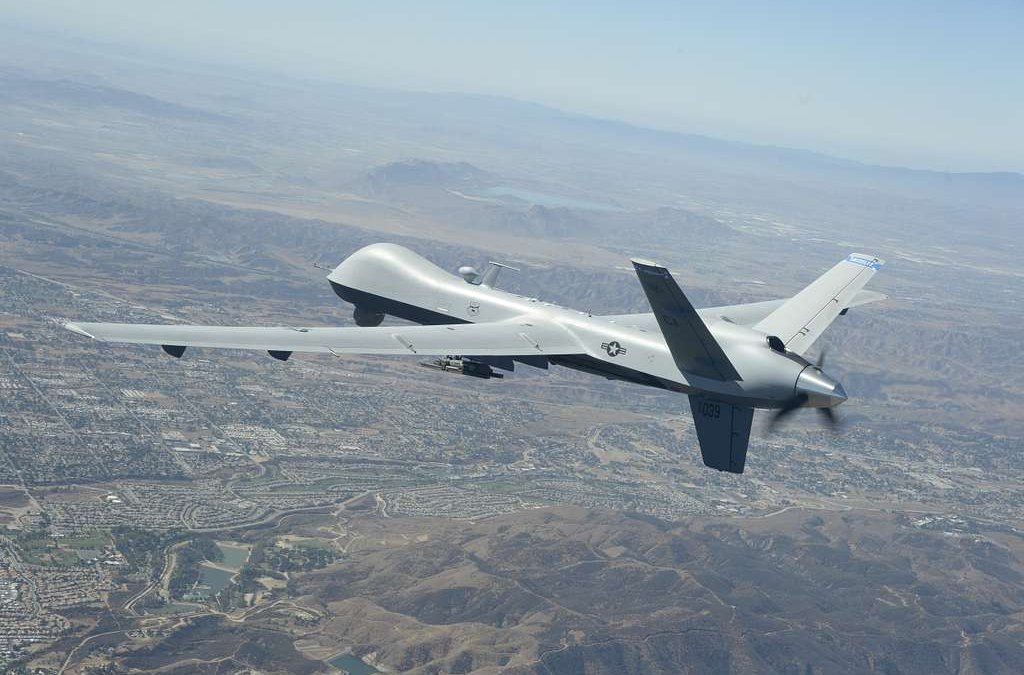
WASHINGTON –– From analyzing satellite imagery to helping commanders process battlefield information, artificial intelligence is becoming an increasingly important tool in how the United States military plans and conducts operations throughout the Middle East and the world.
“AI has become a huge focus across government projects in a really short amount of time,” said Maddie Brown, a project manager working on AI systems at Credence Management Solutions, a government consulting and defense contracting firm.
As defense agencies accelerate the adoption of artificial intelligence tools, policymakers and researchers have said the technology is transforming everything from intelligence analysis to logistics planning. But the rapid expansion of AI in national security also raises new questions about reliability, oversight and how much the government should rely on private technology companies to build systems that could shape the future of warfare.
AI is already influencing how the U.S. military processes enormous volumes of data gathered from satellites, drones, sensors and other communications networks. These capabilities have become increasingly important as U.S. forces continue operations in the Middle East, where intelligence systems must rapidly analyze surveillance data to identify potential threats like drone attacks and missile launches.
The push for AI reflects a broader investment trend as the Department of Defense requested about $1.8 billion for AI programs in its fiscal year 2025 budget, part of the overall defense budget of $850 billion.
AI and military data
Most of the military’s interest in AI stems from the sheer amount of information modern defense systems produce. Intelligence collected from satellites, surveillance aircrafts, drones and digital communications must be processed quickly to detect threats and guide operations.
Patrick Meyers, a proposals manager at Credence, said AI’s ability to process large volumes of data is one of its most valuable military applications.
“There’s a lot of data that comes through from all kinds of different sources, whether it’s sensors, satellites or other intelligence systems,” Meyers said. “AI can reduce work hours on administrative tasks or analyzing data from maybe two or three days down to an hour.”
Speed is crucial in military environments where commanders must respond rapidly to evolving threats. AI can also help analysts identify connections between different pieces of information.
“AI helps classify the data, clean it up and package it in ways that make it easier to review and analyze quickly,” Meyers said.
Brown said many government agencies are first applying AI to modernize internal processes rather than battlefield technology.
“The procurement process is a super manual and tedious workflow,” Brown said. “A lot of what we’re trying to do is automate those tasks so they can focus on more strategic objectives and help the warfighter mission.”
Private companies and national security
The U.S. government has increasingly relied on private technology companies to develop many of the AI systems used in defense and national security programs. Gwanhoo Lee, a professor of information technology and analytics at American University, said this reflects where much of the world’s AI innovation is occurring.
“The government is becoming increasingly dependent on private technology companies for AI capabilities, particularly in areas such as frontier models, cloud infrastructure, advanced semiconductors and highly specialized talent,” Lee said.
However, Lee said the relationship between government and industry is not just a simple one way dependence.
“It is more accurate to describe this relationship as strategic interdependence,” Lee said. “Governments still set missions, fund research, shape regulatory frameworks and determine how technologies are deployed.”
Federal data has shown that this collaboration has grown rapidly. The number of U.S. government AI contracts increased 254 to 657 in a single year, with the DoD accounting for the majority of those agreements.
One of the companies working with defense agencies is Scale AI, a San Francisco-based technology firm that builds data infrastructure used to train AI systems. Dan Tadross, Scale AI’s general manager for public sector programs, said AI is already helping defense agencies manage intelligence data.
“AI is already helping the military process intelligence, analyze imagery, and sift through enormous volumes of data,” Tadross said.
According to Tadross, the next phase of military AI development will focus less on simply analyzing data and more on using that information to support strategic planning and operational decision-making.
“The next step is turning that data into sustained decisional advantage using AI applications to analyze scenarios, generate planning options, and ensure commanders have the information they need to make informed decisions,” Tadross said.
Tadross added that emerging AI systems could eventually monitor operational environments continuously, helping military leaders adapt plans in real time while maintaining human oversight.
“That means deploying agentic systems that can track complex operational environments in real time, run simulations, and continuously update living plans with human commanders remaining in the decision loop,” Tadross said.
Recently, the relationship with the government and the private sector has been scrutinized following a dispute between the DoD and AI company Anthropic, the developers behind Claude AI. President Donald Trump announced the restriction of using Anthropic’s AI systems after the company refused to loosen safeguards that limited how its models could be used for autonomous weapons and surveillance. The federal government is now phasing out Anthropic’s technology and has designated it as a potential supply chain risk.
Risks in defense environments
Despite its advantages, AI also introduces new risks when used in national security settings.
“AI systems deployed in national security and defense operate in environments that are fundamentally different from most commercial settings,” Lee said. “These environments are adversarial, dynamic and high stakes.”
AI models trained in controlled environments may behave unpredictably in real-world military scenarios, especially if adversaries attempt to interfere with them in the form of cyberattacks, data poisoning, or more. Another risk is overreliance on automated systems.
“Human operators may place too much trust in algorithmic outputs, which can lead to automation bias and reduced critical human oversight,” Lee said.
Brown said similar concerns arise when building AI tools for government agencies.
“The biggest risk is error,” Brown said. “Who does that fall on? Is it the person who approves the process, the AI system itself or the team that delivered the solution?”
Developers typically address those risks by keeping human oversight built into AI systems.
“You want humans in the loop and able to own the work the AI tool provided,” Brown said.
The future of military AI
AI is becoming a rapidly expanding part of global defense spending. Analysts estimate the global military AI market was worth about $9.3 billion in 2024 and could grow to more than $19 billion by 2030 as governments invest in advanced technologies.
Within the U.S., defense IT spending has also increased significantly. The Department of Defense’s total IT budget recently reached about $66 billion, with service branches expanding funding for AI-related systems and autonomous technologies.
Experts say those investments reflect the growing importance of data analysis and machine learning in modern warfare. According to Lee, AI is both improving existing government processes and how institutions operate while focusing on efficiency.
“AI tools are being used to enhance logistics planning, intelligence analysis, cybersecurity monitoring, maintenance prediction, document processing, and administrative decision support,” Lee said.
Over time, however, AI could reshape how decisions are made in military and government organizations. Lee said recent examples of U.S. operations in Iran and Venezuela demonstrate how AI can accelerate the military decision cycle by processing large volumes of intelligence data and identifying patterns faster than traditional analysis methods.
Some policymakers and analysts have warned that the implications of AI extend far beyond the speed of military decision-making. Former Secretary of State Henry Kissinger, who wrote extensively about the geopolitical implications of emerging technologies, argued that AI could fundamentally change the nature of conflict and global security.
“Artificial intelligence is not simply another technological innovation,” Kissinger said in an article for The Atlantic in 2018. “It represents a fundamental transformation in how humans understand and conduct warfare.”