
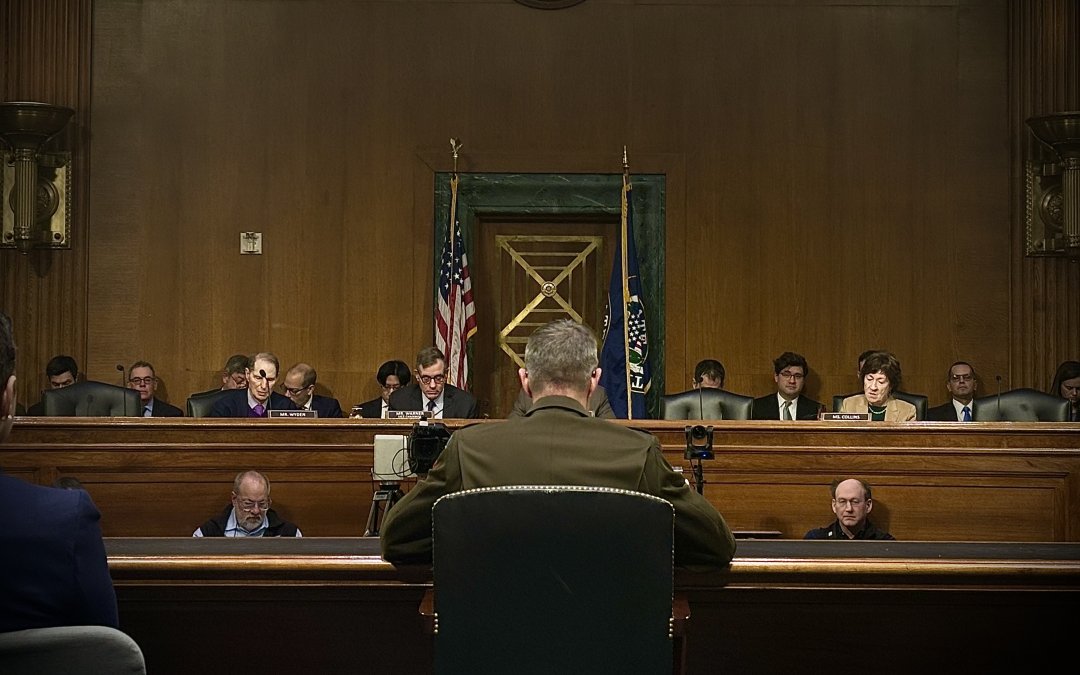
WASHINGTON — As Congress considers whether to renew surveillance legislation enacted after Sept. 11, 2001, President Donald Trump’s nominee to head the National Security Agency and U.S. Cyber Command told senators that authority is “indispensable.”
“I know it’s critical to mission outcomes. It’s forced protection of our men and women in harm’s way, and I know it saved lives here in the homeland,” said Lt. Gen. Joshua Rudd.
Rudd’s endorsement came during his confirmation hearing to lead the NSA and Cyber Command, two agencies responsible for collecting intelligence and protecting American cyber interests from a barrage of digital threats.
Lawmakers grilled Rudd on what he would do as NSA Director under Section 702 of the Foreign Intelligence Surveillance Act. The law, which would expire if it is not renewed in April, authorized the intelligence community to conduct targeted surveillance of non-Americans located outside the U.S. by monitoring emails and phone calls through U.S. service providers without individual court warrants for each target.
“This (law) provides the war fighter, the decision maker, the ability to have critical insight into threats that enables decision making,” Rudd said.
Democrats seemed concerned with how the law affects American citizens’ privacy, and whether it denies them due process without a warrant.
Sen. Ron Wyden, D-Ore., said the Trump administration has neglected Americans’ constitutional rights to privacy with this law and pressed Rudd about what he would do if confirmed.
“If you are directed to target people in the United States for surveillance, will you insist that there be a judicial warrant?” Wyden asked.
Rudd said he will commit to executing the foreign intelligence mission of the NSA “in accordance with the authorities.”
“That, respectfully, though, doesn’t get even close to what I’m talking about,” Wyden said. “That is about as vague as anything I’ve heard. That unfamiliarity based on constitutional rights is not something that can be accepted.”
Republicans expressed support for reauthorizingSection 702, and emphasized its importance in safeguarding people. Sen. John Cornyn, R-Texas, said no intelligence agency can target U.S. persons without a warrant.
Sen. Mike Rounds, R-S.D., said he’d like to see the NSA involve the private sector in the foreign intelligence efforts when executing Section 702. He said the pace at which the U.S. acquired information on adversaries is crucial.
“Speed can make the difference between a life and death situation,” Rounds said.
Russ said his background prepared him for these important jobs.
“I spent over 25 years leading our nation’s Special Operations missions, integrating high consequence capabilities, which has given me a deep, practical understanding on how to use intelligence to drive operational success,” Rudd said.
In 2022, Rudd relinquished command of the U.S. Special Operations Command Pacific, where he oversaw all special operations missions across the Indo-Pacific. He has served as deputy commander for Indo-Pacific Command for a little over a year. Rudd also fought in Iraq across multiple deployments supporting Operation Iraqi Freedom, Operation New Dawn and Operation Inherent Resolve.
Trump nominated Rudd after he abruptly fired two top officials at the NSA in April. Air Force Gen. Timothy Haugh, head of both the NSA and Cyber Command, and NSA deputy director Wendy Noble, were both well-respected on Capitol Hill, current and former officials said to Military.com.
“I remain deeply concerned about the politically motivated firings of career civilian and military leaders across our national security enterprise that includes the firing of your predecessor,” Sen. Mark R. Warner, D-Va., said to Rudd.