
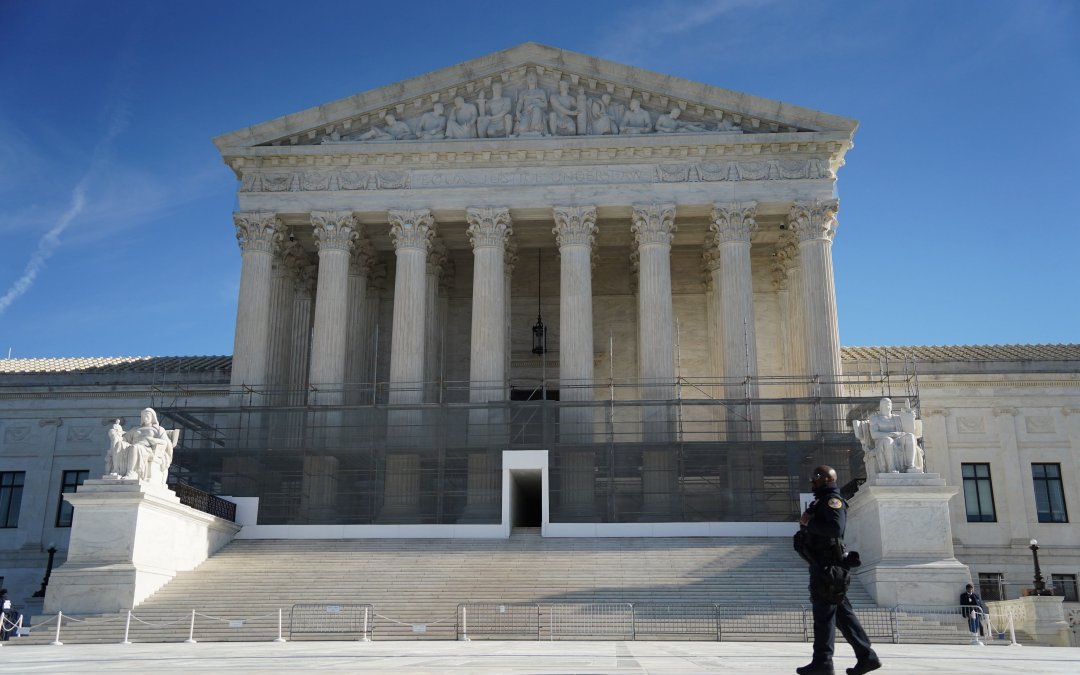
WASHINGTON — The Supreme Court on Monday grappled with whether a federal contractor could move a case from state to federal court, after a state court ruled Chevron, alongside other oil companies, had to pay $745 million to a Louisiana parish.
In the original lawsuit, Plaquemines Parish accused the energy companies of damaging and contaminating the Louisiana coast during oil extraction and production over several decades.
Chevron appealed, citing that the case should be removed to federal court under the federal officer removal statute. This statute empowers contractors and government entities to transfer a state case to federal court if the lawsuit involves actions taken under the authority of the federal government. Chevron argued its crude oil production fell under federal authority because the company held World War II-era federal contracts to produce aviation gasoline.
Previously, Chevron lost before the Fifth Circuit U.S. Court of Appeals. The court agreed that the oil and gas companies were acting on behalf of the federal government, satisfying one portion of the statute. But the court concluded that Louisiana was suing the companies for dumping wastewater from oil wells into coastal areas, and this action was not related to the federal contracts for producing aviation gasoline.
This case’s outcome could have far-reaching effects on environmental litigation, according to an analysis by the American Bar Association. If the Supreme Court rules in favor of Chevron, this could result in similar cases being removed to federal court, including 40 other lawsuits against polluting companies by Louisiana officials, according to legal experts.
However, if the Court sides with Louisiana, it could “chill the vital cooperation between private industry and the federal government during times of national crisis,” America First Policy Institute, a conservative-leaning think tank, warned in its amicus brief.
During oral argument, Chevron’s attorney Paul Clement sought to demonstrate that oil production that caused the environmental damage was related to oil refining, and therefore important to fulfilling those federal contracts.
“The only question is whether that refining activity under contract is connected to or associated with the production activities assailed in these lawsuits,” Clement said.
His reasoning hinged on the phrase “relating to.” In 2011, Congress amended the statute to include activities “related to” acting under the authority of the federal government. Justice Ketanji Brown Jackson expressed concern that this interpretation would go beyond what Congress intended when it amended the statute.
Justice Clarence Thomas echoed her concern, worrying that this interpretation would allow the amending words to “do too much substantive work.”
Similarly, multiple justices had issues with Chevron’s broad interpretation of the phrase “relating to.”
“If we define it as capaciously as you do, I’m not sure what the stopping point would be,” Justice Sonia Sotomayor said.
Chief Justice John Roberts raised the same concern, citing the “butterfly effect.”
“You know, the butterfly flaps its wings and has the end result halfway around the world,” Roberts said.
Meanwhile, Benjamin Aguiñaga, the solicitor general of Louisiana, offered a different reading of the statute. He explained that the acts that Chevron is being charged with were not committed under the authority of the federal government.
Aguiñaga emphasized how Chevron dumped billions of gallons of wastewater from oil wells directly into Louisiana marshes. This action was not taken under the authority of the federal government. So, the case cannot be moved to federal court.
Aguiñaga, responding to Justice Thomas, explained that Louisiana wanted this case in state court because it needed actual experts interpreting state law, especially with the sweeping damage to Louisiana’s coasts.
Justice Neil Gorsuch redirected the conversation back to what Congress intended by amending the law to include activities “relating to” federal authorities.
“Did it do nothing, or did the words that Congress added mean something?” Gorsuch asked.
Justice Samuel Alito recused himself from Monday’s oral argument. If the eight remaining justices were to tie 4-4, the lower court ruling would be upheld.
An environmental group said regardless of the outcome, the environmental damages to Louisiana’s coast must be mitigated.
“Whatever the outcome in this case, the companies and policymakers alike have a responsibility to do their part in addressing the toxic discharges, the damaged land, and the equipment left behind that is a legacy of pollution impacting the people of Plaquemines Parish and people in communities across Louisiana,” said Liz Russell, Environmental Defense Fund Louisiana’s state director. The author of an amicus brief filed by the Environmental Defense Fund shared this statement with Medill News Service over email.