
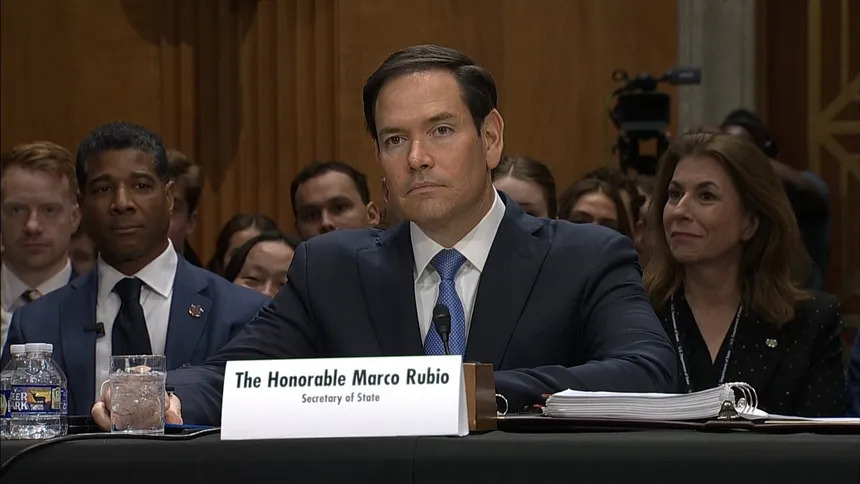
WASHINGTON — Secretary of State Marco Rubio and Sen. Tammy Duckworth, D-Ill., clashed at a Senate Foreign Relations Committee hearing Wednesday over whether U.S. actions could spark international conflict after the capture of Venezuelan President Nicolás Maduro.
Duckworth argued that invoking the Alien Enemies Act, which gives the president authority to deport citizens of an adversarial country, could escalate into a “forever war” with Venezuela. This stands in stark contrast to Rubio and President Donald Trump’s assertions that the United States is not at war with Venezuela, nor does it intend to be.
The debate comes amid rising concerns over what critics describe as an increasingly aggressive U.S. foreign policy stance, following not only Maduro’s capture but also recent threats to seize Greenland and comments from the president regarding possible military action in Iran. Heightened tensions with both adversaries and allies paint a picture of the U.S. as a geopolitical aggressor, hinting at the possibility of broader conflicts to come.
The hearing focused on the White House’s ‘fuzzy messaging’ regarding its relationship with NATO after Trump labelled allies as incapable without U.S. support.
“[Trump’s] rhetoric is undermining NATO and our partnerships with our allies,” Sen. Jeanne Shaheen, D-N.H., said. “That’s a problem.”
Lawmakers also debated the role of Congress in acts of war and foreign policy. Senator Chris Coons, D-Del., said that despite Operation Absolute Resolve reportedly requiring months of preparation, senators were not notified before the operation was implemented. Rather, he said, they were explicitly told that military action against Maduro was not under consideration.
“If there was time to practice, there was time to consult,” said Coons. “Our democracy depends on consultation of Congress that is truthful and timely and the confidence of our allies.”
Nevertheless, Rubio said U.S. actions in Venezuela did not constitute an act of war. “It’s a quarantine — not a blockade,” he said, referring to U.S. sanctioning of Venezuelan oil tankers, which the UN has labelled a blockade. “A blockade is an act of war.”
Sen. Rand Paul, R-Ky., asked if it would be considered an act of war if a foreign country captured an elected official within the U.S.
“We’re in violation of both the spirit and the law of the Constitution by bombing a capital, blocking a country and removing elected officials,” Paul said.
Rubio responded that Maduro was not elected and thus the U.S. did not capture an elected official.
Moreover, Rubio framed the U.S.’s current role in Venezuela as ushering in a period of stabilization and, eventually, transition. Though he seemed open to working with Delaney Rodriguez, Maduro’s Vice President, who assumed power after his removal. He added the U.S. planned to begin a nationwide audit on the recent $500 million obtained from the sale of Venezuelan oil.
“At the front end, we’ll say ‘this is what the allowable expenses are,’ and then they will agree to fund, as part of the overall cost, … an audit system acceptable to us to ensure that that’s how the money was spent,” Rubio said.
Rubio was more reluctant to comment on the continued human rights abuses that the Venezuelan regime has continued to perpetuate after Maduro’s capture, which have grown more severe according to the Washington Post.
“We’re seeing extraordinary examples that the constant oppression of people is continuing,” said Sen. Cory Booker, D-N.J., who argued the U.S. is complicit by working with Rodriguez and funding the Venezuelan government.
Absent from the discussion was major commentary regarding potential U.S. military action following Iran’s violent crackdown on protesters. Despite speaking to the violence of the Iranian government, Secretary Rubio did not clarify comments from White House officials alluding to an intervention.
“I think regimes, including that one in Iran, have learned that when you start shooting people in the head with snipers, it’s effective,” he said.
This morning, Trump seemed to threaten the use of force on Iran over TruthSocial. “A massive Armada is heading to Iran. It is moving quickly, with great power, enthusiasm, and purpose,” he wrote. “Like with Venezuela, it is, ready, willing, and able to rapidly fulfill its mission, with speed and violence, if necessary.”
However, Rubio said that Trump’s actions towards Venezuela, Iran and other adversaries opens up the chance for them to align with the U.S., improve their country and encourage ‘normalcy’ in government and industry.
“In the case of Venezuela, we have a glimmer of hope now, the opportunity to change the dynamic,” he said.