
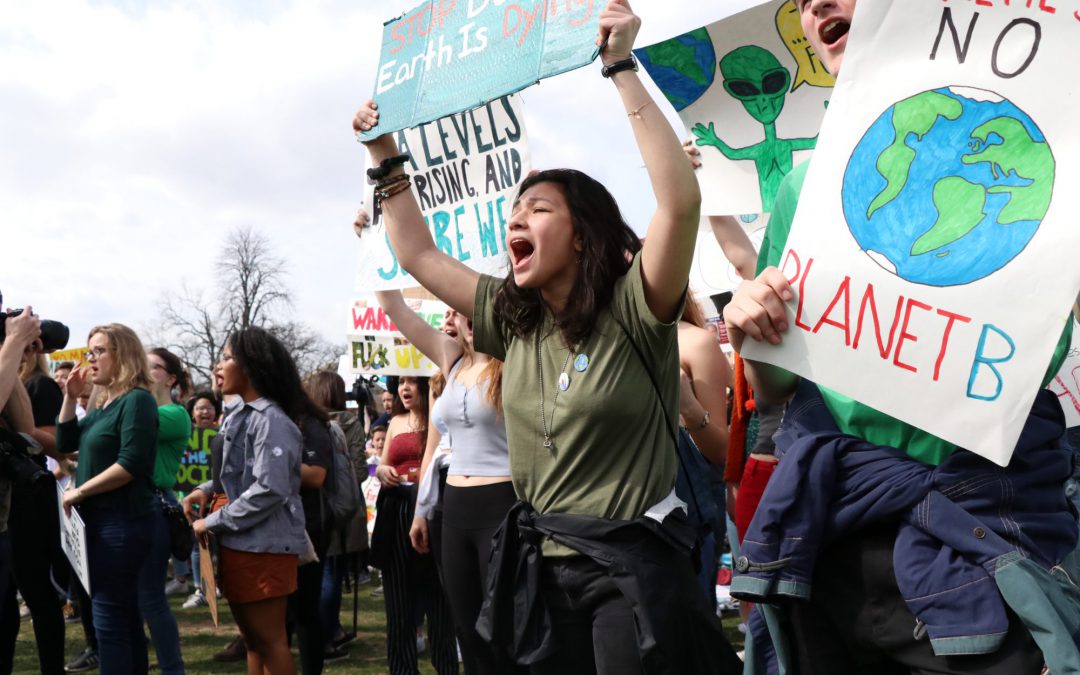
WASHINGTON — With the United States withdrawing from the Paris Agreement and environmental regulations being dismantled under the Trump administration, Democrats are reexamining whether climate change still resonates in American politics.
Earlier this week, the United States officially withdrew from the Paris Agreement, a global treaty adopted in 2015 to combat climate change. That followed major environmental rollbacks, including the Environmental Protection Agency’s decision to ignore health costs in air pollution considerations, and the Trump administration’s dismantling of climate research facilities.
Despite President Donald Trump’s aggressive efforts to roll back climate change action, some Democrats seemed reluctant to use the issue to appeal to voters, which dismayed some of the party’s strongest climate advocates.
Sen. Sheldon Whitehouse, D-R.I., the top Democrat on the Environment and Public Works Committee, posted a thread on social media platform X last week calling on his party to continue talking about climate, despite setbacks.
“When leaders don’t talk about something, enthusiasm falls among voters. In politics, you can often make your own wind, or you can make your own doldrums,” Whitehouse posted.
Other Democrats see climate change as a losing message in a polarized political landscape. Last fall, Democratic Party-aligned think tank Searchlight Institute concluded that elected leaders’ best strategy in battleground states should be to stop talking about climate change entirely. “[V]oters are looking for immediate help with rising costs rather than solutions to abstract problems,” according to Searchlight.
Their study found a 50-point gap between Democrats and Republicans in whether they consider climate change a top concern. Among Democrats, 71% considered it a high priority, compared to 21% for Republicans.
Yet despite all Trump’s efforts to dismantle programs to address climate change, a growing silence on climate change messaging has been felt nationwide. A recently published biannual report, Climate Change in the American Mind, found that only 17% of Americans say they hear about global warming in the media “at least once a week,” the lowest percentage since the question was added in 2015.
This study, co-published by Yale and George Mason climate communications researchers, explored why climate messaging has struggled and how it can better connect with the American public. Its findings were based on a national representative survey.
They said politicians should improve at informing voters how climate change impacts everything they care about, from health care to energy prices.
According to their Fall 2025 report, 64% of Americans said they are at least “somewhat worried” about global warming. Yet even among liberal Democrats surveyed, global warming was only a mid-tier priority when it comes to determining who to vote for in the 2026 congressional elections.
John Kotcher, one of the report’s primary authors and interim director of George Mason University’s Center for Climate Change Communication, said part of that disconnect stems from the fact that voters don’t immediately recognize how climate change has affected their lives.
“The issues that people say they do care the most about, like the economy, cost of living, healthcare: those are all affected by climate change,” Kotcher said. “And so really it becomes, then a question of, how do we connect climate change to the things that people care about?”
Kotcher believed that instead of framing climate change as a distant threat, addressing how it currently affects American communities could help make more voters care.
“When you draw those connections, even those individuals who maybe aren’t fully convinced that climate change is something they should care about, they start tuning in and listening and getting more interested in the issue,” Kotcher said.
Kotcher explained that climate change is not the political loser that some elected officials make it out to be. Their Fall 2025 report finds 59% of registered voters want to vote for a candidate who supports action on climate change. Only 13% say they want to vote for a candidate who opposes action on climate change.
A Pew Research Center 2024 report showed that majorities across party lines backed policies addressing climate change, including tax credits for carbon-capture technology. Further, Trump’s recent climate rollbacks have been deeply unpopular. For example, 77% of registered voters opposed ordering all federal agencies to stop researching global warming.
For Kotcher, talking about climate change remained an urgent issue.
“You need a whole chorus of different voices talking about the issue, not just climate scientists, not just politicians, but a whole host of different actors who are affected by this, whether it’s health professionals or business executives,” Kotcher said.
Whitehouse urged Democrats to keep fighting and speaking out on climate change despite their past track record in climate messaging. The solution isn’t staying silent.
“There’s not a binary choice between crap messaging and abandoning ship,” Whitehouse posted over X. “There’s a fight to be had, while there’s still time.”