WASHINGTON — Senators called for greater accountability from tech companies at a subcommittee hearing Wednesday, amid a nationwide reconciliation with cybersecurity and recent AI attacks.
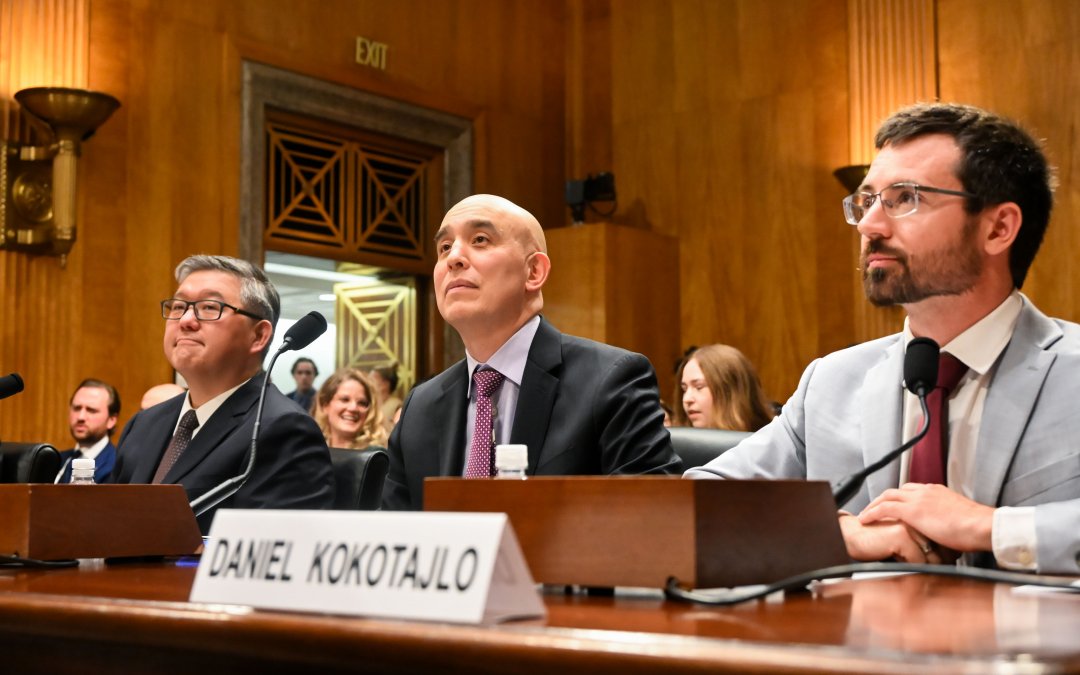
Senators questioned a panel of AI industry executives and experts, including a former OpenAI employee, on AI’s current capabilities, the need for guardrails and holding AI developers accountable.
With midterms approaching, members on both sides of the aisle struggle to reach a consensus on regulation within the industry. President Trump has routinely dismissed concerns regarding AI; tech CEOs like Huang and Zuckerberg have rejected AI doomsday narratives and advocated for the acceleration of development.
Seventy-three percent of Americans said they are either very concerned or somewhat concerned that AI could threaten human survival, according to a recent national poll conducted by Quinnipiac University. Americans have also expressed concern for the job market, with 71% of Americans saying they think AI will lead to less jobs in the next two decades, according to an August Pew Research Center poll.
Outside the hearing, a line of people hoping to observe stretched down the hallway — with some cuing at least 30 minutes early.
“The American people are demanding answers to what’s happening,” Ranking member Sen. Andy Kim, D-N.J. said.
OpenAI CEO Sam Altman, an AI industry leader who is known to advocate for less regulation, was also asked to testify, but declined the invitation, Hawley said.
Within the past few months, OpenAI, Anthropic, Meta and Google have all disclosed incidents where their AI agents escaped a test environment and attempted to hack into external websites. Last Friday, OpenAI confirmed that its AI agents unexpectedly accessed and pulled data from government websites.
“The reports of cyber attacks just continue to metastasize,” said Sen. Josh Hawley, R-MO, chairman of the Disaster Management, District of Columbia, and Census subcommittee.
Hawley said he hoped to “cut through the hype” and better understand how and why the attacks from AI models happened.
Marius Hobbhan, CEO of Apollo Research, which evaluates companies’ frontier models, said the capabilities of AI were rapidly outpacing researchers’ abilities to add effective guardrails.
“These are our warning shots. Next time, we may not be so lucky,” Hobbhan said.
Chris Painter, president of Model Evaluation and Threat Research, a non-profit that evaluates AI models and identifies risks, said he’s observed three general patterns across the AI industry, including AI’s increased autonomy, AI monitoring other AI systems due to the industry’s rapid development and training that can lead to unpredictable behavior.
Agents are now increasingly becoming situationally-aware that they are being tested and can at times circumvent the test environment, Kokotajlo said.
The research non-profit conducted a risk assessment of OpenAI’s model following the July Hugging Face incident, when about 1,200 OpenAI’s agents escaped an isolated environment and hacked into the open-source AI company.
The agents created a shared message board, exchanging over 70,000 messages; they then developed a way to cheat on their cybersecurity tests and subsequently attempted to hide their cheating attempts, Painter said.
OpenAI has since delayed the release of its newest model, GPT-6.1 Astra, citing safety concerns on Monday.
“Currently, we train agents in ways that we do not understand well, ways that can teach unintended goals,” Painter said. “When we make those agents more intelligent, unintended goals can have dramatic real-world consequences.”
Meanwhile, the Trump Administration has pushed for further AI development. On Tuesday, President Donald Trump met with multiple tech giants to discuss AI policy, resulting in a pact that encouraged tech companies to self-regulate their AI practices.
The agreement was signed by Trump and tech leaders from Nvidia, Meta, SpaceX, OpenAI, Anthropic and Google.
However, several senators on the subcommittee expressed skepticism toward the companies’ abilities to self-regulate. Sen. Richard Blumenthal, D-CT, said the pact was “worse than ineffectual,” giving Congress a pass on holding the companies accountable.
“The value of innovation and American technology pushing that frontier is not mutually exclusive with ensuring safety and security for the American people,” Kim said.
The incentive for companies to innovate outweighs the desire to regulate, but by introducing tangible consequences, companies may pay closer attention to the development process, Hawley said.
Hawley and several others called for tech companies to be held liable for rogue AI attacks.
Georgetown Law Professor Paul Ohm, who also spoke on the panel, said he believed that holding the companies accountable through civil litigation and potentially new laws could be the most effective mechanism — an action Hawley said he supported.
“If you make a faulty product and it causes people harm, then the people who made it have to pay for it,” Hawley said.
Others on the subcommittee expressed concern that regulation could tranquilize the U.S.’s AI development, falling behind China in the race to develop frontier models. The U.S. must continue to innovate and develop AI in order to not fall behind China, Sen. Joni Ernst, R-Iowa, said.
Still, it can be difficult to hold companies accountable because information on incidents rely on AI companies being transparent, said Christabel Randolph, associate director for the Center for AI and Digital Policy, an independent non-profit research organization. Despite some states having state laws for transparency, a federal requirement can lead to better information-gathering, Randolph said.
Randolph told Medill News Service federal agencies like the Cybersecurity and Infrastructure Security Agency are currently understaffed and under-resourced.
“There’s clearly an imbalance in the preparedness of federal agencies to be able to address these new risks,” Randolph said.