
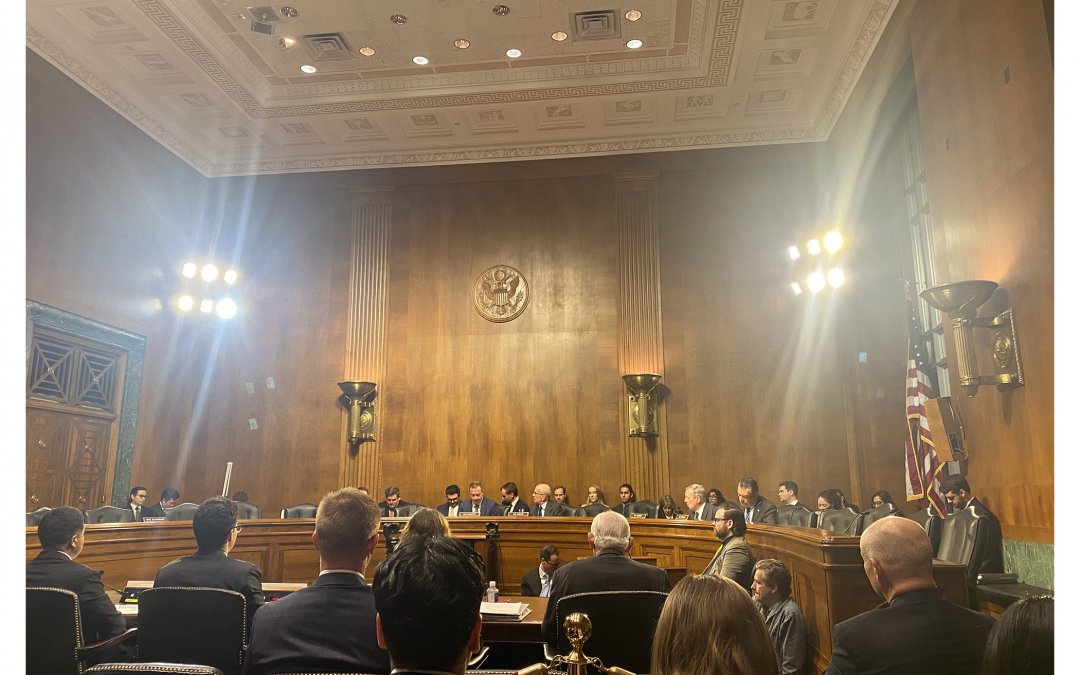
WASHINGTON – The Senate Judiciary Subcommittee on the Constitution examined birthright citizenship Tuesday after President Donald Trump issued an executive order denying citizenship to children born to undocumented immigrants.
Ranking chair Sen. Eric Schmitt, R-Mo., said citizenship is not just paperwork issued by the government, but is the essential bond between the nation and its people.
“Citizenship is the legal expression of the American people; it carries a responsibility of freedom, from one generation to the next,” Schmitt said. “If citizenship becomes detached from belonging, the institution itself begins to weaken.”
Schmitt said some foreign nationals travel to the U.S. late in pregnancy to secure citizenship for their children, fueling illegal immigration, and treating birthright citizenship as a “loophole”.
Executive Order 14160, signed on the first day of Trump’s second term, challenges the long-standing constitutional 14th Amendment’s Citizenship Clause by ending birthright citizenship for children born to undocumented parents and those legally but temporarily in the United States, including students, workers and tourists. It is a part of the Trump administration’s deportation agenda.
Sen. Dick Durbin, D-Ill., criticized Trump’s executive order and said it’s not just an attack on the Constitution, but an attack on millions of immigrants who contribute to the country.
“The executive order would create a permanent underclass of American-born children who would contribute to our nation and yet be denied the opportunity of citizenship,” Durbin said.
The 14th Amendment of the Constitution, ratified in 1868, grants citizenship and equal protection under the law to all persons born or naturalized in the United States, particularly benefiting Black people and formerly enslaved individuals after the Civil War. The Supreme Court established that interpretation in United States v. Wong Kim Ark in 1898, becoming the first case ruling that birth on U.S. soil grants citizenship regardless of parents’ immigration status.
Charles J. Cooper, chairman of Cooper & Kirk PLLC, testified that the Supreme Court’s ruling in United States v. Wong Kim Ark applied to a child born to lawful, domiciled Chinese immigrants. He argued the decision assumed the parents were lawfully present and said unauthorized immigrants fall outside the case.
“They are not lawful, permanent residents who are domiciled in this country,” Cooper said.
Amanda Frost, a law professor at the University of Virginia School of Law, called the executive order “unconstitutional” and said it could strip citizenship from roughly 250,000 children born in the U.S. each year, potentially leaving some stateless or subject to deportation.
Frost said critics often point to “birth tourism,” in which foreign mothers enter the U.S. on tourist visas to give birth so their children gain citizenship. Birth tourism results in approximately 33,000 births to women on tourist visas annually, according to the Center for Immigration Studies.
She said such cases account for less than 1% of births and suggested that, if it is a concern even though it doesn’t seem like one, lawmakers could make the practice illegal.
“The solution is to enforce the law on the books and not to deprive American families of citizenship of their children born on U.S. soil, or force them to prove their lineage or lose their citizenship,” Frost said.
Ranking member Sen. Peter Welch, D-Vt., said the U.S. was built by immigrants and that citizenship requires upholding the ideal that all people are created equal and contributing to the country. He criticized what he called a “reckless rampage” of mass deportations by Immigration and Customs Enforcement (ICE) and warned the approach could worsen the nation’s immigration challenges rather than solve them.
“It’s time for us to protect our constitutional rights, not violate them,” Welch said.
Marine veteran Alejandro Barranco said he grew up in a Mexican family that taught him to love the country and be proud to be American. After immigration agents beat and detained his father, Narciso Barranco, an undocumented immigrant, while he was landscaping outside an IHOP in California in June 2025, Barranco said his family still lives with the trauma, and Trump’s executive order affects families who have built their lives in the U.S.
“When we talk about birthright citizenship, we are not talking about a loophole,” Barranco said. “We are talking about a clear constitutional guarantee that has been part of this country for more than a century.”
The Supreme Court scheduled to hear oral arguments on Trump’s executive order next month.