
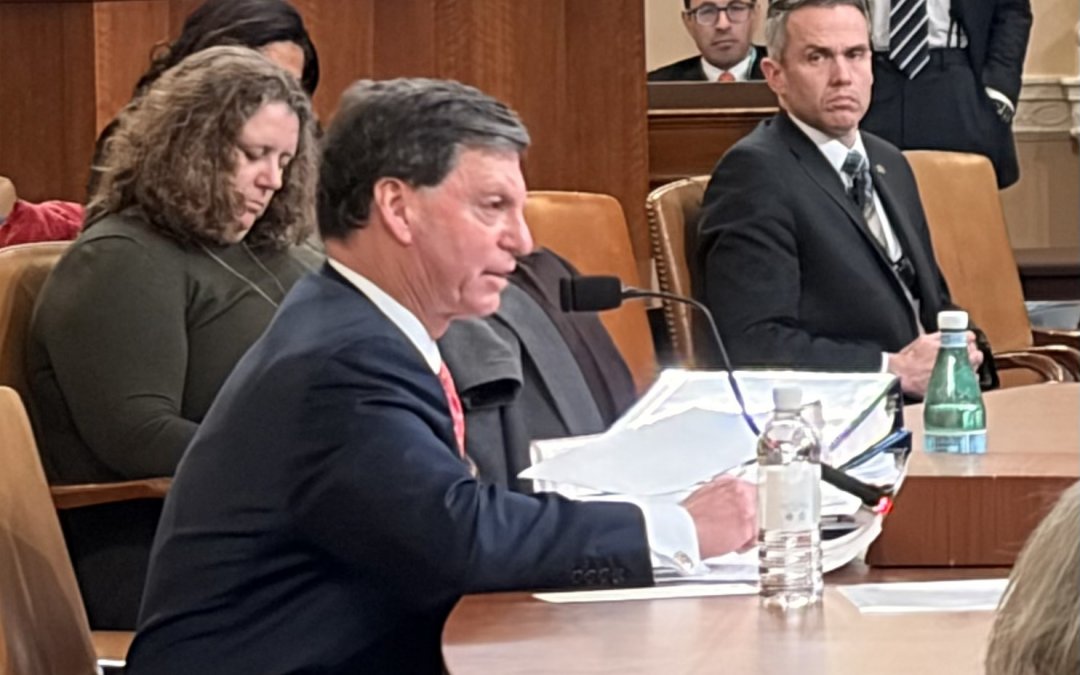
WASHINGTON – Chief Executive Officer of the Internal Revenue Service Frank Bisignano on Wednesday celebrated bigger refunds for American taxpayers, while lawmakers criticized Bisignano’s for exposing tens of thousands of U.S. taxpayers’ private information.
“This is a catastrophic leadership failure and a huge hit on the public’s confidence in your integrity,” said Rep. Suzan DelBene, D-Wash.
During the House Means and Ways committee hearing, legislators confronted him on mishandling private information and the fairness gap between how the tax system treats the richest Americans and working‑class taxpayers. However, Bisignano bragged about lowering taxes for families by $220 billion under the Working Families Tax Cuts Act, mentioning that the average refund is currently up $775. “The average American family is already seeing greater benefits than ever before. This is thanks to the signature provisions of the Act — no tax on tips, no tax on overtime, no tax on auto‑loan interest, and a special tax deduction for seniors,” said Bisignano.
Rep. Mike Thompson, D-Calif., pressed Bisignano on the IRS’s transmission of confidential taxpayer data to the U.S. Immigration and Customs Enforcement without proper authorization.
“The IRS violated the law 42,695 times,” said Thompson. “This isn’t a paperwork error. It’s a breakdown in leadership.”
Federal court found the IRS violated the Internal Revenue Code by disclosing confidential taxpayer addresses to ICE on Feb. 26.
Bisignano said that nobody had been fired or disciplined, mentioning that everyone was held accountable. He refused to publicly acknowledge the violations, saying “I don’t want to debate the numbers.”
Rep. John Larson, D‑Conn., pressed the committee to subpoena Justice Department records and call a whistleblower to testify about government employees allegedly funneling sensitive Social Security and tax data to outside political groups. He said his constituents “want to know what has been done with their information” and whether it is sitting “in a cloud” that may not be secure.
“What happened and why is it that we can’t get the names?” asked Larson.
Bisignano largely declined to delve into the specifics, pointing back to ongoing reviews and reiterating that safeguarding personal data is a core responsibility of the IRS under his leadership.
Lawmakers also questioned whether the IRS has administered the tax system fairly.
Rep. Richard Neal, D-Mass., criticized the IRS for tilting the tax system away from ordinary Americans. He accused the Trump administration of turning the IRS into a political tool while simultaneously starving it of resources, arguing that working‑ and middle‑class taxpayers were left to deal with service breakdowns and shrinking enforcement at the top. Neal warned that a voluntary tax system cannot function if people believe “the referee” has been undermined and wealthy people have different rules than for everyone else.
“Meanwhile, wealthy tax evaders are celebrating as investigations into abusive schemes this month plunged by 65% when refunds do come with more fractured, broken promises,” said Neal.
Where Neal described the IRS as a system being weaponized against ordinary taxpayers, Rep. Adrian Smith, R-Neb., saw it as a bloated bureaucracy threatening the middle class.
Smith warned that expanding the IRS bureaucracy would leave middle-class taxpayers more vulnerable, arguing that a proposed $1 billion infusion for the agency would mean more staff and more audits that “squeeze a lot of dollars… out of the middle class.”
“The American people deserve better, and it makes me think about various federal workers who work hard to do the right thing, and the bureaucracy stands in the way,” Smith said.
Bisignano pushed back on the idea that the IRS has burdened the middle class. He repeatedly said his top objectives are higher service, higher compliance and stronger privacy.
“We’re going to increase compliance. We’re going to have an easier way to operate with us. And we have, we have 30,000 people working on compliance,” said Bisignano.