
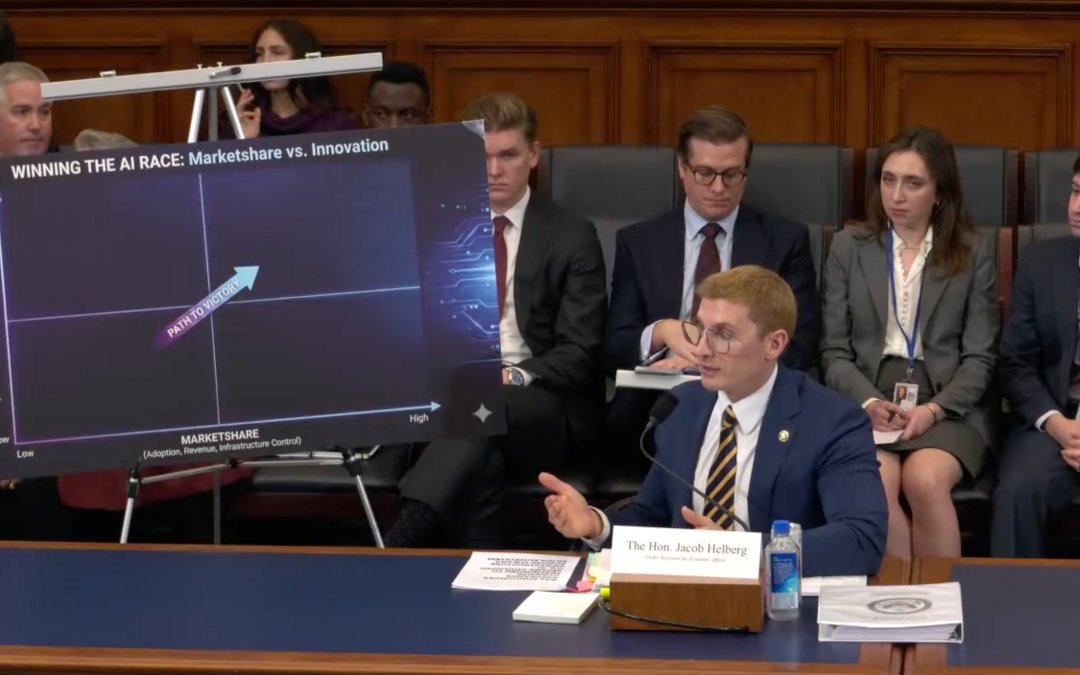
WASHINGTON –– The Trump administration announced Tuesday they plan to formalize a new economic security coalition designed to counter China’s dominance in rare minerals and artificial intelligence infrastructure.
“The nation that controls the industrial foundation of artificial intelligence will lead the century,” said Jacob Helberg, Under Secretary of State for Economic Growth, Energy and the Environment. “The nation that doesn’t will depend on those who do.”
Helberg told the House Foreign Affairs Committee that the administration will introduce a new initiative: “Pax Silica,” Latin for positive sum, a multilateral economic coalition aimed at controlling AI supply chains and mineral refining capacity outside China. The coalition includes Japan, South Korea, Singapore, Israel, United Arab Emirates, United Kingdom, Australia, Qatar, Taiwan and India.
Currently, China processes roughly 90% of the world’s mineral refining capacity, which lawmakers on both sides described as strategically dangerous for the United States. To reduce that dependency, the State Department is mapping available refining operations in allied countries where they hope to accelerate production outside China, rather than building entirely new facilities from scratch.
Chairman Brian Mast, R-Fla., Rep. Gregory Meeks, D-N.Y. and others introduced the bipartisan Dominance Act to codify and reduce dependence on China by expanding partnerships for critical mineral extraction, refining, and financing with allied countries.
“Breaking China’s chokehold on critical minerals will not happen overnight,” Mast said. “It will require sustained bipartisan resolve here in Congress and in close coordination with the administration.”
Beyond minerals, Helberg also described a coordinated push to control AI infrastructure exports. Last week, the United Arab Emirates’ AI firm G42 announced a voluntary common operating picture framework to track AI chip usage through cryptographic monitoring.
“(G42) agreed to build a common operating picture that would allow American policymakers to actually have internal transparency and assurance,” Helberg said.
The Trump administration also planned to launch a concierge service to help allied countries adopt U.S. AI technology. They would offer up to $200 million in foreign assistance to countries that use these secure, low-cost devices running on American software. Helberg described the effort as “economic deterrence” against China’s dominance.
“American technological leadership requires supply chain security,” Helberg said. “Pax Silica is our strategy.”
Lawmakers commented on the Trump administration’s broader strategic shift of how economic diplomacy is no longer separate from national security policy.
“As the President has said repeatedly, economic security is national security, whether we’re talking about enforcing sanctions, securing critical mineral supply chains, building new semiconductor manufacturing capacity, expanding energy exports, or strengthening transportation networks,” Helberg said. “These priorities are about protecting America, American workers, businesses, and our strategic position in the world.”
Rep. Keith Seif, R-Texas, pressed Helberg specifically on how to counter China’s dominance in refining rare minerals. Helberg focused on the U.S. dominance in fossil fuel energy, especially petroleum.
“China is incredibly vulnerable for its energy imports, and that is a point of leverage that the administration is keenly aware of,” Helberg said.
As U.S.-China competition intensifies, the committee signaled that oversight of economic statecraft from mineral refining to AI exports will remain central to U.S. foreign policy.
“American economic strength is the foundation of American leadership abroad,” said Rep. Young Kim, D-Calif.