
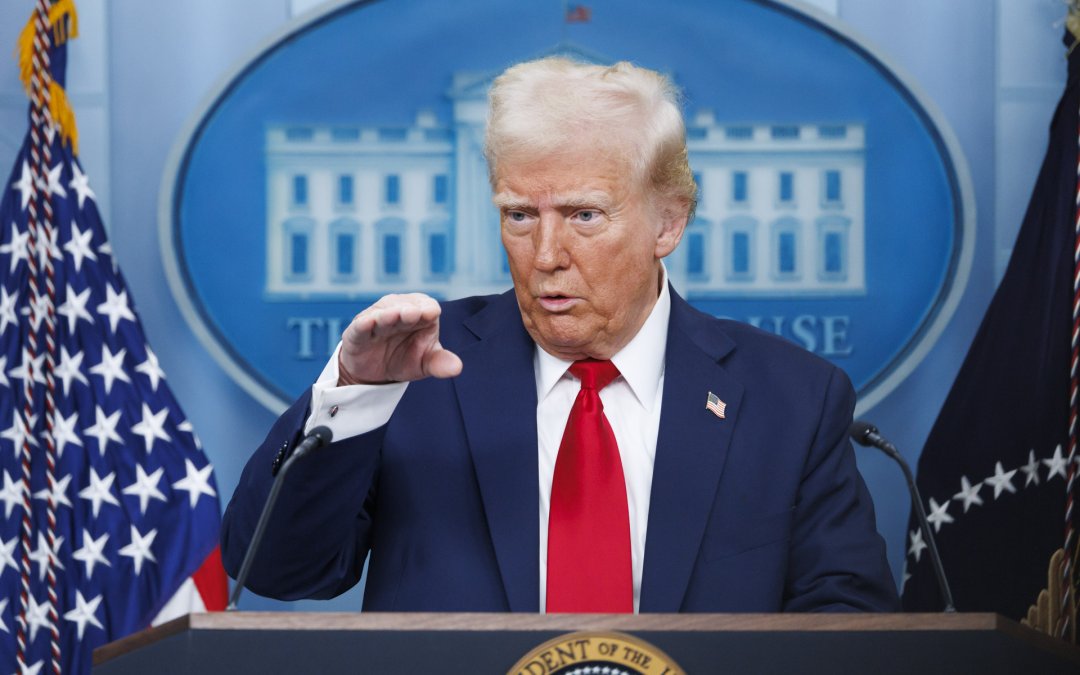
WASHINGTON – For the second time, President Trump Tuesday withdrew the U.S. from the Paris Agreement on climate, the latest casualty of his approach to climate change.
Though Trump’s move to exit the climate accord lacked immediate policy consequences, it symbolizes the administration turning its back on climate action at home and abroad.
“That symbolism is really, really important because it sends a message to other countries that climate change is not being taken seriously by the most powerful country in the world,” said political scientist Brian Greenhill.
The White House announced its plan to officially withdraw from the agreement and several other international treaties in a 2025 executive order on President Trump’s inauguration day. “These agreements steer American taxpayer dollars to countries that do not require, or merit, financial assistance in the interests of the American people,” the order said. Though it was announced then, exits from the Paris Agreement take a year to go into effect.
President Trump has not commented on the withdrawal today.
In 2015, world leaders decided on emission reduction goals for their own countries to limit the long-term increase in global average temperature to well below 2°C above pre-industrial levels. As of 2025, only Gambia, Morocco, Ethiopia, Kenya, Nepal, and Costa Rica have promoted policies in line with these goals, according to some climate experts.
The agreement, negotiated by President Barack Obama and other world leaders, was famously non-binding and has no enforcement mechanism, functioning through an ‘honor system,’ according to Greenhill. The idea behind it was for countries to set actionable goals that they decided, not that were forced on them.
“Think of it like if you and a bunch of friends decide to join a gym or something like that, and you all kind of make a pact with each other that you’re going to go three times a week,” Greenhill said. “It’s just a mutual accountability pact. So there was no need for the US to withdraw.
Even before formally exiting from the Paris Agreement, Trump supported legislation and rule changes that would expand carbon emissions and actively curtail clean energy. The ‘Big Beautiful Bill,’ for instance, removed subsidies for electric vehicles and clean energy industries, which quickly impacted U.S. manufacturing. The president also promoted renewed emphasis for the coal and oil industries to ”drill, baby, drill.”
According to Greenhill, the president has positioned climate change as a ‘woke’ issue that the average American shouldn’t worry about. However, he emphasized that Trump voters in rural America shoulder the burden of climate change.
As evidence that Trump has moved more strongly against climate action, Greenhill mentioned Trump’s exit from the UN Framework Convention on Climate Change, a lesser-known but foundational 1992 treaty that established the first major multilateral effort to address climate change, which the president didn’t leave in his first term.
Taken together, Trump’s exit from the Paris Agreement and the UN Framework Convention on Climate Change add to an already significant list of actions to curtail clean energy.
“It seems that this is not really based on rational policy considerations,” Greenhill said. “This is based more on a real contempt for climate policy and everything about it.”
During both Trump campaigns, he pledged to exit the agreement. “Not only does this deal subject our citizens to harsh economic restrictions, it fails to live up to our environmental ideals,” he said in a 2017 speech before the initial exit.
Following former President Biden’s election, the U.S. reentered the agreement. The next president could do the same.
The Biden administration promoted clean energy policies that were estimated to put the U.S. on track to reduce emissions by 29%–39% in 2030 below 2005 levels. He strove to restore the U.S.’s role as a global climate leader through legislation like the Bipartisan Infrastructure Law of 2021 and the Inflation Reduction Act of 2022, which were used to fund clean energy and emission-reduction technology to meet long-term goals.
Some states continued to move forward with climate action independent of the federal government, particularly California.“As climate disasters cost Americans trillions, Trump’s answer is to wave the white flag,” California Democrat Gov. Gavin Newsom said in a statement. “We’ll keep working with our partners around the world to cut pollution, create jobs, and lead the clean energy economy that the Trump administration is too weak to fight for.”