
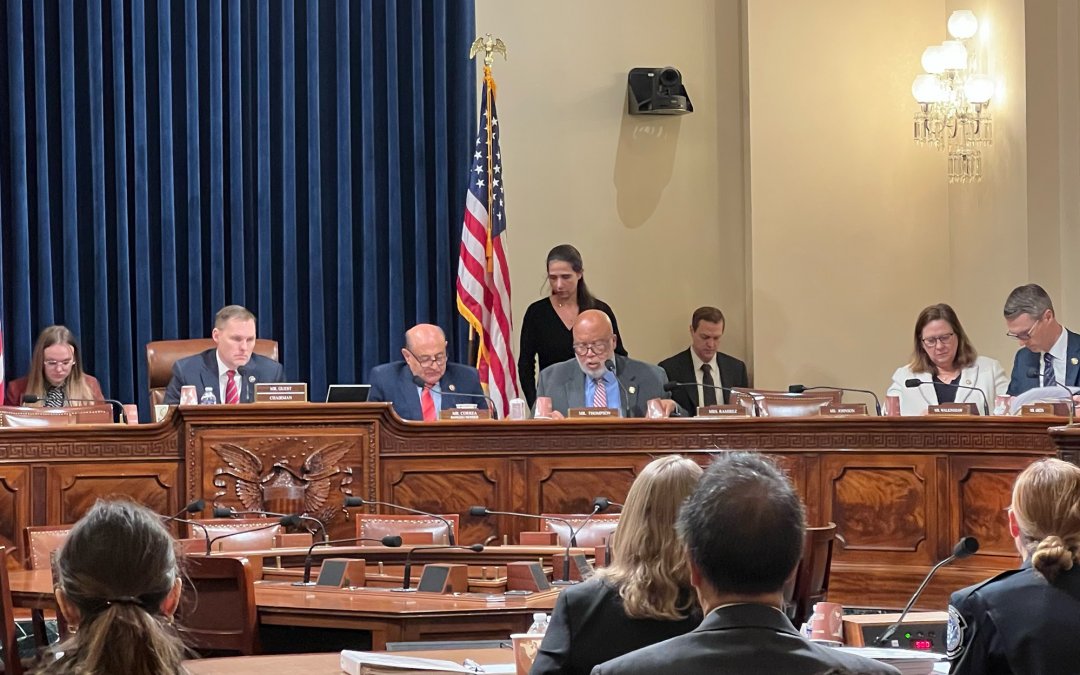
WASHINGTON –– The acting director at the Government Accountability Office told a congressional panel Thursday that the government has fallen far behind on its legal requirement to scan 100% of vehicles at border crossings before 2027.
“Scanning rates for passenger vehicles only increased from 2% in 2020 to 8% in 2024,” said Hilary Benedict, the acting director at the Government Accountability Office. “For commercial vehicles, scanning increased from 16% to 27%.”
U.S. Customs and Border Protection officers screen vehicles and cargo without physically opening them using non-intrusive inspection technology.
Witnesses told the Border Security and Enforcement Subcommittee that widespread use of vehicle scanning technology is crucial to intercept drugs, weapons, and other contraband more effectively without interfering with commercial traffic at entry ports.
Diane Sabatino, acting executive assistant commissioner for CBP’s Office of Field Operations, described how the scanning systems use advanced X Ray and Gamma ray imaging are a core tool for agents tasked with protecting the border.
“Our frontline personnel work tirelessly to protect our homeland,” Sabatino said. “On a typical day, they process more than one million travelers and enable billions of dollars in importing goods at the same time they seize illicit drugs, intercept contraband, and prevent biological threats.”
Sabatino said with the technology, officers no longer must examine each vehicle physically, which allows them to focus resources on the highest-risk vehicles and shipments, while maintaining efficiency at border crossings.
“In the fiscal year 2025, CBP officers used NII systems to scan more than 17 million sea containers, rail cars and vehicles,” Sabatino said. “These inspections led to the interdiction of 110,000 pounds of narcotics.”
While lawmakers broadly supported expanding and continuing to invest in the technology, witnesses warned of significant gaps between congressional mandates and current implementation.
Benedict identified that a major obstacle in increasing implementation is that some of the busiest border crossing points were not even included in CBP’s current deployment plan.
“There are nine crossings together that account for 40% of passenger vehicle crossings on the southwest border,” Benedict said. “CBP officials said these sites are not included in the current plans because they are still determining how to overcome space issues in these sites.”
Democrats raised concerns that CBP personnel had been reassigned from border crossing to interior immigration operations, possibly weakening efforts to intercept drugs at the border.
“The focus on deportations has left a lot of open doors in our national security that could be exploited by those who want to do our nation harm,” said Rep. Lou Correa, D-Calif.
Republicans emphasized that continued investment is necessary to prevent drug trafficking by using modern inspection tools.
“We’re getting better, and we’re moving in the right direction,” said Rep. Michael Guest, R-Miss., chairman of the Border Security and Enforcement Subcommittee. “But we’re not getting there fast enough, and Americans are dying because fentanyl continues to flow into our country.”
While lawmakers showed bipartisan support for expanding the technology, they also made clear that future funding decisions would depend on whether CBP can demonstrate measurable progress toward higher scan rates and more consistent deployment.
“We need to make sure taxpayers’ dollars are invested effectively,” emphasized Rep. Bennie Thompson, D-Miss.