
WASHINGTON – Sandra Moreland and Carl Grady finally visited the Smithsonian National Museum of African American History and Culture on Friday, after a previous visit was thwarted by the government shutdown.
The couple traveled from Detroit for a second time in a few months to examine the history of Black Americans. As an interracial couple, they said understanding how diverse groups support one another is a personal priority. However, Grady noted that he was troubled by how the current administration was affecting the representation of history.
The couple’s visit to Washington coincided with Martin Luther King Jr. Day weekend and pressure from the federal government to align exhibits at the Smithsonian with Trump’s historic views.
In March 2025, President Trump issued the executive order “Restoring Truth and Sanity to American History,” criticizing the government-funded Smithsonian Institution for being “under the influence of divisive, race-centered ideology” and “promoting narratives that portray American and Western values as inherently harmful and oppressive.” White House warned the institution, which receives more than 60% of its funding from the federal government, in a Dec. 18 letter that federal funds would only flow if the institute followed Trump’s mandates.
The couple worried that the Trump administration would alter the history represented at the museum.
“Slavery existed here as part of our history. As ugly and horrible as it might be, and guilt producing as it might feel, I don’t like eliminating it,” said Moreland. “It’s the truth.”

Sandra Moreland and Carl Grady attending an exhibit at the National Museum of African American History and Culture. (Dasha Dubinina/MNS)
Last week marked the deadline for the Smithsonian to submit documentation regarding current and upcoming exhibitions for review. Employees at the National Museum of African American History and Culture declined to comment on whether the audit has altered current displays.
“It bothers me that this administration has anything to do with how culture is presented,” Grady said.

Visitors explore exhibits at the National Museum of African American History and Culture. (Dasha Dubinina/MNS)
The tension over cultural policy was underscored Monday when the White House initially failed to issue a formal Martin Luther King Jr. Day proclamation. Following sharp criticism from lawmakers and civil rights leaders, the administration published a statement late Monday evening, “As President, I am steadfastly committed to ensuring that our country will always be guided by the same principles that Dr. King defended.”
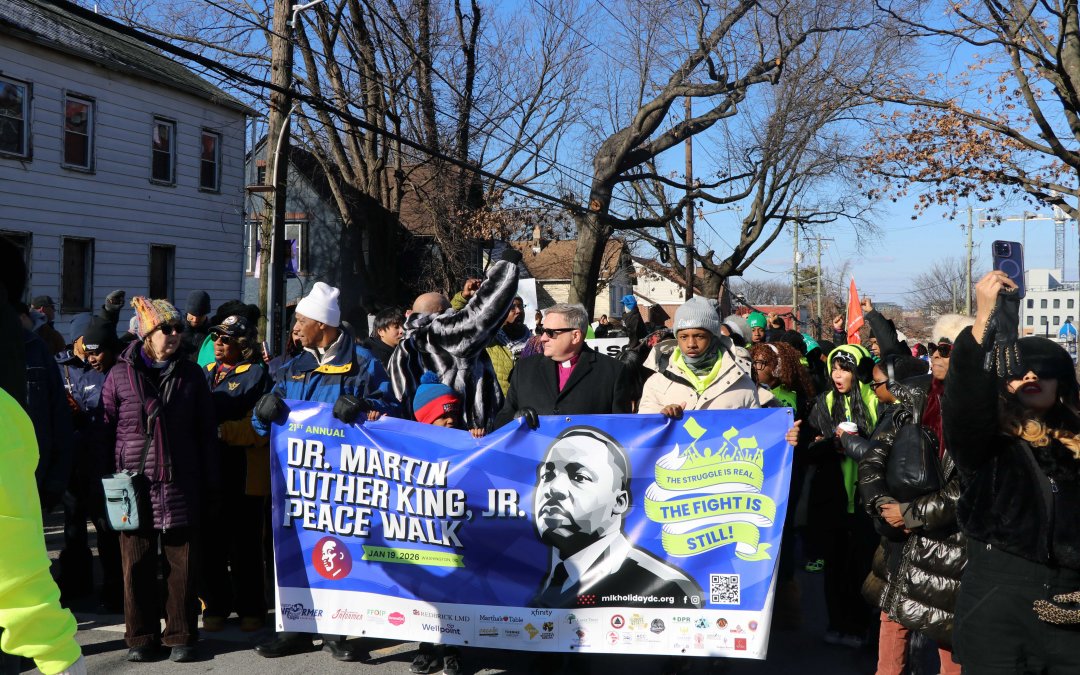
Despite the delayed White House recognition, hundreds of demonstrators joined the 21st annual demonstration in Southeast Washington. Participants marched two miles along Martin Luther King Jr. Avenue under the theme, “The Struggle is Real! The Fight is Still!” Groups called for community empowerment and the protection of civil rights.

A participant at the MLK Day peace rally performs a song from the stage. (Dasha Dubinina/MNS)

Protesters on the street carrying signs calling for equality and justice. (Dasha Dubinina/MNS)
The rally featured performances and discussions regarding King’s legacy, though the tone was sharply political. Demonstrators chanted, “No more kings!” and “Get ICE out of our community!” Others shouted, “Let’s protect the history they’re trying to erase!”
The event emphasized the representation of young people in the public sphere.
Emma P. Ward, the 2011 Miss Senior District of Columbia, said she was fighting for a place on the stage to represent the interests of seniors. She said it’s important to connect generations through the event.
“Overall, it [the holiday] means everything to me in the sense that it helps me go back and reflect from the past and hope for the future,” said Ward.

Emma P. Ward talking about the role of seniors for positive engagement. (Dasha Dubinina/MNS)
The commemorations served as a dual celebration of King’s legacy and the early start of Black History Month. This Friday, the MLK Library opened its flagship exhibition, “Freedom and Resistance,” which portrays the historical connections between the lived experiences of Black Americans and ideals of liberty.
The three-section exhibition features artwork from the “1619 Project,” curated by The New York Times Magazine, alongside interpretations of freedom created by young Washington residents.

“Freedom and Resistance: An Exhibition” on display at MLK library in Washington. (Dasha Dubinina/MNS)

Attendees gathered for the opening of “Freedom and Resistance: An Exhibition” at MLK library. (Dasha Dubinina/MNS)
For attendee Barbara Franklin, observing the art pieces of the younger generation provided a necessary perspective.

Barbara Franklin viewing the works of young artists at MLK library. (Dasha Dubinina/MNS)
“We should think about what these children are thinking about,” Franklin said. “As they’re the future.”