
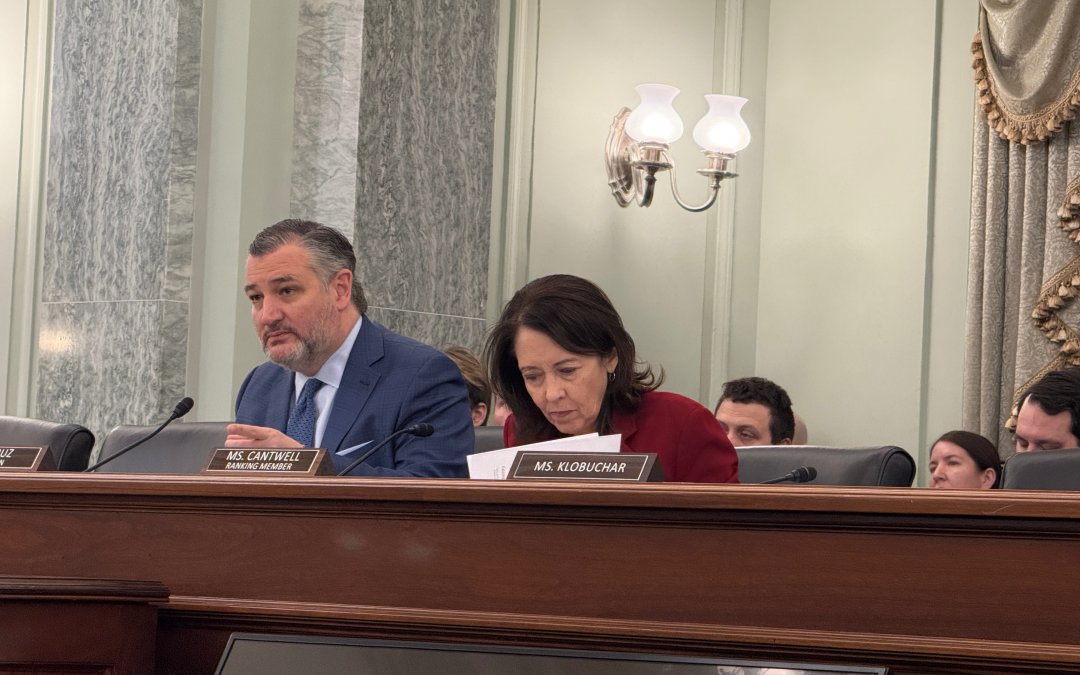
WASHINGTON – Republican and Democratic Senators on Thursday expressed similar concerns over the harmful effects of social media and AI on children, highlighting the need to address the “societal emergency” through federal regulations at a Senate Commerce, Science and Transportation Committee hearing.
“It’s incredibly hard to be a kid right now,” committee Chairman Sen. Ted Cruz, R-Tex., said. “All of the parents I know, myself included, are deeply concerned about all the time kids spend glued to screens watching and reading insidious content that puts their minds and their bodies at risk.”
Senators’ discussion Thursday centered around regulating algorithmic targeting, AI, data collection and technology use in schools.
The hearing came as parents, pediatricians and politicians struggle to respond to a youth mental health crisis driven at least in part by social media. AI advancements continue to amplify safety concerns, particularly for children. Cruz said a step towards addressing the problem would be for the Congress to adopt the Kids Off Social Media Act, which passed the committee last February but has not yet been put on the Senate calendar.
The Kids Off Social Media Act would set a minimum age to use social media platforms at 13 and prevent social media companies from using algorithms to feed addictive content to users under 17.
“I think the headline about KOSMA is the 13 year old threshold,” Sen. Brian Schatz, D-Hawaii, said. “Arguably, the more powerful aspect of KOSMA is the banning of the algorithmic feed for kids who are permitted to be on social between 13 and 18.”
The bill also aims to limit the use of social media in schools by blocking social media and other harmful content on federally funded school networks and devices.
Under the Kids Off Social Media Act, schools that receive discounted telecommunications service under the Schools and Libraries Universal Service Support (E-rate) program must reimburse the federal government if they violate the bill.
Some Democrats said they oppose this aspect of the bill.
“Congress is obligated to act, but rather than focusing on threatening E-rate connectivity for schools, I think we should be passing meaningful protections for kids’ online privacy regardless of whether they are accessing the internet from home or school,” said Sen. Maria Cantwell, D-Wash., the top Democrat on the panel.
Cantwell pointed to other draft legislation, including the Kids Online Safety Act, Children and Teens’ Online Privacy Protection Act, American Privacy Rights Act and her own Future of Artificial Intelligence Innovation Act, which she said would “regulate AI in a better way.”
Cruz criticized the Democrats and the Federal Communications Commission under Biden, saying they “sought to bankroll kids’ unsupervised internet access” and “undermine parental rights by expanding the E-rate program to install wifi hotspots off campus, including in school buses and student homes.”
The E-rate program funds much more than just “online distractions,” including connectivity, cybersecurity, teacher professional development and vocational programs, said witness, Dr. Jenny Radesky, a developmental pediatrician and professor at the University of Michigan Medical School.
“I think it is too blunt of a response to a problem that I think could be more effectively addressed through pressure on the tech companies that are doing the filtering,” Radesky said.
Sen. Dan Sullivan, R-Alaska, and Sen. Ben Ray Luján,D-N.M., said they want to hold big tech companies accountable. Luján said he hopes the committee will use its subpoena power to force tech executives to testify in future hearings.
“If we’re concerned about kids, then put their asses in those chairs and have them answer questions and face the families,” Luján said. “When are they going to fix the damaging behavior of just lining their pockets with dollars at the expense of the health of kids all across America?”
Cruz said Luján was “preaching to the choir” and that KOSMA would hold big tech accountable to their terms of service.