
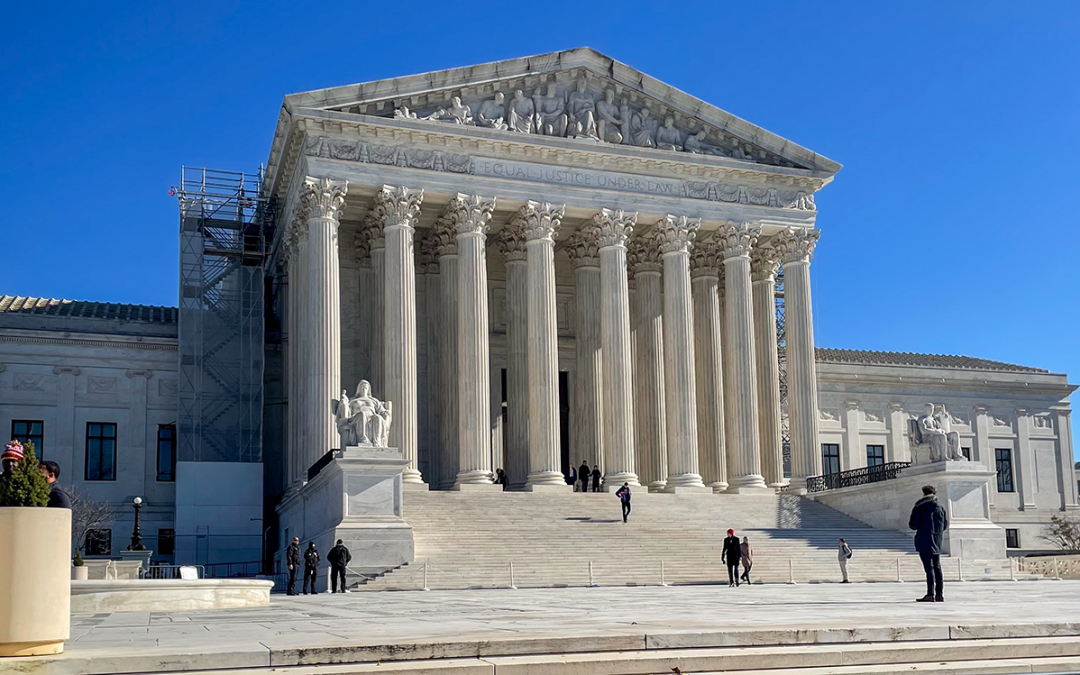
WASHINGTON — Supreme Court justices pressed counsel for the music industry and internet providers on secondary copyright liability in oral arguments on Monday.
The case, Cox Communications Inc. v. Sony Music Entertainment, focuses on whether internet service providers (ISPs) should be held liable for copyright violations if user access was not terminated despite knowledge of infringement.
In 2019, a federal jury in Virginia awarded a group of music labels roughly $1B in statutory damages after finding Cox liable for vicarious and contributory infringement.
Cox’s subscribers illegally pirated copyrighted music owned by several record companies, including Sony, resulting in widespread infringement allegations.
In 2024, the 4th US Circuit Court of Appeals reversed the vicarious liability decision, which alleged that Cox financially benefited from subscribers’ infringement, and vacated the damages.
But the appeals court affirmed the willful contributory infringement verdict because of Cox’s knowledge of consumer violations and should therefore be held responsible for its subscribers’ online activity. Cox petitioned the Supreme Court to review the verdict.
E. Joshua Rosenkranz, Cox’s attorney, cited precedent cases Twitter, Inc. v. Taamneh and MGM Studios, Inc. v. Grokster in arguing that “mere failure to take affirmative steps to prevent infringement” should not equate to liability.
Rosenkranz urged justices to reverse the appeals court decision holding Cox liable because the company did not exhibit purposeful, culpable affirmative conduct, which is needed to establish secondary liability.
The justices questioned Rosenkranz on the matter of purposeful facilitation versus knowledge and the obligation for ISPs to police infringement.
“What incentive would you have to do anything if you won?” Associate Justice Amy Coney Barrett asked. “If you win and mere knowledge isn’t enough, why would you bother to send out any notices in the future?”
“Your Honor, for the simple reason that Cox is a good corporate citizen that cares a lot about what happens on its system,” Rosenkranz said. “We do all sorts of things that the law does not require us to do.”
Deputy Solicitor General Malcolm L. Stewart represented the Trump administration, which supports Cox’s position.
Stewart argued that if internet companies take down infringing works on their platform, such action would constitute a “targeted approach.”
“The approach of terminating all access to the internet based on infringement, it seems extremely overbroad given the centrality of the internet to modern life and given the First Amendment,” Stewart said.
Former Solicitor General Paul Clement, arguing on behalf of Sony, noted that Cox continued to supply internet access after receiving specific, repeated notices of accounts engaged in infringement. Clement classified such behavior as a form of secondary liability and material contribution.
He added that a strict direct infringement standard would render the Digital Millennium Copyright Act (DMCA), which updated copyright law to regulate digital piracy, a “dead letter.”
“If Cox is right on the law, then Cox could take tens of thousands of copyright notices and throw them in the trash, and they could have its employees say ‘F the DMCA,’” Clement said.
Associate Justice Samuel Alito pressed Clement on the unreasonable burden ISPs would face if required to track infringement on enterprise accounts to individual users.
Alito used the example of a university with several thousand students, some of whom may be responsible for copyright violations, describing the situation as “not workable at all.”
“The university then has to try to determine which particular students are engaging in this activity,” Alito said. “And so then it knocks out a thousand students. And then another thousand students are going to pop up doing the same thing.”
Clement argued that the DMCA was intended to “accommodate measures that treat multi-user addresses quite differently from residential customers.
Associate Justice Sonia Sotomayor explained that the “internet is amorphous,” which makes determining material contribution from individual to regional customers challenging.
“How do we announce a rule that deals with those two extremes?” Sotomayor said.
According to Clement, his client would be “without scalable functional recourse” if limited in their ability to hold ISPs accountable in copyright matters.
“So if my clients are limited to direct infringement actions, they are in very, very dire straits,” Clement said.
In an amicus brief in support of Cox, the Computer and Communications Industry Association (CCIA) argued that ISPs face the threat of mounting statutory damages should the contributory infringement standard be affirmed.
According to Jonathan Band, founder of law firm policybandwidth, the consequences may extend beyond ISPs themselves.
“The way the internet works is that you have a lot of entities involved in the transmission of content over the internet,” said Band, who filed the brief on behalf of CCIA. “ If there’s a knowledge-based standard, depending on how it’s defined, all of them conceivably could have a degree of knowledge of something infringing.”
Band noted that some entities may be more vulnerable than others and deem the risk of providing intermediary services too large.
Parties supporting Sony, such as the National Music Publishers’ Association (NMPA), argued that “secondary liability is essential to protect creators and the industries that sustain them.”
“We wanted to point out that the industry spent a lot of time trying to work with service providers to find a solution to this problem,” said Michael J. Allan, an attorney at Steptoe and author of the NMPA’s brief.
“The same subscriber, the same IP address gets notices weekly, monthly, yearly, and nothing’s being done about it, so at some point you file a case,” Allan added.
A ruling is expected in summer 2026, in which the high court may send the case back to the appeals court for additional review.