
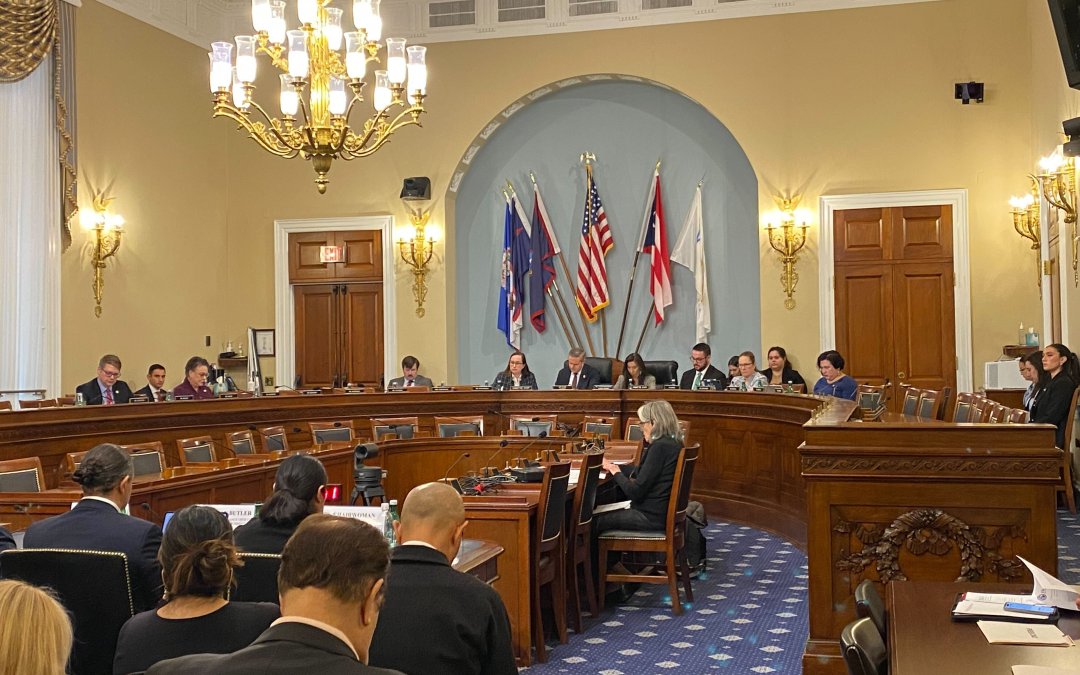
WASHINGTON – The House Subcommittee on Indian and Insular Affairs warned Tuesday that Trump administration cuts to tribal economic and renewable energy programs are stalling development across tribal nations as tribal leaders testified the changes are already disrupting projects and jobs.
Hope Silvas, chairwoman of the Shivwits Band of Paiutes, said limited staff and resources force small tribes to be cautious in economic decisions, adding that many federal development programs remain difficult to access.
“For federal programs to truly work in Indian Country, they must be accessible, transparent, and designed with the diversity of tribal nations in mind,” Silvas said.
Silvas said federal programs spread across agencies and are announced through channels that often miss small tribes, saying this poor outreach leaves them unaware until after deadlines or with programs unsuited to their needs.
“When federal programs fail to reach tribes like the Shivwits Band, these programs miss the opportunity to strengthen tribal governments,” Silvas said.
Rep. Teresa Leger Fernandez, D-N.M., the Ranking Minority Member of the House Natural Resources Committee, raised concerns about the Trump administration’s attacks on the 8(a) Business Development Program, a federal initiative that helps disadvantaged businesses compete for government contracts.
In January, the Trump administration changed the program by eliminating the presumption of social disadvantage based on race and is scrutinizing the program for alleged fraud. They also dismantled DEI-related programs, leading to the suspension of more than 1,000 participants.
Derrick Watchman, president of the National Center for American Indian Enterprise Development, said the 8(a) Program has been effective for Alaska Native corporations and Native-owned businesses.
He said cutting the program would cut key revenue streams and force layoffs, including the loss of half the Navajo Nation’s 8(a) workforce.
“With the 575 tribes here in the country, only about a third benefit,” Watchman said. “But the rest need these entities to help provide for the health, education and welfare of the tribal governments.”
Fernandez also expressed concerns on the Trump administration’s attack on renewable development. Tribal communities experience power outages at more than six times the national rate and pay nearly 30 percent higher energy costs with thousands still living without electricity, said Fernandez.
She warned that new review procedures, issued by the U.S. Department of the Move Interior in July 2025 could further restrict access to renewable energy by making wind and solar projects harder to approve.
Watchman said staffing reductions have stalled programs, citing the Hopi Tribe in Arizona. Under the Biden administration, Congress approved nearly $2 billion for tribal renewable energy projects through the 2022 Inflation Reduction Act, including a $25 million grant for the Hopi Tribe to electrify about 600 homes under the Solar for All program.
But in August 2025, the Trump administration terminated the program, cutting off the Hopi Tribe’s federal grant. Watchman says many residents there still lack electricity, relying on generators or kerosene lamps.
Fernandez argued the administration misunderstands tribal governments’ participation and wrongly targets tribal economic and renewable energy development under the banner of DEI.
“We need to make sure that wherever tribes are located within our amazing United States of America, that they have the tools to prosper,” Fernandez said.
Ranking Member on the House Natural Resources Committee, Jared Huffman, D-Calif., also criticized the Trump administration after every Republican on the subcommittee except Chairman Hurd refused to support overriding President Trump’s veto of a bipartisan tribal bill that would have benefited the Miccosukee Tribe of Florida.
“In that moment, they turned the Congress into Trump’s version of the Russian Duma, with the Republicans in Congress acting like finger puppets that simply do whatever the wannabe dictator tells them to do,” Huffman said.
Huffman said the administration is punishing perceived enemies, including tribal nations, treating them with contempt and dismantling programs that serve Americans, including Tribal nations.
Rep. Tim Walberg, R-Mich., said it’s important to understand how many support opportunities there are for municipal governments while referring to the Tribal nations in his district.
“To make sure that the array of federal programs are used appropriately to assist, and not to hinder, is very important,” Walberg said.
When Walberg asked Silvas which program design features favor larger, better-resourced tribes, she declined to answer, prompting Rodney Butler, president of the Native American Finance Officers Association’s board, to respond that outcomes often depend on available resources.
“That’s the point we’re talking about, that we need to balance the opportunity for all tribes and having the technical expertise available to all tribes so that it’s much more understandable for everyone to take advantage of,” Butler said.