
WASHINGTON — The Trump administration started Operation Metro Surge in the Minneapolis–St. Paul area of Minnesota in December 2025 as part of its deportation agenda. In January, an Immigration and Customs Enforcement agent killed Renee Good, a couple of weeks before two Customs and Border Protection agents killed Alex Pretti, both U.S. citizens. After weeks of escalated protests in response to the deaths, Border Czar Tom Homan called to end the administration’s surge of agents in Minnesota.
As immigration enforcement increased in Minneapolis and nationwide, Democratic lawmakers and advocates increased pressure on Congress to put limits on ICE.
Nayna Gupta (Weinberg ’07), policy director for American Immigration Council, focuses her work on immigration enforcement, the U.S. detention system and the intersection of immigration and criminal law.
The American Immigration Council is a national nonprofit that advocates for fair immigration policies through litigation, research and legislative advocacy, while expanding access to legal representation for immigrants and challenging misinformation about immigration.
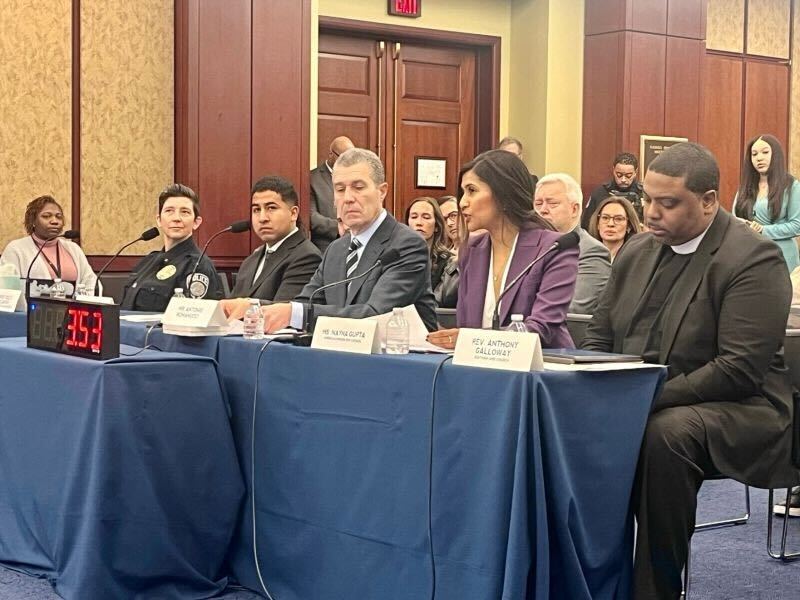
At the House Democratic Steering and Policy Committee hearing on ICE accountability on Feb. 12, Gupta criticized ICE tactics under the current administration as “unlawful and abusive.”
Gupta spoke to Medill News Service about her work at the American Immigration Council, the Trump administration’s immigration enforcement tactics, the impact on immigrant communities and the potential for policy change after the 2026 midterm elections.
This interview has been lightly edited for brevity and clarity.
Medill News Service: As a Northwestern alumna, how do your academic and early professional experiences shape the kind of immigration work you do today?
Gupta: I graduated from Northwestern in 2007, and while I was there, I studied history and political science with a heavy focus on the Middle East. But it was the experiences I had outside of the classroom working on urban and social policy issues in the cities, serving as a research assistant for a former professor there, Dorothy Roberts, and just living so close to Chicago that really shaped my career and, in particular, my perspective on civil rights and racial justice.
It was those early experiences at Northwestern that were incredibly formative for my view of how the law, legal systems and social policy often exclude the most marginalized and vulnerable communities and often dictate to them the limits of their own power in their lives.
Those experiences I had working in communities in Chicago, working alongside a professor at the University, were what compelled me to become a lawyer and, in particular, to be a public interest lawyer focused on civil and immigration rights.
Medill News Service: Your American Immigration Council biography mentioned that you have an immigrant background.
Gupta: That’s correct. I was born in India, and my family immigrated here when I was a very little baby, before I was one year old. I did grow up my entire life in the United States, but just like so many other families, my immigrant family had a formative experience coming to this country, leaving behind their career and home in India and building a life in the United States, learning what it meant to be here and contribute meaningfully to this country.
Like so many other naturalized U.S. citizens, I was sworn in as a U.S. citizen while I was a college student at Northwestern. At the time, frankly, I was frustrated to have to leave campus to come home to the D.C. area, where I’d grown up, for my swearing (in) ceremony. I was a bit self-absorbed and arrogant about the fact that I had to take time for a ceremony, given how American I felt and how engaged I was in my community and in American politics.
The naturalization ceremony itself was an incredibly humbling and moving experience. Being in a room of hundreds of non-citizens from different countries around the world, all of whom were so eager to become U.S. citizens, who had been contributing so meaningfully to their communities and our country — to be alongside them in one room in that moment had a profound impact on me all those years ago.
I was sitting next to a woman from Honduras who cried through the entire ceremony because she was so relieved to have U.S. citizenship. On the other side of me was an older gentleman from Australia whose parents had flown to the U.S. for his ceremony, given how important it was to him to become a U.S. citizen, to keep growing a business he started here.
That experience reminded me of the privilege of having access to citizenship, which is something we deprive of literally millions of non-citizens in our country who are contributing richly to their communities and families and the fabric of our country. That has animated my work, especially now at the American Immigration Council.
Medill News Service: With the American Immigration Council’s mission to advocate for fair immigration policies, why is it important for you to address the gaps and challenges in our immigration system today?
Gupta: At the American Immigration Council, we do a lot to document the contributions that immigrants make to the United States and the value they bring to American interests, as well as to serve as experts on the scope of rights that are afforded to immigrants in our country.
When our broken immigration system fails to bring into the fold the very many immigrants that are contributing richly and impose laws in a way that violate the rights of immigrants, it is critical to us that we work to educate folks on those problems and present solutions to fix that broken system, so that this is a country that meaningfully welcomes immigrants and also honors and protects their rights.
Medill News Service: You attended and testified at the House Democratic Steering and Policy Committee hearing on ICE accountability. What key insights from that hearing do you think are critical for policymakers and the public to understand?
Gupta: The first key insight from the testimony we heard at the congressional hearing is that the Trump administration’s mass deportation agenda is bad for American communities, because it hurts and undermines public safety, it imposes cruelty on non-citizens and the U.S. citizens that support them, and it is an agenda that is violating American norms, policies and laws.
The testimony we heard from a reverend, a police chief and the lawyer of Renee Good underscored just how wide-reaching the negative impacts of this agenda have been, particularly in places like Minneapolis.
Medill News Service: On Feb. 12, Border Czar Tom Homan announced ICE would end its immigration operation in Minnesota. A week prior, President Donald Trump said his administration could use a “softer touch” in its tactics. From your perspective, does what’s happening on the ground in Minnesota now reflect those statements?
Gupta: We’re still learning in real time what folks in Minnesota are dealing with, given some of the shifts that the Trump administration has announced in the face of the growing public pushback on their surge and enforcement efforts there. But what we know is that there has been a decrease in the number of agents on the ground, but that very many non-citizens in Minnesota are still facing a very high risk of arrest, apprehension and detention at the hands of ICE.
Medill News Service: Looking ahead, what long-term or permanent effects could Trump’s immigration policies have on families and communities?
Gupta: The first long-term effect we’re really concerned about is the way this agenda decreases public safety by undermining public trust in law enforcement agencies. An agenda like this makes people, especially immigrant communities and other people of color, more afraid to report crime, including when they’re victims of domestic violence.
It makes them less likely to trust public institutions out of fear of what will result if they interact with them. This is an agenda that is eroding those relationships, which will ultimately mean less safety in our communities and a lot more work to rebuild and regain that trust.
This is also an agenda, of course, that is actively separating families. We know that detention and deportation has devastating, irreparable, long-term effects on financial security, economic stability and social capital in immigrant communities, and we can expect that those consequences will last long after this agenda.
Medill News Service: Democrats are introducing bills to defund ICE and hold the Department of Homeland Security accountable. Do you think Democrats could have more influence on immigration policy after the 2026 midterm elections?
Gupta: Yes. If the Democrats can win back a majority in the House and/or the Senate, there will be an opportunity for them to pass overdue reform to our immigration legal system, which includes strengthening the accountability mechanisms that exist when there is ICE overreach and abuse, in addition to reforming the outdated laws that opened the door and allowed the Trump administration to pursue this agenda.
We hope that, in addition to getting back that power, that Democrats will use it to finally move forward these changes, including offering pathways to citizenship for the millions of undocumented immigrants who pay taxes every year and have lived in our country for years without posing any kind of threat.
This Q&A was published in partnership with The Daily Northwestern.