
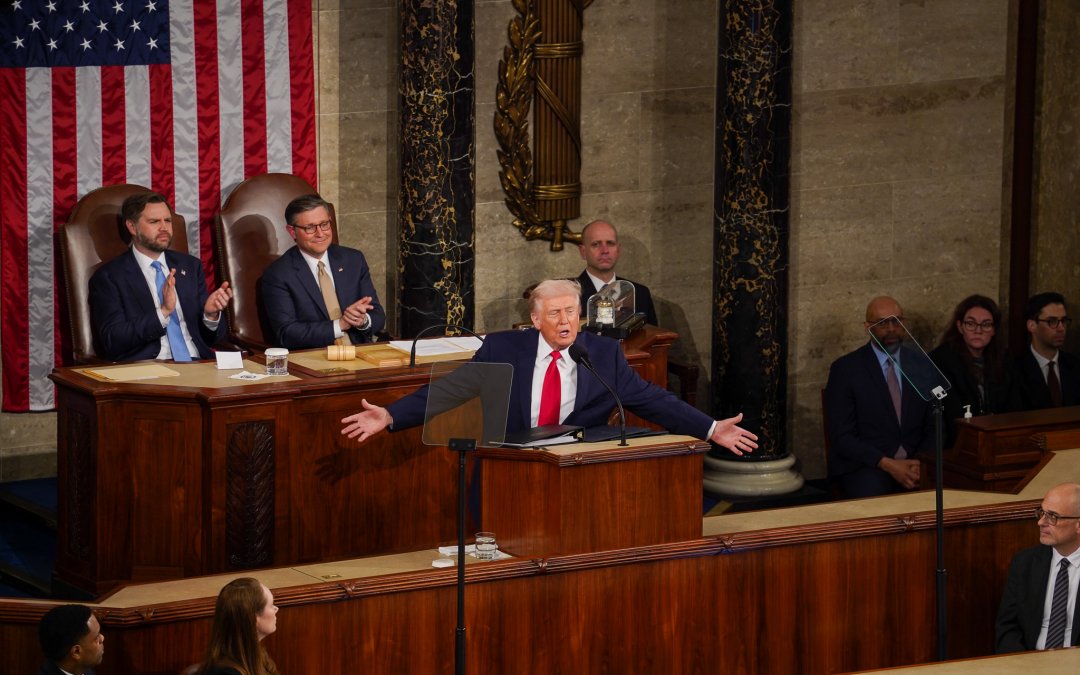
WASHINGTON — President Donald Trump launched into his State of the Union speech Tuesday night with sweeping bravado about the economy after his first year in office. At best, his claims were misleading or lacked context. At worst, they were blatantly false.
Inflation Claim: “The Biden administration and its allies in Congress gave us the worst inflation in the history of our country. But in 12 months, my administration has driven core inflation down to the lowest level in more than five years. And in the last three months of 2025, it was down to 1.7%.”
Verdict: False.
Analysis: It’s not clear why Trump singled out a period of three months considering that inflation reports tend to operate on a monthly, quarterly or annual basis, but regardless, his assertion of inflation at 1.7% is inaccurate. When Trump took office, the average annual inflation rate was 2.9% and went up to 3% after the introduction of global tariffs, settling to 2.6% for 2025. Five years ago in February of 2021, inflation was at 1.7%. During Biden’s administration, inflation hit a recent high of 9.1% due to post-COVID federal spending, labor market issues and price shocks from the Russia-Ukraine war. However, this was not the worst inflation rate in U.S. history – in 1980, inflation reached a rate of over 14%.
Gas Prices Claim: “Gasoline, which reached a peak of over $6 a gallon in some states under my predecessor and was, quite honestly, a disaster, is now below $2.30 a gallon in most states, and in some places $1.99 a gallon.”
Verdict: Misleading.
Analysis: According to the American Automobile Association, on the day of the State of the Union address, the national average for regular gas prices was $2.95. Gas prices have come down: the average a year ago at this time was $3.14 a gallon. While Trump exaggerated his numbers, the general sentiment of falling gas prices was echoed by Federal Reserve Chairman Jerome Powell at a January press conference. “Geopolitical risk for us, a lot of it is around energy and oil,” he said. “For all the turmoil, oil prices have come down.”
Electricity Costs Claim: “We’re telling the major tech companies that they have the obligation to provide for their own power needs. They can build their own power plants as part of their factory, so that no one’s prices will go up and in many cases, prices of electricity will go down for the community.”
Verdict: Misleading.
Analysis: According to the U.S. Energy Information Administration, the U.S. average for electricity prices is up almost 9% from 2024, and is projected to continue to rise. There is also no legal mandate that tech companies must swallow additional costs rather than hiking consumer costs. After his speech, White House spokeswoman Taylor Rodgers announced Wednesday that tech companies would meet with Trump next week to sign a pledge that prices will not go up.
At a recent energy conference, Google’s Senior Lead for U.S. Energy Markets Brian George made no allusions to direction from the executive branch on powering their own facilities. George said the company is working with utility partners to offset demand, but did not promise that consumers will see stable costs. “It’s going to be a balance between how much flexibility we can provide and how much infrastructure we need to build,” he said.
Foreign Investment Claim: “In 12 months, I secured commitments for more than $18 trillion pouring in from all over the globe.”
Verdict: False.
Analysis: According to the White House’s own investment announcements website, total U.S. and foreign investments currently stand at $9.7 trillion.
Jobs Claim: “More Americans are working today than at any time in the history of our country. Think about that. Any time in the history of our country. More working today, and 100% of all jobs created under my administration have been in the private sector.”
Verdict: Misleading.
Analysis: While more Americans are currently employed than ever before, this is a statistic that could be touted by nearly every president since the country’s population increases every year. A more accurate measure of economic growth is the unemployment rate which measures employment as a proportion of the population. This percentage has increased under Trump’s second term from 4% when he took office to its current standing at 4.3%, according to the Bureau of Labor Statistics.
Debt Claim: “When it comes to the corruption that is plundering, really, it’s plundering America, there’s been no more stunning example than Minnesota, where members of the Somali community have pillaged an estimated $19 billion from the American taxpayer… And we’re able to find enough of that fraud, we will actually have a balanced budget overnight.”
Verdict: False.
Analysis: Two points to address here: The total for fraud in Minnesota was reported to be $9 billion according to the House Oversight Committee, less than half of Trump’s claim. Of the 98 defendants, 85 were reported to be of Somali descent. Second, this number is nowhere near enough to write off the nation’s debt. The national deficit blew past $1.8 trillion in the 2025 fiscal year, per the Congressional Budget Office.
Economic expert Jim Clouse spent many years working at the Federal Reserve and Federal Open Market Committee and now conducts research at the Andersen Institute for Finance and Economics as a senior fellow. Clouse said the national deficit is unusually large considering the general strength of the economy.
“They’re also continuing to run deficits even when the economy is at full employment,” he said. “Those are usually periods when the economy is strong and back at full employment, that you’re running surpluses, or at least slowing down the pace of the size of deficits relative to GDP. And that doesn’t seem to be the case.”
Tax Cuts Claim: “Last year, I urged this Congress to begin the mission by passing the largest tax cuts in American history, and the Republican majority delivered so beautifully!”
Verdict: False.
Analysis: Trump is referencing the One Big Beautiful Bill Act, which was signed into law over the summer. The bill delivered tax cuts for working citizens, businesses and several federal programs. The Tax Foundation think tank gathered data on the impact of tax cuts by measuring revenue changes as a share of GDP, which determined that Trump’s cuts stood in sixth place. The largest tax cut in history was the Economic Recovery Tax Act of 1981 under former president Ronald Reagan’s administration.
SNAP Claim: “We cut a record number of job-killing regulations, and in one year we have lifted 2.4 million Americans – a record – off of food stamps.”
Verdict: Misleading.
Analysis: Yes, 2.4 million people are now unable to receive benefits through the Supplemental Nutrition Assistance Program. However, this is not a sign of decreasing poverty but a result of the One Big Beautiful Bill Act, which is cutting federal spending on certain welfare programs. Millions of people will lose eligibility for food stamps due to new work requirements. In fact, according to the Economic Policy Institute, the federal minimum wage officially fell below the poverty line in 2025.
“Warrior Dividend” Claim: “Every service member recently received a Warrior Dividend of $1,776. They put it on my desk. We got the money from tariffs and other things. A lot of money.”
Verdict: False.
Analysis: Yes, more than 1.4 million service members received a bonus in December, but this money did not come from tariffs. The bonuses came out of a supplemental housing fund included in the One Big Beautiful Bill Act. Congress appropriated $2.9 billion to the Department of Defense to support personnel who do not live in barracks housing. Instead, Trump used that money for his widespread “Warrior Dividend,” which will go to all active service members, whether they are living in barracks or not.
Trump accounts Claim: “With modest additional contributions, these young people’s accounts could grow to over $100,000 or more by the time they turn 18.”
Verdict: False.
Analysis: Trump is launching investment accounts with a base of $1,000 for babies born between Jan. 1, 2025 and Dec. 31, 2028. Growth from accumulating interest is not guaranteed, and it is extremely unlikely that a base investment of $1,000 would become $100,000 in 18 years. Using a historical annual growth rate in the stock market of 10%, the U.S. Securities and Exchange Commission’s investment calculator predicts the total after 18 years to be less than $6,000. Inflation would offset those gains by a further 2-3% per year, and that’s only if the economy does not face any big fluctuations.