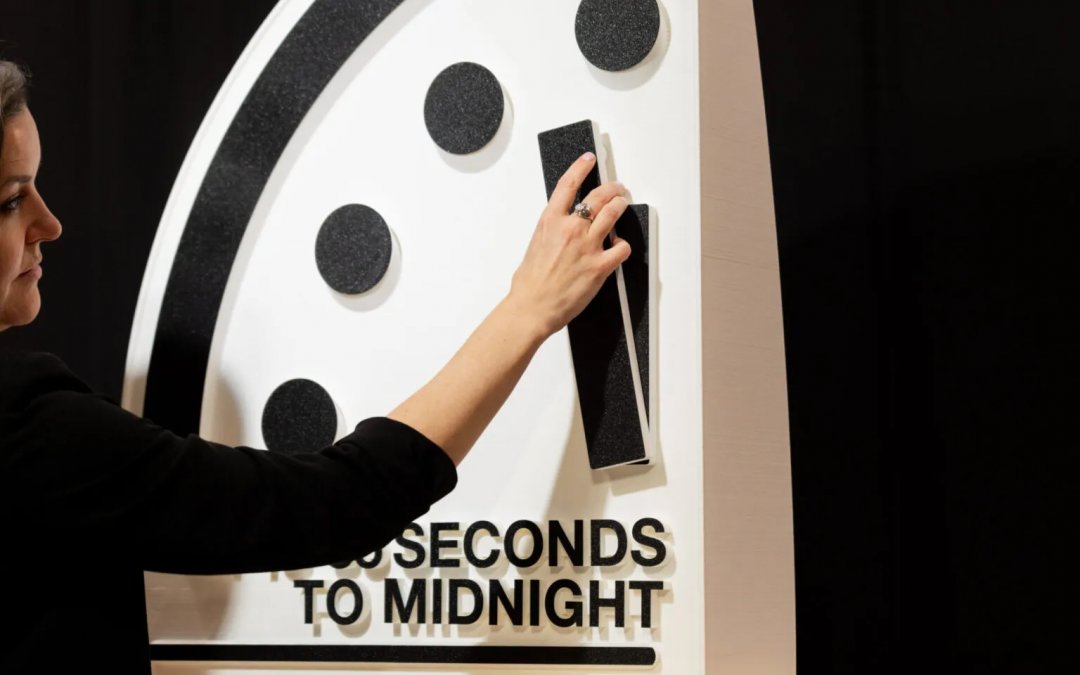
WASHINGTON – The Bulletin of the Atomic Scientists moved the Doomsday clock to 85 seconds to midnight on Tuesday, the shortest the metaphorical countdown to apocalypse has ever been in the clock’s 79-year-long history.
The science-oriented advocacy group emphasized the threats of artificial intelligence, climate change and nuclear war. The Bulletin’s Science and Security Board said the global rise of nationalistic autocracies and the erosion of democratic institutions increased the risk of global issues. These political shifts, combined with rapid developments in the biotechnological threats, have significantly increased the probability of a man-made catastrophe.
“Every second counts. And we are running out of time,” said Bulletin President and CEO Alexandra Bell.
The combined threats present such a substantial risk to humanity that the people of the world should call on their leaders to fight these global challenges, according to the group of scientists and other experts.
NUCLEAR THREAT
The Bulletin specifically criticized the United States, Russia and China for expanding and modernizing their nuclear arsenals while favoring “grandiosity and competition over diplomacy and cooperation” in international relations.
For example, deploying weapons in space, such as President Trump’s proposed “Golden Dome” missile defense system, could trigger a competition with other great powers and increase the risk of a space-based war, said Steve Fetter, a member of the Science and Security Board.
Another reason the clock moved closer to midnight was that the leaders of nuclear-armed states have recently threatened to use nuclear weapons on the battlefield, said Jon B. Wolfsthal, a member of the Science and Security Board. Wolfsthal noted that Russia and Pakistan had both made such threats recently.
Previously nuclear weapons played a role in deter warfare and force adversaries to negotiate, he said.
This shift to actively threatening to use nuclear weapons came as the last remaining nuclear arms control agreement between the U.S. and Russia, the New Strategic Arms Reduction Treaty (New START), was set to expire next week.
“So for the first time in generations, both of these countries will be free to deploy as many nuclear weapons as they want or believe they need,” warned Wolfsthal.
BIOTECHNOLOGICAL THREAT
Another biological threat that the Bulletin said could pose a radical departure from life as we know it in the future would be the development of mirror-image life, synthetic organisms made from molecules that are the reverse version of those used in nature. According to the Bulletin, a self-replicating mirror cell could plausibly spread throughout all ecosystems and eventually cause the widespread death of humans, other animals, and plants. Yet, experts said scientists would not have the capability to create mirror life for at least another decade.
Despite the risk, researchers in some countries continue to compete to develop mirror life, said Asha M. George, executive director of the Bipartisan Commission on Biodefense.
George said biotechnology is advancing so rapidly that the international community has failed to designate which experiments are too risky to perform.
She also warned that non-state actors continue to seek biological agents for use in terrorism, such as ricin, a toxic chemical made from castor seeds.
“We keep seeing these incidents all over the place. We have ricin incidents occurring here in the United States pretty frequently,” said George.
THREAT OF ARTIFICIAL INTELLIGENCE
According to the Bulletin, the evolution of AI also poses threats across multiple sectors. Biological risks now include people using AI to design new pathogens for which humans have no effective defenses. The United States, Russia and China are incorporating AI across their defense sectors, despite the potential dangers of such moves.
The Bulletin specifically criticized the Trump administration for revoking a previous executive order on AI safety. The board stated the move reflects a “dangerous prioritization of innovation over safety.”
The board also warned that AI “hallucinations” can generate misinformation and undermine the fact-based public discourse required to address global threats.
“We are living through an information Armageddon that’s brought by the technology that rules our lives,” said Maria Ressa, Cofounder and CEO of Rappler and 2021 Nobel Peace Prize Laureate. “Without facts, you can’t have truth. Without truth, you can’t have trust. Without these three, we have no shared reality. We can’t have journalism. We can’t have democracy, the radical collaboration this moment demands becomes impossible.”
CALL TO ACTION
By moving the clock forward, the Bulletin hoped to encourage experts and average people to exert pressure on leaders and governments “to do the right thing,” John Mecklin, the Bulletin’s editor-in-chief, said in an interview
“National leaders—particularly those in the United States, Russia, and China—must take the lead in finding a path away from the brink. Citizens must insist they do so,” the group’s statement said.
For example, grassroots movements and private sector pressure in the past have demanded government action to switch to cleaner renewable energy, which is now more economical and convenient than fossil fuels, said Ines Fung, Bulletin Science and Security Board member.
In closing, members of the Science and Security Board urged the public around the globe to ensure that government action is sufficient to counter the existential threats facing society.
“The destruction has happened. We’re standing on the rubble of the world that was. Now it’s time to create, to build the world we want that is more compassionate, more equal, more sustainable,” said Ressa.