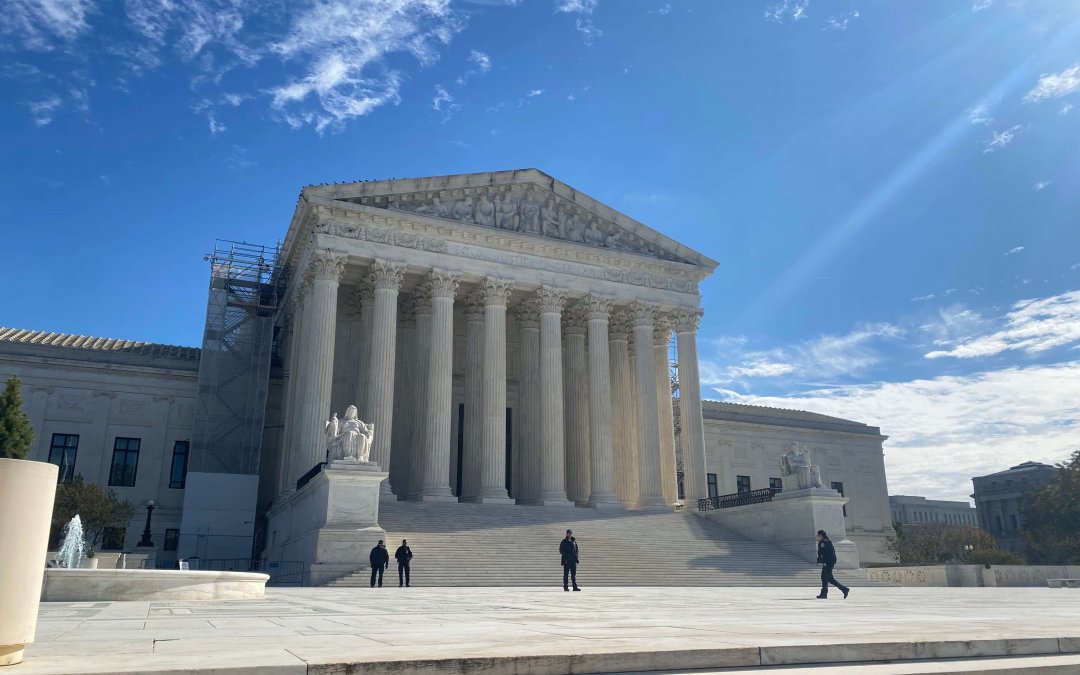
WASHINGTON – The Supreme Court Tuesday seemed divided while hearing oral arguments in Wolford v. Lopez, a case concerning a Hawaii gun restriction.
The law in question, known among gun rights activists as the “vampire rule”, prevents people with concealed carry licenses from bringing guns onto private property open to the public without the explicit consent of the property owner.
If struck down, the case would establish a national default of allowing concealed guns to be brought onto private property open to the public unless owners explicitly ban concealed carry on their property via signage. This would shift the regulatory power away from states and impact similar laws in states such as California, Maryland, New York, and New Jersey.
While the more liberal justices seem inclined to support the Hawaii law, others harshly questioned the historical justification.
The 2023 Hawaii law was passed after the Supreme Court’s 2022 ruling in New York State Rifle & Pistol Association v. Bruen struck down a New York law that had required those who want to carry a handgun in public to show a special need to defend themselves. This case struck down state laws that previously restricted concealed carry licenses.
In Justice Clarence Thomas’ majority opinion in Bruen, he instituted a new test for how courts should determine constitutionality regarding Second Amendment cases.
“Only if a firearm regulation is consistent with this Nation’s historical tradition may a court conclude that the individual’s conduct falls outside the Second Amendment’s ‘unqualified command,’” Thomas wrote.
In court Tuesday, Neal Katyal, the attorney representing the Hawaii Attorney General, gave his opening oral argument and stated that there is no constitutional right to assume that every invitation to enter private property includes an invitation to bring a gun.
“It’s pretty clear an invitation to shop is not an invitation to bring your Glock,” Katyal said.
Katyal claimed Hawaii has approved 2,207 concealed carry licenses since Bruen and denied petitioners’ claims that the law “burdens” gun owners.
“When you ask yourself what in the text informed by history this Hawaii law violates, the answer is precious zero. No commentator, no treatise, no court. No one has ever said you have the right to imply consent of the private property owner. Rather, the fundamental tradition… is that there is a fundamental right to exclude,” Katyal said.
The case was originally heard in federal district court in Hawaii. Three Maui residents with concealed carry permits and a local gun-rights group challenged the Hawaii law, arguing it violates their Second Amendment rights.
In September 2024, the 9th U.S. Court of Appeals upheld the Hawaii law, deciding it met the requirement of a historical tradition of firearm regulation based on its similarity to two state laws.
The gun owners appealed the case to the Supreme Court to determine whether the permission requirement violates the Second Amendment. They argued that the laws used to establish historical tradition were not analogous to Hawaii’s.
One of the laws used in the case is a New Jersey law from 1771 that barred poaching on lands that were closed to the public. The other was an 1865 Louisiana law enacted as part of the Black Codes, which barred the carrying of guns on premises or plantations without the owner’s consent.
In court Tuesday, the petitioners’ lawyer, Alan Alexander Beck, argued that the laws Hawaii’s attorney used to establish historical tradition are not similar enough to the law in question, in response to questioning from Justice Elena Kagan.
“One dealt with private property that was not open to the public, whereas this law is dealing with private property that is open to the public,” Beck argued.
Justice Neil Gorsuch followed up, asking about the Louisiana law.
“Do you think the ‘black codes’, as they’re called, should inform this court’s decision-making when trying to discern what is this nation’s traditions?” Gorsuch asked.
Beck said he did not. “I just don’t see how a law like that can be used to be analogized to a modern-day law,” Beck said.
Gorsuch seemed to support Beck’s argument by claiming Hawaii’s counsel believes the law is analogous, as they described the Louisiana law as a “dead ringer” for the Hawaii law, according to Gorsuch.
The Principal Deputy Solicitor General Sarah Harris, arguing in support of the petitioners, seemed to agree with Gorsuch’s skepticism.
“Those laws are dead ringers only in the sense that this law too is an unconstitutional pretext,” said Harris.
Justice Jackson challenged the petitioners’ claim, arguing that if all historical regulations cannot be taken into account when deciding historical analogies, there might be something wrong with the Bruen test.
In defense of their usage, Katyal argued that the 1865 consent requirement law is relevant to the case because when Louisiana was admitted to the union, Congress did not strike down the firearm restriction law and argued this specific law protected black churches and black-owned businesses.
Justice Sonia Sotomayor questioned the petitioner’s defense on whether Hawaii’s local tradition creates an expectation that the general public carries guns wherever they go.
Beck disregarded the question, arguing that because Hawaii is a part of the United States, the national tradition is that people are allowed to carry on private property that is open to the public.
“This law is not banning you from doing that. It’s just requiring you to get the owner’s permission,” Sotomayor countered.
Following a hypothetical from Chief Justice John Roberts about the public’s right to enter privately owned gas stations, Justice Jackson asked Beck about whether the presumption to enter is based on the owners’ consent or constitutional rights.
“You don’t have the right to go into private property,” Jackson claimed. “You are only there because the owner has either explicitly or expressly consented.”
Beck responded, arguing that there is a constitutional right to carry a firearm onto that specific gas station.
“You do? Where is that? I thought the reason this was all here is because you have an implied license,” said Jackson.
While Jackson, Sotomayor and Kagan seem poised to uphold the Ninth Circuit’s decision, the court’s conservative justices’ positions were less clear.
Gorsuch intensely questioned the respondent’s inclusion of a law from the Black Codes.
While Justice Brett Kavanaugh harshly questioned the argument presented by the Solicitor General in support of the petitioners, he said he “just [didn’t] see the kind of broad tradition here” that’s required for a gun control law to be permissible.
Justice Amy Coney Barrett, meanwhile, pressed Beck on whether Hawaii could restrict firearms on private property not open to the public, such as homes, without express authorization. When Beck said such a law would be illegal, Barrett replied, “Really?”
The Court is expected to release a decision by summer.