
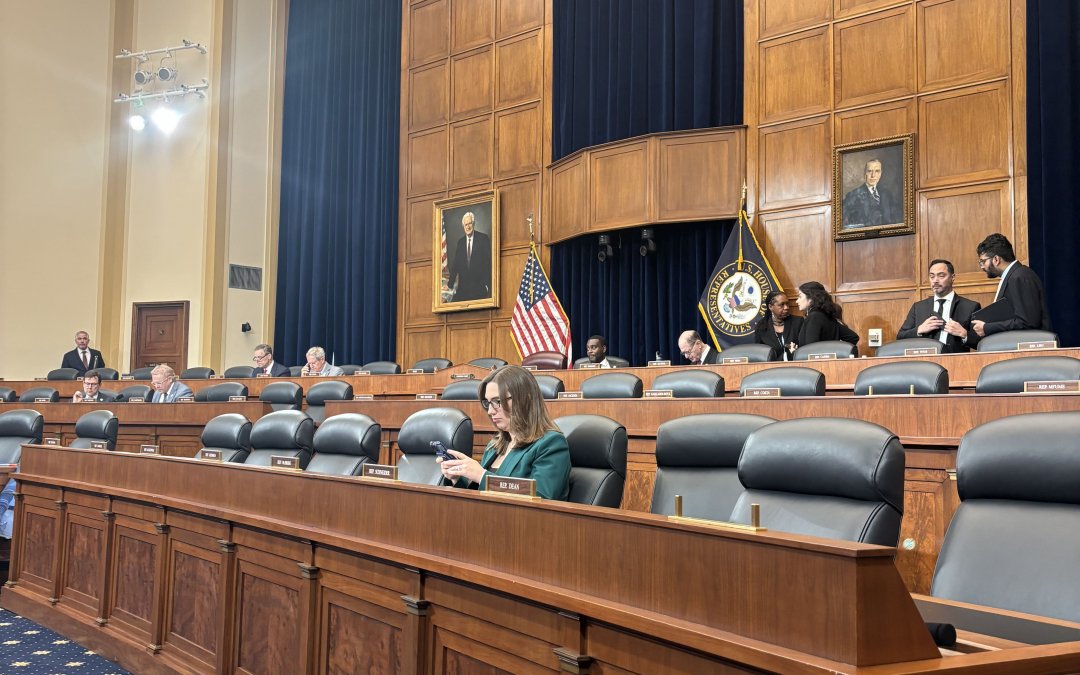
WASHINGTON –– National security experts and lawmakers argued against the sale of advanced artificial intelligence chips to China at a Wednesday House of Foreign Affairs hearing, warning that continued sales could undermine U.S. dominance in technology and spark an artificial intelligence arms race.
“These chips — they’re not just kids playing videogames on Xbox, playing war games,” said Foreign Affairs Committee Chairman Brian Mast, R-Fla. “They affect real wars, real weapons, real war powers, and they will be a part of bringing about real casualties.”
Committee members discussed whether the U.S. should completely halt the sale of Nvidia’s H200 chips, one of the most powerful high-performance chips crucial in developing modern warfare through weaponry, mass surveillance and cybersecurity. These systems optimize weapon supply chains, enhance drone and missile targeting, and more, giving countries with access to this computing power a strategic advantage in military capability.
Both Democrats and Republicans repeatedly emphasized the growing possibility of an AI arms race, drawing similarities to the Cold War and nuclear competition where technological superiority meant greater military power.
“[AI] powers autonomous weapons, nuclear modernization,” Mast said. “AI dominance can decide who sees first, who decides first, and who strikes first.”
When pressed on whether restricting chip access could backfire by encouraging China to develop its own advanced semiconductors, Chief Economist Oren Cass of American Compass said China still lacks access to the computing scale needed to match the U.S.
“Even if Huawei can produce a couple hundred thousand chips in a year that are equivalent to some American chips, the U.S. can produce millions,” Cass said. “That’s why Chinese companies are trying to buy millions of these chips because it is not just the capability of the individual chips, it is the scale.”
While American companies like Nvidia, Intel and Apple dominate the design and development of the AI chip market share, 83% of the manufacturing occurs overseas based on a Center for Strategic and International Studies article. According to the Council on Foreign Relations, Taiwan Semiconductor Manufacturing Company produces around 90% of the world’s most advanced chips, making Taiwan a critical link in the supply chain and target for China.
“Taiwan is a friendly democracy and has the only major capacity in the world to make these advanced chips,” said Matt Pottinger, former deputy U.S. national security advisor. “If China coercively annexes Taiwan, it gives them a kill switch to overtake U.S. technology.”
A solution proposed during the hearing was that the U.S. must maintain alliances with allies, including Taiwan, South Korea, Japan, and the Netherlands.
However, the problem is that the U.S. cannot control the actions of companies in allied countries. Even if the U.S. could, the U.S. and allied nations both have companies that heavily depend on Chinese goods and services, which prevents them from exerting maximum pressure tactics.
“If we roll back or erode the restrictions on our companies, certainly the incentive is there for them [allies] to roll back or erode the restrictions they are placing on their own companies,” said Jon Finer, a researcher at Yale and former national security advisor.
Winning an AI arms race against China is not limited to banning sales. According to Chairman Mast, legislation needs to go further to address the full potential of AI as an emerging field that is sure to impact the balance of global power. It is one reason why he and other lawmakers are pushing for legislation — the AI Overwatch Act — to ensure congressional oversight with the power to block adversaries from accessing AI-enabled technology while ensuring allies receive it.
“AI is one of the areas that it’s not just about technology as a tech sector — it is an enabling technology that is the advantage that we potentially have in becoming better at materials, […] automation, […] manufacturing processes, […] supply chains,” Cass said. “If we are going to rebuild our industrial base and compete with China, we have to leverage that advantage.”