
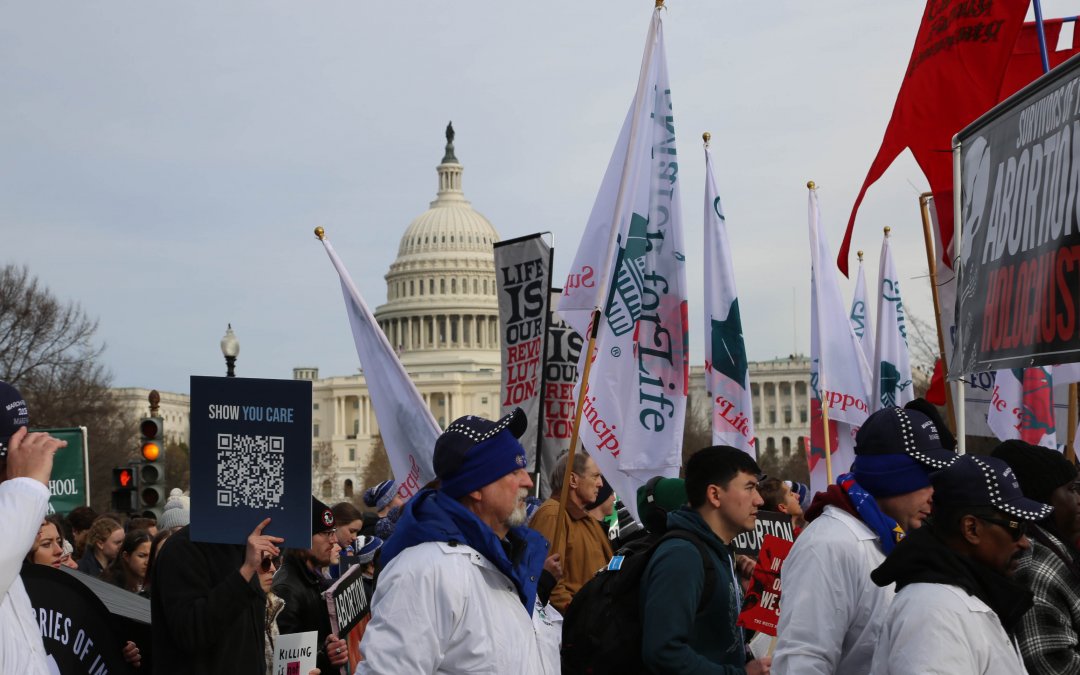
WASHINGTON – Thousands gathered Friday for the 53rd annual March for Life, celebrating pro-life policy gains while appearing split over the movement’s future in the wake of the 2022 Dobbs decision.
Alongside signs expressing hope, many demonstrators voiced frustration with the administration’s efforts to advance their cause. Pro-life voters overwhelmingly support Republicans, and that increased strain has led to efforts by the administration to curry support before the midterms, amid pro-life calls for action.
Ahead of the march, President Trump met with several pro-life leaders at the White House and released a message outlining his administration’s pro-life policies. Still, his administration drew criticism from the movement last year after the Food and Drug Administration approved a generic version of the abortion pill and after Trump said Republicans should be “flexible” on the Hyde Amendment, which prevents the use of federal funds for abortions.

This is Vice President JD Vance’s second time appearing at the March for Life. Last year, it constituted his first public appearance after becoming vice president. (Isabel Papp/MNS)
Vice President JD Vance headlined the rally, where he celebrated blocking foreign aid to groups involved in abortion services, diversity programs, and transgender care. Under the theme “Life is a Gift,” he touted the administration’s return to the Geneva Consensus Declaration to advance women’s health and a renewed federal ban on the use of aborted fetal tissue in research.
“The mark of barbarism is that we treat babies like inconveniences to be discarded rather than the blessings to cherish that they are,” he said, addressing a largely Christian audience. “But the inheritance of our civilization is something else, the fact that, as scripture tells us, each life is fearfully and wonderfully made by our creator.”
Aborted fetal tissue research has always been controversial, but constitutes a small, specialized portion of biomedical research and represents a fraction of 1 percent of total research projects. It used .3% of the National Institutes of Health’s funding, according to the Department of Health and Human Services.
Despite recent policy shifts, many demonstrators said they expect the government to do more to restrict abortion access, though the crowd remained divided on exactly what the next steps should be.
Randall Terry, founder of anti-abortion group Operation Rescue, interrupted Vance’s address several times by shouting, “Ban the abortion pill!” Before the vice president’s speech, he had attempted to rally the crowd to join his protest.
“Our hope for the future is that we create a civil protest movement that creates massive social tension and disruption in the country, so that we outlaw the killing of human beings,” Terry said. His voice was one of many calling for the administration to do more against abortion.
Others wore hats or signs saying ‘Defund Planned Parenthood,’ including student spokespersons for Students for Life of America. One of them was Kyra Kishore, a student at the University of Pittsburgh, who argued that Planned Parenthood mostly conducted abortions and should be completely abolished.
In fact, according to Planned Parenthood’s 2023-2024 annual report, abortive care made up 4% of its total services. While the government is Planned Parenthood’s largest revenue source through health services grants and reimbursements, 96% of pregnancy-related services are indeed abortive. The most common services provided are STI and STD testing, making up 54%. The majority of Medicaid beneficiaries who received services at Planned Parenthood received contraceptive and STI services, not abortions, according to KFF.
Some demonstrators supported a nationwide abortion ban, but others emphasized expanding adoption programs, providing resources for women struggling with domestic violence and financial support to families without criminalizing abortion.
“I’m happy for any legislation which supports women who are in a situation where they’re trying to decide,” said Rita Zubricki. “That would be my first priority.”
The march also featured a visible international presence, with demonstrators carrying flags from South Korea, Poland, Ukraine and Canada, highlighting global anti-abortion efforts. Among the international visitors was a bus of youth activists from the Campaign Life Coalition, a Canadian organization that travels annually to Washington for the march.
“Our country is a little different,” said Justyna Armatowicz, a representative with the delegation.“We are hoping that we follow in your footsteps, but it takes a little bit of time.”
As demonstrators waited for the march to reach its final destination at the Supreme Court, five counterprotesters gathered nearby carrying signs against ICE and the Trump administration.
“The truth is, we’re spread awfully (expletive) thin,” said Karen Erwin, seated between signs calling the Trump administration fascistic. “[Trump’s] entire agenda is about control and has nothing to do with life, but supporting him runs away at all the rest of our rights.”

Karen Erwin (right), one of the only counterprotesters against the March for Life this year, sits with her friend amid signs condemning the Trump administration and the pro-life movement. (Isabel Papp/MNS)
“I’m here because abortion bans violate my religious freedom,” said Sarah Kolick, a traditionally observant Jew and another counterprotester. “My religion obligates a woman to undergo an abortion when our life or mental health is endangered by the pregnancy.”
Although the marchers were fighting for the rights of the unborn, internal disagreement on federal policy, internal disagreement on federal policy left questions for the movement’s future.
“We love each other, but we’re going to have open conversations about how best to use our political system to advance life, how prudential we must be in the cause of advancing human life,” said Vance.