
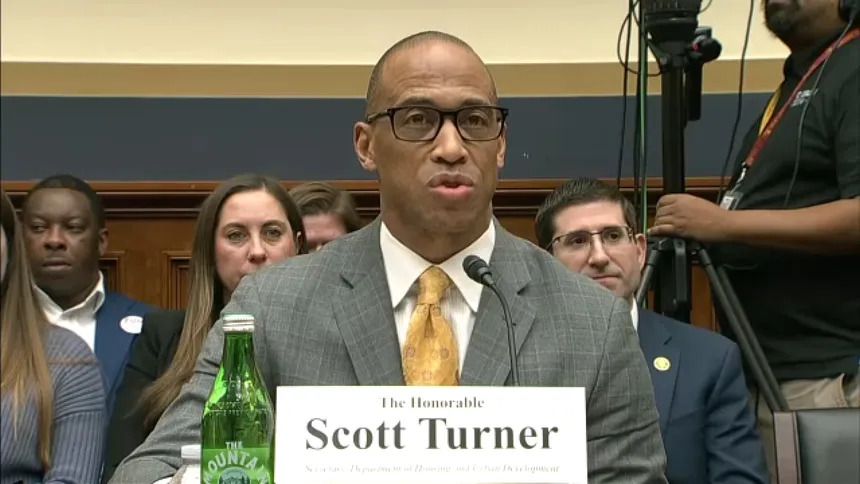
WASHINGTON — Lawmakers pressed Housing and Urban Development Secretary Scott Turner on oversight of federal housing programs and the Federal Housing Administration during a House Financial Services Committee hearing on Wednesday, as housing affordability remains a persistent challenge nationwide.
The hearing comes as U.S. consumers continue to navigate a costly housing market. While mortgage rates have fallen to about 6.06%, down from more than 7% a year ago, affordability remains strained. ATTOM data shows that in 99% of U.S. counties, median-priced homes are less affordable than historical averages.
Lawmakers pointed to housing supply constraints as a key factor behind those trends.
“As you are likely aware, the average first-time homebuyer in the United States is now 40 years old,” said Rep. Ann Wagner, R-Mo. “Clearly, housing supply is not keeping up with demand.”
HUD oversees roughly 100 major housing, mortgage and assistance programs and received more than $89 billion in discretionary funding in fiscal year 2025. Four programs — tenant-based rental assistance, project-based rental assistance, the Public Housing Fund and Homeless Assistance Grants — account for about three-quarters of the agency’s annual budget.
Much of the hearing focused on concerns that some long-standing HUD programs have not been meaningfully reviewed recently, raising questions about whether they are being effectively overseen and evaluated by Congress.
Rep. Ayanna Pressley, D-Mass., criticized the department’s responsiveness to congressional oversight, calling it “unfortunate, unacceptable and deeply disappointing” that it took more than a year for the secretary to appear before the committee.
Concerns over federal housing assistance were also raised through personal testimony. Rep. Brittany Pettersen, D-Colo., cited her mother’s experience relying on federally funded housing programs to highlight the stakes for vulnerable populations, including people struggling with addiction and housing instability.
Turner emphasized the department’s focus on accountability, pointing to oversight mechanisms aimed at improving safety in public housing and ensuring basic protections for residents.
The hearing also examined the financial health of the Federal Housing Administration, which insures mortgages primarily for first-time, low- and moderate-income buyers. HUD reported that the FHA’s mortgage insurance fund held a capital ratio of 11.47% in 2025, well above the statutory minimum.
Even with recent declines in interest rates, housing costs remain high for many households. According to a recent analysis by Zillow, typical monthly mortgage payments now consume more than 30% of median household income nationally, exceeding the threshold commonly used to define housing cost burden.
The hearing unfolded as housing policy continues to draw attention beyond Capitol Hill. Speaking at the World Economic Forum in Davos, Switzerland, on Jan. 20, President Donald Trump reiterated proposals aimed at boosting homeownership, including restricting large institutional investors from purchasing single-family homes and directing federal agencies to buy mortgage-backed securities to help lower borrowing costs.
One of the most contentious exchanges during the hearing centered on disaster recovery funding. Rep. Brad Sherman, D-Calif., questioned HUD’s handling of Community Development Block Grant Disaster Recovery funds following recent wildfires in Los Angeles, noting no assistance was directed to affected communities.
“You’re saying people in my district should be shafted because you don’t like our politicians?” Sherman said.
Turner responded that responsibility for disaster recovery efforts rests with state leadership, a reply that drew further criticism from several Democratic members.
Still, Turner sought to frame housing as a nonpartisan issue.
“Housing to me is not political. Housing affects the 340 million people in our country,” Turner said, adding that the department is working to modernize programs while maintaining access to affordable housing and protecting taxpayer funds.