
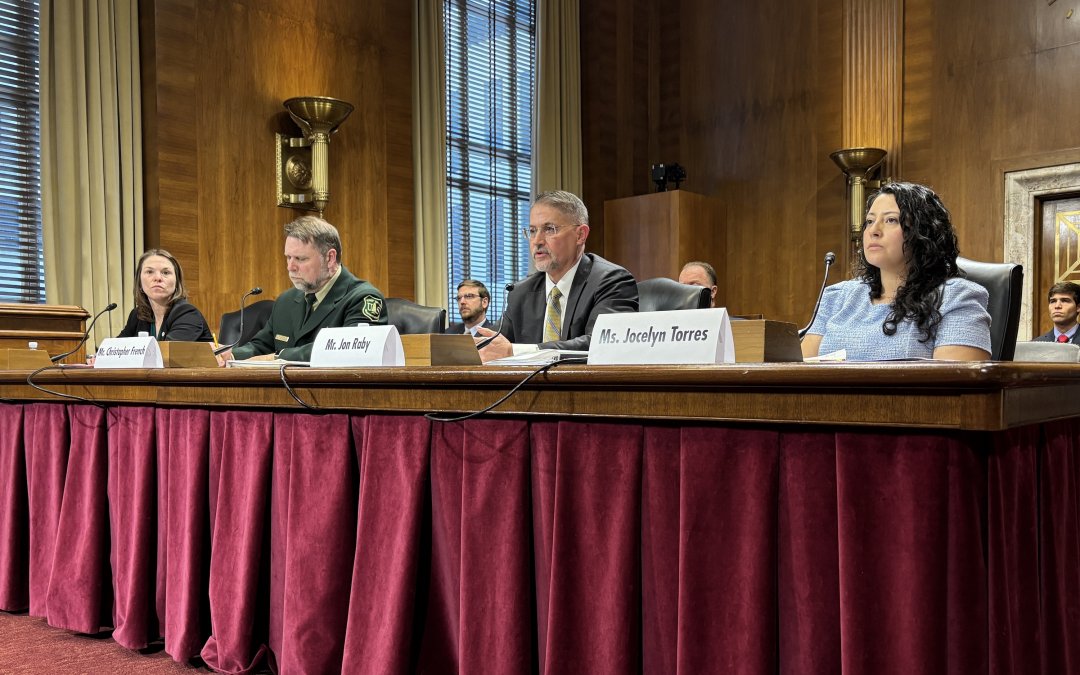
WASHINGTON — The Trump administration is working to achieve their goals to develop public lands, even if they are “in conflict” with preferences of local communities, federal agency employees said in a Public Lands, Forests and Mining Subcommittee hearing Tuesday.
The Trump administration has been rescinding President Joe Biden-era land policies and frustration communities affected by those decisions.
In response, Democratic senators have proposed legislation to limit these changes.
On Tuesday, senators questioned four experts about the potential impacts of 26 bills, which spanned from wildfire prevention to withdrawing some federal lands from mining and road development.
Lawmakers from both sides of the aisle stressed the importance of listening to local communities and improving cooperation across all levels of government when managing public lands.
The federal employees testifying said that the administration’s development priorities take precedence.
Ten of the bills, sponsored by Democrats, seek to restrict mining leases and road development on some federal lands in various states.
The senators championing these bills said they received widespread support from local communities, and many of the pieces of proposed legislation already passed the subcommittee last year.
However, Jon Raby, the Nevada state director for the Bureau of Land Management, said the Trump administration will not support expanding the number of acres under environmental protections in order to accomplish their development goals.
“Under the Trump administration, the BLM is managing the public lands as national assets capable of growing our economy, helping balance the budget, generating revenue for the American taxpayers,” Raby said.
Sen. Martin Heinrich (D-N.M.) sponsored a bill to remove some of the federal land in the Upper Pecos Watershed in northern New Mexico from eligibility for mining claims and leases.
In 2024, Biden’s Secretary of the Interior Deb Haaland withdrew roughly 165,000 acres of public land in the Upper Pecos from mining claims and leases for 20 years — a decision that received support from local communities. Earlier this year, President Donald Trump’s BLM and the Forest Service rescinded that decision.
BLM is required to hold a 90-day public comment period when making decisions like that. They postponed a promised in-person public comment meeting in February, and it was never rescheduled. BLM went ahead with overturning the withdrawal in April.
“We want these decisions to be rooted in local communities, and yet they seem to have been cut out of this process,” Heinrich said.
Both Acting Associate Chief of the U.S. Forest Service Christopher French and Raby said their departments did not support Heinrich’s bill.
When asked if he would meet with local communities in the Upper Pecos watershed, French said he would be open to it but added that the administration is focused on achieving its development goals.
“We know that the comments that we received on (Haaland’s) withdrawal overwhelmingly supported the withdrawal, but across the agency, the administration’s policy is to preserve the spaces we have right now for future development,” French said.
French and Raby were more supportive of wildfire prevention bills, which aim to improve cooperation between federal, state and local governments. French said they aligned with the administration’s goals of improving the federal response to wildfires.
Subcommittee Chairman Sen. John Barrasso (R-Wyo.) sponsored a wildfire prevention bill and thanked the administration for the help streamlining bureaucratic processes for better land management in the western U.S.
“There’s broad agreement that the U.S. Forest Service and the Bureau of Land Management have failed to manage our forests in a serious, incredible way over the years,” Barrasso said. “Though I’m grateful for President Trump and his agenda for improving many of these practices, there’s still plenty of work that needs to be done.”
The administration’s current plans to develop federal lands for energy ignore years of work that factored into proposed land management strategies for states like Oregon, Sen. Ron Wyden (D-Ore.) said.
“It’s further evidence that the Trump administration simply isn’t willing to look at locally driven, crafted solutions for responsible resource management,” Wyden said.