
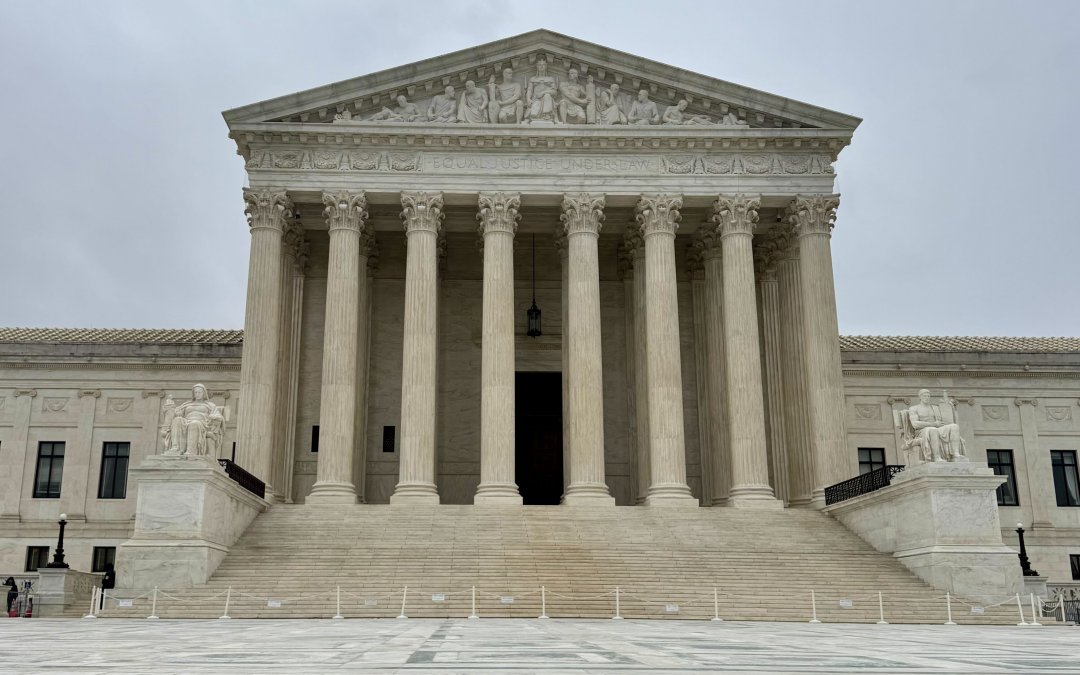
WASHINGTON – The Supreme Court heard oral arguments Monday in United States v. Hemani, and a majority of the justices appeared deeply skeptical that the federal government should prosecute a Texas man for owning a gun, simply because he regularly used marijuana.
The case has forced the nation’s highest court to grapple with a constitutional puzzle. If James Madison reportedly drank a pint of whiskey every day and was not considered a “habitual drunkard,” what does that say about Ali Danial Hemani, who smokes marijuana every other day? Justice Neil Gorsuch posed that question directly to the federal government’s attorney, but nobody in the courtroom had a clean answer.
In 2022, FBI agents investigating the Hemani family’s alleged ties to the Iranian Revolutionary Guard Corps searched his Denton County home and found a legally purchased Glock 9mm pistol, 60 grams of marijuana, and 4.7 grams of cocaine. Hemani told agents he used marijuana almost every other day.
He was not charged with terrorism. He was not charged with drug dealing. But he was charged under 18 U.S.C. 922(g)(3), a provision of the 1968 Gun Control Act that makes it a felony, punishable by up to 15 years in prison, for anyone who “is an unlawful user of or addicted to any controlled substance” to possess a firearm.
The government’s case rests on an analogy to founding-era laws against “habitual drunkards.” Gorsuch was unpersuaded. “John Adams took a tankard of hard cider with his breakfast every day. James Madison reportedly drank a pint of whiskey every day. Thomas Jefferson said he only had three or four glasses of wine a night,” he told Sarah Harris, the principal deputy solicitor general. “Are they all habitual drunkards who would be properly disarmed for life under your theory?” The only thing the record shows about Hemani, Gorsuch noted, is that he used marijuana roughly every other day, with no specifics on quantity.
Justice Amy Coney Barrett pushed further, asking whether someone who takes their spouse’s sleeping medicine Ambien without a prescription would also lose their right to have a gun. “It’s not the drug itself that’s causing the dangerousness. If my husband has a prescription and I don’t, what is it about Ambien that would make one of us more likely to be dangerous? It’s not. It’s the lawfulness.” She pressed the same logic onto Adderall, a medication for ADHD, Robitussin, a cough syrup, and testosterone. “None of those drugs strike me as drugs for which it is obvious that a risk of violence would ensue,” she added.
Justice Ketanji Brown Jackson identified a deeper structural problem. The 2022 New York State Rifle & Pistol Association Inc. v. Bruen protected the right to carry a handgun in public for self-defense. Under that case, she argued, a modern legislature must follow founding-era judgments about dangerousness. It cannot substitute its own.
“You have to have a policy judgment at the founding that matches the policy judgment today,” she said. “And if we don’t see that, then the fact that today’s Congress thinks that person is dangerous is irrelevant.”
Hayley Lawrence, executive director of the Duke Center for Firearms Law, called Jackson’s interpretation of Bruen the most consequential moment of the oral argument.
“We’re operating in this legal fiction where we’re forced to ask whether Congress considered dangerousness determinations in relation to historical analogs when we know that’s not what Congress did,” she said. “You’re asking the government to go back and do homework for an assignment that was due 50 years ago.”
Gorsuch also pressed Harris on why the administration chose this case to test the principle while simultaneously moving to reclassify marijuana as a less dangerous drug, from Schedule I to Schedule III.
“It’s an odd case to have chosen,” he said. Matthew Cavedon of the Cato Institute, who authored an amicus brief for Hemani, noted the contradiction:
“The chaos is even within the administration, it appears, about how dangerous marijuana is,” he said. “On one hand, it has approved medical uses… On the other hand, it’s this thing that, by golly, if you’re doing it, you’re so dangerous you can’t be trusted with a gun.”
Carissa Hessick, a criminal law professor at the University of North Carolina, compared the case to the federal government charging Al Capone for tax evasion prosecution. Prosecutors often pursue the case they believe they can win.
“As long as we think these are appropriate penalties for the crimes people are actually being convicted of, as opposed to the ones we just suspect them of committing, then we should be okay with it,” she said.
The case has drawn an unusual alignment of advocacy groups. The NRA, ACLU, Gun Owners of America, and Cato all filed briefs for Hemani. Everytown, the Brady Center, and 19 states, including California and Illinois, backed the Trump administration.
“This puts the decriminalization crowd and the gun violence prevention folks on opposite sides, and those two camps are often comprised of a lot of the same people,” Lawrence said.
The ruling will land amid significant legal uncertainty about marijuana. The federal government is moving to lessen penalties for marijuana, while 40 states have some form of legalization, and hundreds of lower-court challenges to the federal statute that makes it a felony to illegally use drugs while possessing a gun.
Hemani could face a maximum of 15 years if convicted. The Supreme Court was expected to rule by summer.