
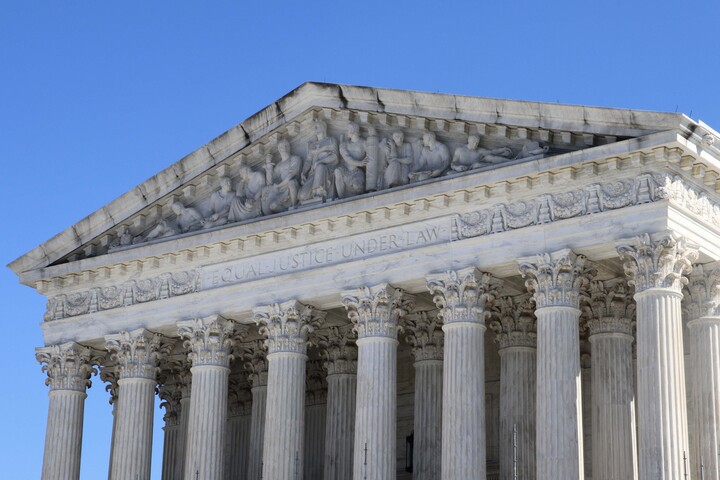
WASHINGTON — The Supreme Court heard arguments Tuesday on what limitations there should be for defendants who waived their right to appeal if their sentence would otherwise be deemed illegal.
Courts generally uphold two exceptions to appellate waivers: either the defendant claims ineffective assistance of counsel or the sentence exceeds the statutory maximum. The outcome of Hunter v. U.S. will determine if there will be more flexibility for defendants to appeal unreasonable sentences even if they had previously waived that right.
Munson P. Hunter III pleaded guilty to aiding and abetting wire fraud in 2024 and was sentenced to more than four years in prison, followed by three years of supervised release. As part of the deal, Hunter waived his right to appeal the sentence, which is extremely common – according to the Suarez Law Firm, appeal waivers are “nearly universal” in plea deals.
During sentencing, the court ordered Hunter to take mental health medication while in supervised release. Hunter objected to this mandate, but the court rejected his arguments. The judge then misinformed Hunter that he could appeal his sentence.
In his appeal, Hunter argued that the court’s mandate for him to take mental health medication while on supervised release violated his due process rights. The district court ruled against Hunter and said the written waiver overrode the judge’s spoken statements in court.
During oral arguments on Tuesday, Chief Justice John Roberts expressed concern over treating plea agreements like a typical binding contract. He pressed both counsels on what wording could be used to allow for more flexibility, but the court did not land on a catch-all term for unreasonable sentencing.
“Plea agreements have some attributes of a contract, but they’re not, they’re not like ordinary contracts,” Roberts said. “Imposing the entire law of contracts here seems to me rather open-ended.”
Hunter’s counsel Lisa Blatt argued that there needs to be more exceptions to appeal waivers if defendants receive unconstitutional sentences.
“It is inconceivable and hypocritical and embarrassing to say a criminal defendant has no contract defense at least when the government is seeking to enforce the contract,” Blatt said.
Ruling in Hunter’s favor could change how criminal cases conclude, which is usually final since most defendants entering a guilty plea have waived their right to contest the sentence.
Waiving one’s right to appeal saves the government time and litigation costs, since they do not have to entertain the possibility that a defendant’s case will return to the court.
Associate Justice Neil Gorsuch expressed concerns to Department of Justice lawyer Zoe Jacoby that defendants may face prejudice from judges and receive sentences influenced by racism or sexism.
Gorsuch also said the case is a public policy issue because contractual agreements should not change the fundamental court system. He posed a hypothetical to Jacoby that a court of orangutans could issue a sentence and under the government’s strict interpretation of appellate waivers, the defendant would not be able to take action.
“It’s a district court who says, I’m going to let an orangutan pick a sentence out of a hat,” Gorsuch said. “And you would say no, no right to appeal that.”
Associate Justice Ketanji Brown Jackson raised the issue of the government’s stake in plea deals. She argued that the Sentence Reforming Act of 1984 is proof that appeals incentivize courts to follow the law and impose reasonable sentences.
Waiving one’s right to appeal saves the government time and litigation costs, since they do not have to entertain the possibility that a defendant’s case will return to the court. Jackson said if the outcome of Hunter v. U.S. sides with the government, it could pose issues in public policy.
“We have a congressional policy that, in fact, revamps the entire sentencing system to allow for appeals,” she said. “To suggest that an appeal waiver is not against public policy, I think, runs up against all of that.”
Director of the Cato Institute’s Project on Criminal Justice Matthew Cavedon published an amicus brief in support of Hunter, and also challenged the notion that this case should fall under contract law.
Cavedon said a contract is defined as two consenting parties acting in their best interests, while a plea bargain is a surrender from one party that cannot walk away.
“It’s really hard to say that most plea bargains can qualify as a genuine contract in the first place,” Cavedon said. “That said, even contracting law would not put up with the sort of wide open uncertainty that’s reflected in a plea like the one that was at issue today.”
After hearing Tuesday’s oral arguments, Cavedon said he is confident that the Supreme Court will rule in favor of Hunter and give more flexibility with appeal waivers.
“It’s a good sign that the court certainly wasn’t willing to indulge the government’s argument here that an appellate waiver prevents all abuses,” he said. “From there to a ruling in favor of Mr. Hunter is a pretty short distance.”
A decision on the case will be released by the end of the court’s term in the summer.
Published in conjunction with 