WASHINGTON – The Washington Post remains mired in upheaval after laying off at least one-third of its staff last Wednesday.
The Associated Press reported Saturday that publisher and CEO Will Lewis resigned amid criticism of his handling of the staff layoffs. The Post named chief financial officer Jeff D’Onofrio as the temporary publisher.
The Post eliminated its entire sports department, photo department and book section. It also cut positions across most other departments of its newsroom, according to the AP.
The extensive downsizing at the 149-year-old newspaper sparked broader concerns about the state of the industry and the decline in local news outlets. Public outcry from journalists and news consumers also highlighted disillusionment with billionaire media company owners.
Victor Pickard, a media policy and political economy professor at the University of Pennsylvania, described the extent of the Post’s layoffs as “deeply troubling.”
“In retrospect, it’s clear that (Jeff Bezos) was never that committed to journalism as an institution, and especially its relationship to democratic society,” Pickard said. “I think it brings into focus that this was always a kind of vanity purchase.”
Pickard said the Post’s recent changes dashed hopes for “benevolent billionaires to swoop in and save the day.”
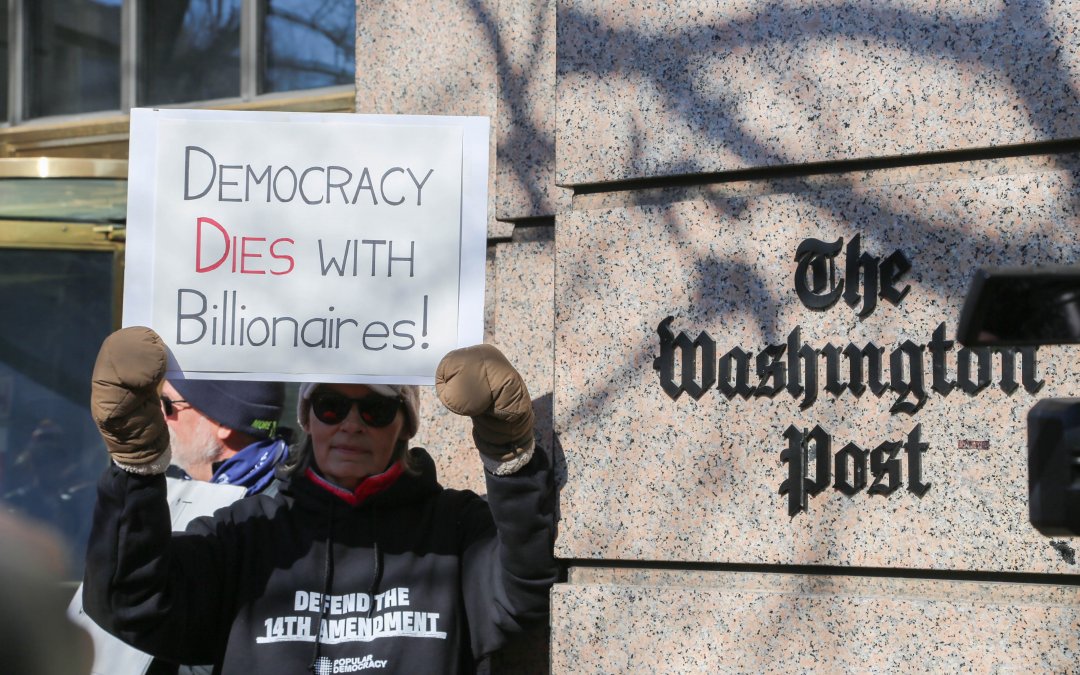
Despite uncertainty about the future of the Washington Post and journalism in the nation’s capital, the Washington Post Guild and Tech Guild hosted a rally last Thursday outside One Franklin Square to support journalists and a strong free press in the wake of the layoffs.
Patrick Nielsen is co-chair of the Washington Post bargaining unit of the Tech Guild. He said while there had been rumors of layoffs weeks before they occurred, he didn’t think anyone realized how “devastating” they would be.
A staff software engineer for the Post, he said he wanted to send a message to the leaders of the Post that the newspaper is a “special” place.
“The abdication of responsibility from up top… is incredibly disheartening,” Nielsen said. “I think the only thing keeping this organization afloat is the rank and file who are doing the work on a day-to-day basis. ”
Dominique Landinez, a D.C.-based event producer and creative project manager who runs her own business, attended the rally. She said she felt like the Post layoffs directly affected her because many of the local journalists who would typically highlight small businesses and events around the city are no longer employed.
Pickard said the “last best hope” for journalism, and for local journalism in particular, is public media. He said many nonprofit news organizations, such as the Texas Tribune and ProPublica, are thriving but are ultimately an unsustainable model for what’s needed to address news deserts.
National newspapers tend to fare better than local news, which has struggled to survive in the U.S. According to the Medill School of Journalism’s 2025 State of Local News report, about 40% of all local U.S. newspapers have shuttered in the past two decades, leaving millions of Americans without a reliable source of local journalism.
News deserts are associated with increased polarization, reduced voter participation and less government accountability, according to the American Journalism Project.
“We all learn in school that democracy requires a free, and by implication, a functional press system,” Pickard said. “If we know that the market’s not going to support this, then we’re going to have to come up with creative policy interventions to make sure we actually have a press system in place.”