
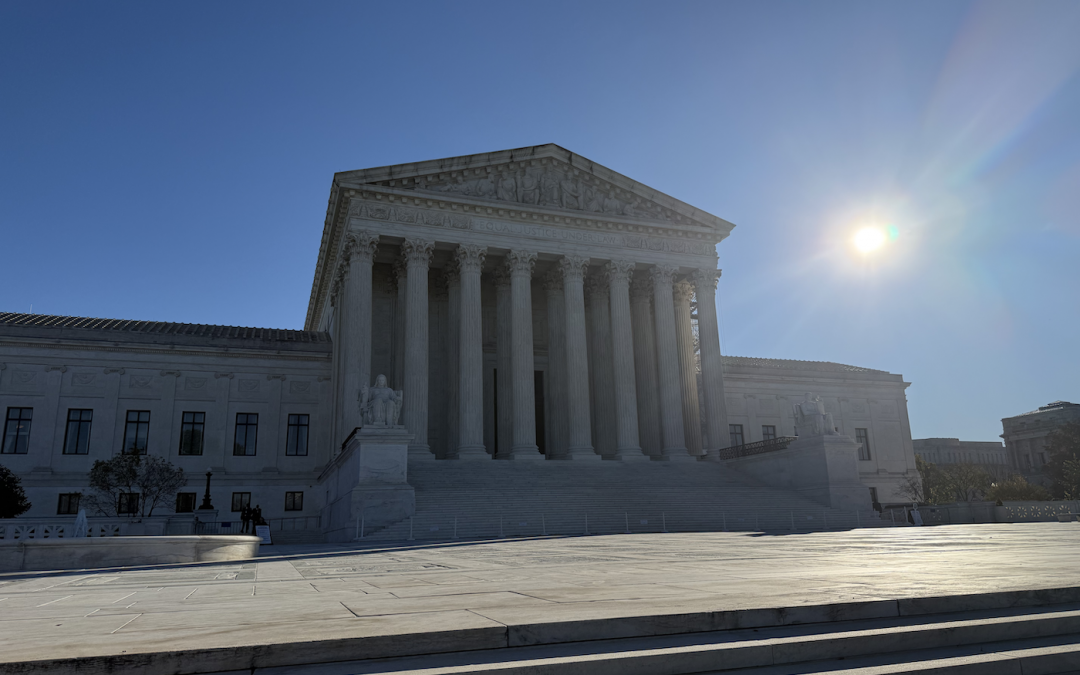
WASHINGTON —The Supreme Court heard oral arguments Wednesday in a case where a county foreclosed on a Michigan family’s home and sold it at auction at a price far below market value in order to recoup $2,200 in taxes.
Pung v. Isabella County, challenges the High Court to expand its 2023 ruling requiring the government to pay the debtor all the proceeds from a foreclosure sale, except the taxes. Lawyers for Michael Pung, who lost his house, argued that under the Takings Clause of the Fifth Amendment, the county should have given him the fair-market value of the home minus the taxes.
Despite justices’ clear sympathy for the homeowners, they seemed unwilling to risk making a ruling that would put the foreclosure system in jeopardy.
Associate Justice Elena Kagan expressed concern that if the government is forced to pay the fair-market value of a house minus the taxes, counties would no longer foreclose because it would be too costly to make up the difference between the fair market value and whatever they get in an auction.
“If you’re selling a house on foreclosure, you’re just not going to get the fair market price,” Kagan said.
Frederick Liu, assistant to the solicitor general of the Department of Justice, said a ruling requiring governments to pay the fair market value of a home minus the taxes owed by the homeowner would discourage counties from recouping taxes through foreclosures.
“It would spell the end of tax sales in America,” Liu said. “At the end of the day, it hurts other taxpayers.”
Associate Justice Amy Coney Barrett said that it would be “a pretty dangerous road for us to go down.”
The case began when Michael Pung declined to pay about $2,200 in real estate taxes because he did not believe they were due. The county set the Pung’s property for foreclosure and sold the property at a public auction for about $76,000. The Pungs were paid the surplus funds generated by the sale, totaling just under $74,000. The individual who purchased the Pung family’s home in the auction sold it soon after for $195,000.
Although the Pungs were paid the surplus generated from the foreclosure sale, they asserted that the just compensation requirement in the Takings Clause of the Fifth Amendment requires the monetary equivalent of the property taken, an additional $118,000.
Pung also argues that the process has violated the Eighth Amendment prohibition on excessive fines, resulting in a loss of $118,800 to cover the $2,242 in tax debt he claims was never owed in the first place.
Some justices were sympathetic to the Pung family, Associate Justice Neil Gorsuch saying it has a “striking set of facts.” Associate Justice Samuel Alito said that while he understands there is an emotional attachment to a house, that is not the issue of the case.
“Is this normally how the county does it?” Barrett asked Matthew Nelson, Isabella County’s counsel. “If the tax owed was $100, will the county still foreclose on a house?”
Kate Pomery, the media director at Pacific Legal Foundation, said Pung v. Isabella County is different from previous equity theft cases, such as the unanimous 2023 Tyler v Hennepin County case, because it goes beyond the constitutional right to surplus equity.
“Destroying $118,000 in equity to collect (or punish a protest over) the $2,242 disputed portion of the Pungs’ 2012 tax bill is a punitive forfeiture grossly disproportional to the underlying ‘offense,” in violation of the Eighth Amendment’s Excessive Fines Clause,” she wrote in an email to Medill News Service.
A victory for the Pungs would set a precedent, forcing local governments to avoid unnecessary and unfair forced sales of homes over relatively small debts, Pomery said.
Tia Pung, Michael’s wife, said that the case is not about property taxes but is rather about private property rights and “something taken from law-abiding taxpayers over something so stupid.”
“Somebody has to stand up for what’s right, and we’re praying that we are and we will win and that people across the country will not be taken advantage of, and put in this situation and losing copious amounts of equity in homes,” Pung said in a video statement relayed by Pomery.
The Court is expected to release a decision by summer.