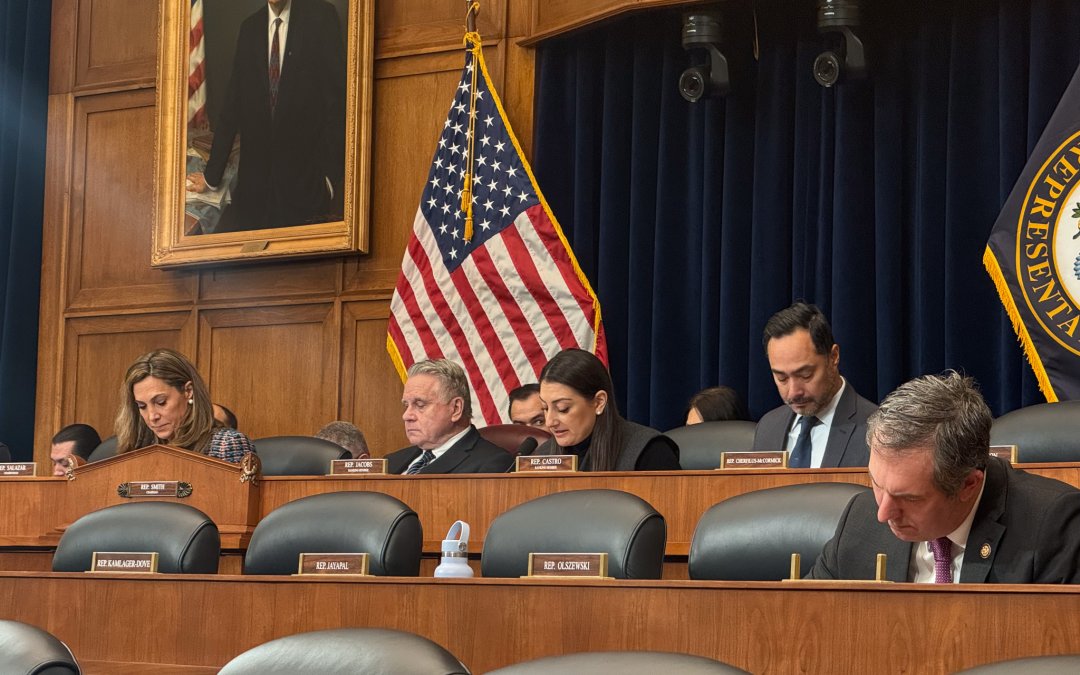
WASHINGTON – A “war against God” is being waged globally, according to witnesses at a congressional hearing on Feb. 4 calling for U.S. intervention to support religious freedom overseas.
Amid increasing reports of persecution of Christians in Nicaragua, Nigeria, and China, witnesses appealed for political pressure on regimes threatening religious freedom. The discussion reflects an aggressive expectation for U.S. foreign policy following the extraction of President Nicolás Maduro from Venezuela, with representatives poised to support action.
“Their game is over,” said Co-Chair Maria Salazar, R-Fla., directly addressing the Nicaraguan government, which has been targeting Christians since 2018. “It’s time to understand things are changing in the Western Hemisphere. There’s a new sheriff in town.” She repeated the message in Spanish.
These concerns echo broader concerns by the Trump administration of apparent anti-Christian bias in the United States, as questions continue about how that will bleed into foreign policy.
In China, though there is no state-sponsored religion, President Xi Jinping has worked to limit the independence of Chinese religious groups. These efforts include forcing the modification of religious texts and symbols to align more closely with the Chinese Communist Party’s ideology and prosecuting religious leaders on dubious charges.
“Even authoritarian repression cannot extinguish faith,” said Grace Drexel, daughter of Pastor Ezra Jin, leader of the Zion Church in China, an independent Christian ‘house church,’ who was imprisoned by the Chinese government seven years ago. She lives in the U.S. now.
“It’s a literal war on God,” said Sam Brownback, former ambassador at large for International Religious Freedom. Brownback stated that he believed that global Christian persecution is being masterminded by China in a bid to threaten Western culture.
“Various politicians have sought to seize on that and say, ‘Look, our values are under attack, and we’re being victimized one way or another,’” says Professor Randal Balmer, an expert on religion in the U.S. at Dartmouth University. “And that’s a very, very effective political motivation for politicians and for voters.”
Some raised concerns that the discussion was disproportionately focusing on the plight of Christians internationally. Though the ongoing genocide of Uyghur Muslims in China was condemned, the hearing was dominated by concerns for Christians.
“Religious freedom is universal. It is not the domain of one faith, one region, or one party,” said Representative Joaquin Castro, D-Texas. “Unfortunately, the White House has pursued a narrow, exclusionary definition of religious liberty, one that prioritizes Christian concerns to the near total neglect of other persecuted groups.”
But assertions that Christians are the most persecuted religion in the world are fraught and rely on misinterpreted data, according to research conducted in 2025 by the Association for the Sociology of Religion. Antisemitism accounts for 70 percent of religion-based hate crimes in the U.S., according to research, but is followed by attacks on Muslims and Sikhs.
Recent intervention on behalf of the federal government has been skewed to favor Christians, though, like an executive order entitled “Eradicating Anti-Christian Bias.” Other actions have been taken against antisemitism, such as the administration’s crackdown on universities as a response to pro-Palestine protests. Vice President J.D. Vance has touted his Catholic faith and routinely speaks at the annual March for Life, the largest annual pro-life rally in the country.
“Reagan arguably started it, but Trump has amplified it many times over,” said Professor Balmer. “Because he speaks the language of victimization, I think, better than anyone I’ve ever heard in my lifetime. It’s always about him. Of course, he’s the victim. I think there’s some sort of visceral way in which [Christians] see themselves also as victims, and so they identify with his rhetoric.”
This focus on Christians was justifiable for some other representatives, who saw threats to Christian religious freedom as an existential threat against Western civilization as a whole.
Castro maintained, however, that viewpoint holds an idea of life in the West as inherently tied to Christianity and criticized Vice President J.D. Vance’s focus on the religion. “It’s a violation of the First Amendment,” he said.
Nevertheless, the road ahead is uncertain. No specific foreign or domestic policy initiatives were proposed, but some only wanted to raise awareness for the issue to result in political pressure.
“I think China does care about what the U.S. does. If this becomes part of the conversation between President Trump and the CCP, that would be incredible,” Drexel told the Medill News Service after the hearing. “My ultimate hope is to get my dad out.”