
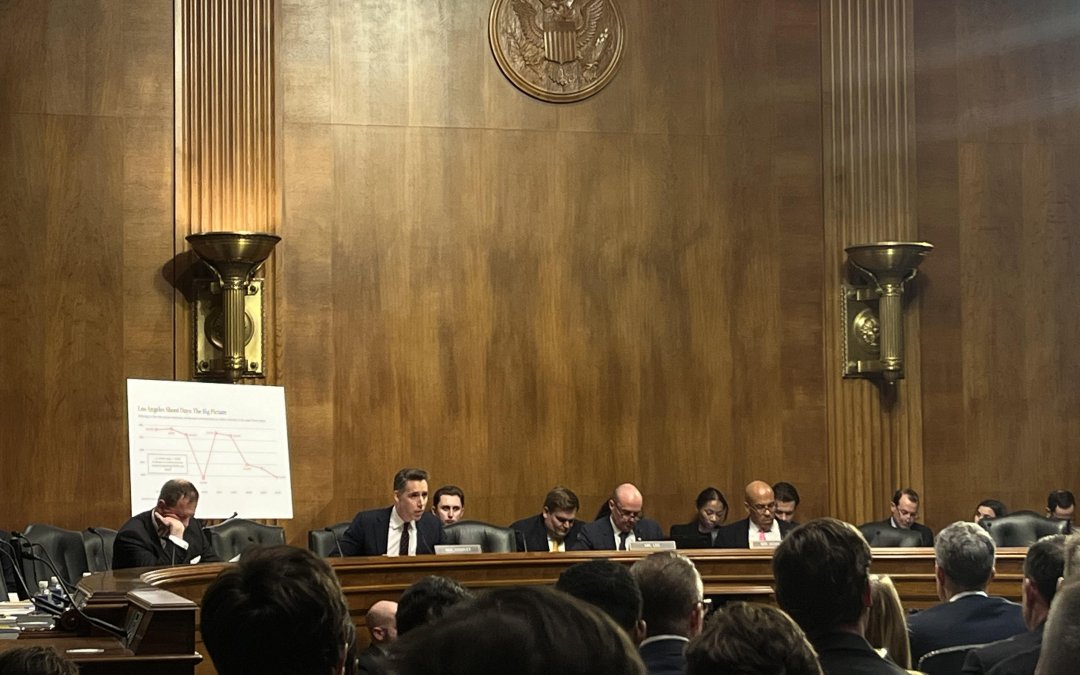
WASHINGTON — A Senate antitrust hearing on Netflix’s proposed $83 billion acquisition of Warner Bros. Discovery began Tuesday with debate on market power, labor competition and consolidation in the entertainment industry — before exploding into a partisan fight over America’s culture wars.
“Almost half of your content for children is about transgender,” said Sen. Josh Hawley, R-Mo. “I don’t want my kids being pushed an agenda of gender sexuality.”
Announced on December 5, 2025, the deal is one of the largest proposed media acquisitions in recent years. Netflix is already the world’s largest paid streaming service, with more than 300 million subscribers. However, Republican senators’ gripe with Netflix’s “woke agenda” dominated the discussion on antitrust enforcement.
Democrats, on the other hand, did not directly comment about accusations of the “woke agenda”. Subcommittee Ranking Member Cory Booker, D-N.J., was quick to steer the conversation back to antitrust policy.
“I am angry about our antitrust laws which have been ignored by Democrats and Republicans in the White House,” Booker said. “I believe we are now seeing consolidation that is screwing Americans from our farms to Pharma.”
In a packed and tense hearing room with Netflix and Warner Bros. C-suites, Subcommittee Chairman Mike Lee, R-Utah, said if Netflix absorbed another major content producer like Warner Bros., it would harm the entertainment industry’s job market, Lee said.
“Consolidating two major employers within the same market inevitably has an impact on, and can significantly weaken, competition for that labor,” Lee said.
Booker also said the merger is likely to have a negative impact on consumers. Consolidation in the entertainment industry has resulted in shrinking options, lower pay for artists and higher subscription costs for consumers, Booker said.
Netflix co-CEO Ted Sarandos and Warner Bros. Chief Revenue and Strategy Officer Bruce Campbell sought regulatory approval, stating that Warner Bros. would focus on production while Netflix works with distribution to the public. In their words, the merger would strengthen competition in an increasingly fragmented media landscape.
Sarandos also emphasized how Netflix competes not only with traditional studios and streaming services, but also with online video platforms that now command significant shares of viewer attention, he said.
“YouTube is not just cat videos anymore,” Sarandos said. “YouTube is TV.”
He said the transaction would also preserve all five major Hollywood studios, comparing that a deal with Paramount, for example, could have reduced that number to four.
Campbell echoed Sarandos’ defense, calling Netflix “the best platform available to consumers.” The acquisition would allow Warner Bros.’ content to reach a broader global audience, he said.
The hearing continued to heat up again when lawmakers returned to labor and production concerns. Hawley pointed to a sharp decline in film and television production in Los Angeles, long considered the center of the American entertainment industry.
Hawley cited FilmLA Research data showing that total shoot days in the region have fallen to levels comparable to those seen during the COVID-19 period, and pressed Sarandos on whether Netflix would commit to union labor across its productions.
For Sen. Eric Schmitt, R-Mo., the biggest concern if the merger proceeds would be Netflix’s monopoly on content production.
“Why in the world would we give a seal of approval or thumbs up to make you the largest behemoth on the planet related to content?” Schmitt said. “It seems as though you have engaged in creating not only a monopoly of content, but the wokest content in the history of the world.”
As lawmakers debated, one attendee sat behind Campbell dressed as Mr. Monopoly, clad in a top hat, white mustache and monocle — a symbolic critique of the proposed acquisition.
The man was later identified as Ian Madrigal, an activist known as the “Monopoly Man,” who has performed similar protests during past congressional activities involving major corporations, including Equifax and Google. More than an hour into the session, he was escorted out of the hearing room after becoming verbally disruptive.