
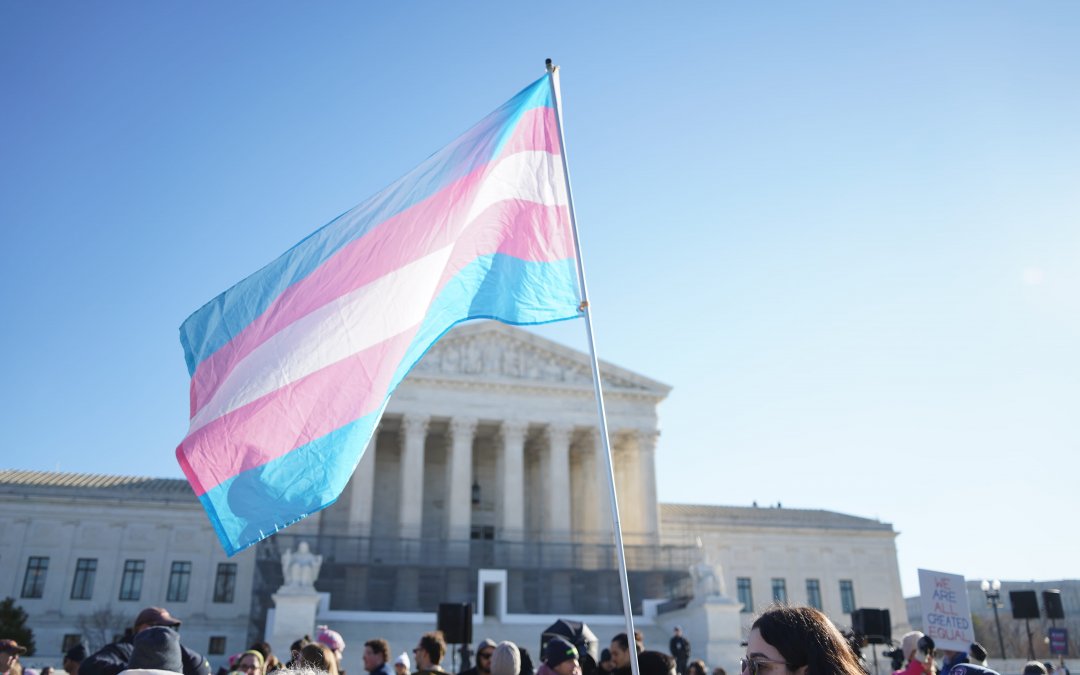
WASHINGTON — The Supreme Court appeared poised to uphold state laws barring transgender athletes from competing in women’s and girls’ sports after hearing oral arguments in two cases Tuesday.
The cases, Little v. Hecox and West Virginia v. B.P.J., challenge Idaho’s Fairness in Women’s Sports Act and West Virginia’s Save Women’s Sports Act, respectively. Idaho’s law places a flat ban on the participation of transgender women and girls in female-designated sports teams in public schools at all levels. West Virginia’s law bars participation only in public secondary schools and colleges.
Both states’ laws cite “biological differences” between the sexes as justification for separating athletic competition by natural-born sex.
Challenger Lindsay Hecox, a transgender woman, sued Idaho Gov. Bradley Little, along with Boise State University, after seeking to try out for the university’s women’s track and cross-country teams. Heather Jackson, the mother of challenger Becky Pepper-Jackson, a now 15-year-old high school student, sued West Virginia on her daughter’s behalf upon learning that the state’s law barred her from competing with the middle school’s girls’ track and cross-country teams.
“West Virginia argues that to protect these opportunities for cisgender girls, it has to deny them to B.P.J.,” said Joshua Block, Pepper-Jackson’s counsel. “But Title IX and the Equal Protection Clause protect everyone.”
In February, President Donald Trump issued an executive order directing the federal government to revoke funds from schools that allow transgender women and girls to compete on teams that match their gender identity. Quickly after, the National Collegiate Athletic Association changed its policies to limit competition in women’s sports to athletes who were assigned female at birth.
Today, 27 states have laws barring transgender athletes from competing in girls’ and women’s sports. The NCAA told a Senate panel that as of December 2024, there are fewer than 10 transgender athletes who compete in college sports. Pepper-Jackson is the only known high school-age transgender athlete in West Virginia.
The challengers in both cases allege that the state laws violate the Equal Protection Clause of the 14th Amendment by discriminating against them based on sex. Pepper-Jackson also argues that the West Virginia law violates Title IX, which prohibits sex-based discrimination in education programs and activities receiving federal funding.
The Supreme Court has ruled against multiple LGBTQ+ protections in recent years. In June, the court upheld state bans on gender transition care for minors and allowed parents to opt their children out of school lessons dealing with LGBTQ+-themed topics. The court’s conservative majority Tuesday appeared skeptical of the 14th Amendment and Title IX arguments against the state laws restricting transgender athletes.
Some of the justices appeared weary of where to draw the line between when and where state laws can treat boys and girls differently in schools. They asked a series of hypothetical questions about the differences between separating boys and girls in areas like a calculus class, a chess club and athletics.
“I think it opens a huge can of worms that maybe we don’t need to get into here,” Associate Justice Amy Coney Barrett said.
The court’s conservative front has not always ruled against gay and transgender protections. Associate Justice Neil Gorsuch provided a key swing vote in 2020’s Bostock v. Clayton County decision, which upheld laws that ban employment discrimination based on sexual orientation and gender identity.
Some legal experts were focused on Gorsuch’s questions in Tuesday’s arguments. He appeared warm to the idea of upholding the state laws.
The conservative justice seemed receptive to some of the challengers’ arguments. He indicated that further litigation could help decide whether medical treatments could eliminate some of the biological athletic advantages transgender girls and women have.
“There is a healthy scientific dispute about the efficacy of these treatments. And that’s understandable,” Gorsuch said.
The appellate courts in both cases struck down the state laws, finding that they violated equal protection.
According to a Pew Research Center study, the Fourth and Ninth Circuit courts’ holdings part with the views of the majority of Americans. The 2025 study found that 66% of U.S. adults support policies requiring transgender athletes to compete with members of the sex they were assigned at birth.
Some LGBTQ+ activists worry that athletic policies similar to the laws in question create a dangerous and invasive environment, especially for minors. In 2022, a high school in Utah put together a secret coalition to investigate whether a female student athlete was transgender after she won a competition.
“Inviting that level of scrutiny into high school athletics is going to ensure that not only transgender students but cisgender students are facing a more hostile athletic environment,” said Director Brian Dittmeier, the director of LGBTQI+ equality at the National Women’s Law Center.
The Center filed an amicus curiae brief in support of the athletes in both cases.
The Court is expected to release a decision by summer.