
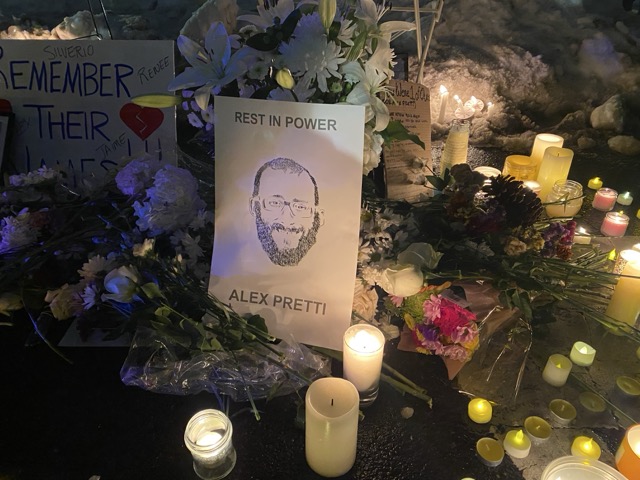
WASHINGTON – Hundreds of people joined federal workers in D.C. Wednesday night to host a vigil mourning the murder of Alex Pretti and protesting the massive Immigration and Customs Enforcement (ICE) surge.

Attendees gathered around Pretti’s vigil. (Gloria Ngwa/MNS)
Pretti, 37, was fatally shot by two federal agents in Minneapolis on Saturday, weeks after an ICE agent shot and killed Renee Good. The shooting caused the city to experience another wave of protests against ICE.
President Donald Trump responded to backlash over Alex Pretti’s death by sending his border czar, Tom Holman, to Minnesota to lead immigration enforcement there and demoted Border Patrol commander Gregory Bovino, a shift that signals a reassessment of the administration’s approach to its immigration crackdown.

(Gloria Ngwa/MNS)
Trump on Tuesday said he plans to “de-escalate a little bit” when referring to his administration’s ICE operations in the state, without specifying how it will do so.
At Thursday’s press conference in Minneapolis, Holman said the federal agency hasn’t been “perfect” with its operations, but said progress will be made in targeting “criminals” in ICE operations.
“What we’ve been working on is making this operation safer, more efficient, by the book,” Holman said. “The mission is going to improve because of the changes we’re making internally.”
In freezing temperatures in D.C., people joined the Federal Unionist Network (FUN) on Vermont Avenue in a vigil, lit candles and held signs for Alex Pretti and others killed by immigration enforcement. They also called for an end to ICE violence in Minneapolis and nationwide.

Vigil attendees hold candles and protest signs in tribute to Pretti. (Gloria Ngwa/MNS)
FUN is a coalition of labor, community and faith groups that defends federal workers and promotes a government that aims to improve living conditions in every community.
Dante O’Hara, a D.C. organizer of the vigil, said the nationwide movement seeks to push ICE out of cities and stand in solidarity with victims like Alex Pretti, a federal worker and ICU nurse, adding that everyone who attended was there to defend democracy.
“We need to make that clear that people who represent us need to do more to demand more protections of our rights as workers,” O’Hara said.


