
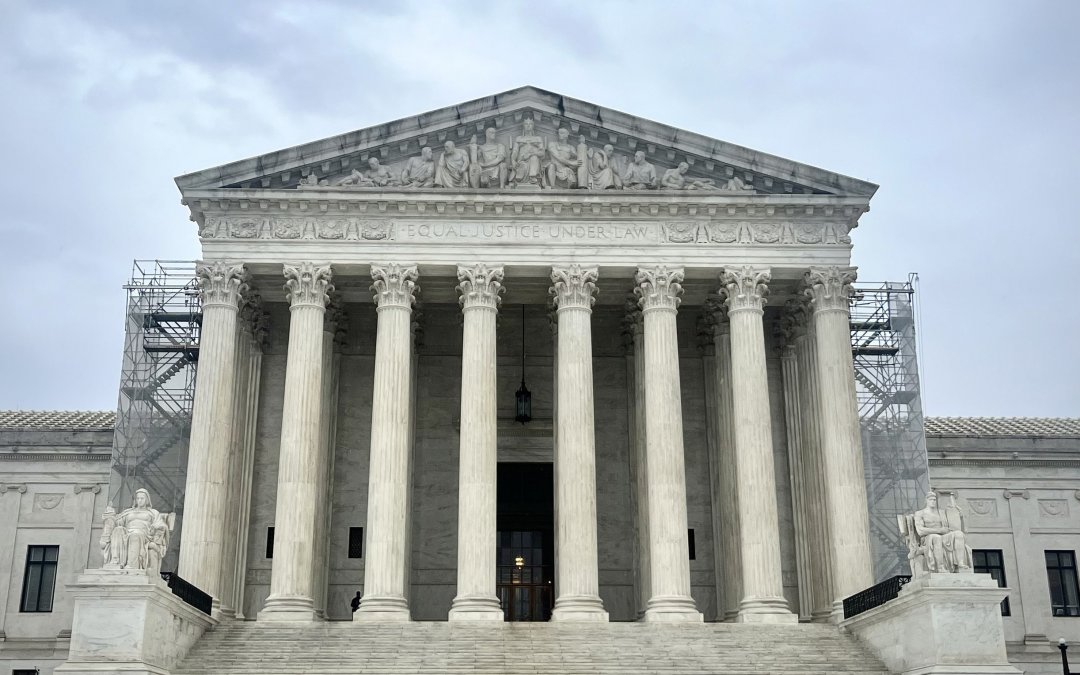
WASHINGTON — Supreme Court justices seemed likely to expand presidential ability to fire the heads of independent, multi-member federal agencies during oral arguments Monday.
The case centers around President Donald Trump’s firing of Rebecca Slaughter from the Federal Trade Commission (FTC) in March. Slaughter challenged this action by pointing to Humphrey’s Executor v. United States, a 1935 Supreme Court case outlining the FTC’s removal provision.
Humphrey’s Executor states that an FTC Commissioner “may be removed by the President for inefficiency, neglect of duty, or malfeasance in office.” Since Trump had declared only that Slaughter’s continued seat on the commission would be “inconsistent with [the] Administration’s priorities,” lawyers for Slaughter asserted that Trump had not relied on any of the legal grounds for removal in terminating her.
Before Trump v. Slaughter reached the Supreme Court, the lower court ruled in favor of Slaughter, upholding the precedent of Humphrey’s Executor and ordering the Trump administration to reinstate her. Furthermore, when the Trump administration asked the U.S. Court of Appeals for the District of Columbia Circuit to put the ruling on hold while it appealed, the court of appeals rejected that request.
However, things appeared to go a different direction during the oral arguments at the Supreme Court on Monday.
Solicitor General D. John Sauer, arguing for the government, urged the Court to overrule a nearly century-old precedent, declaring that Humphrey’s Executor “stands as an indefensible outlier.” He added that the decision “must be overruled” because it rests on a theory that no longer “withstood the test of time,” describing it as “a decaying husk … [which] continues to generate confusion in the lower courts.”
He argued that any for-cause restrictions on the president’s ability to remove principal officers are impermissible. When asked by Justice Clarence Thomas whether there is “one example […] of a permissible restriction on the authority to remove a principal officer,” Sauer replied simply, “We don’t believe there are permissible restrictions on principal officers […] who exercise the executive power.”
Several conservative justices signaled openness to narrowing or overturning Humphrey’s Executor. Chief Justice John Roberts observed that many federal agencies now combine executive, legislative and adjudicative powers — making it “hard to parse whether it’s an executive function […] or a legislative function” when the Court assesses removal protections.
Justice Brett Kavanaugh likewise appeared receptive, pressing Slaughter’s lawyer, Amit Agarwal, on the potential implications of his legal theory, suggesting that it would essentially mean that “a subordinate could ignore the president’s supervision and direction without fear and the president could do nothing about it.”
But several of the Court’s liberal members pushed back. Justice Sonia Sotomayor warned that ruling for the government would undercut the independence built into certain agencies by Congress. Justice Ketanji Brown Jackson also raised alarms about the political consequences of erasing bipartisan, expert-led commissions.
“Independent agencies exist because Congress has decided that some issues, some matters, some areas should be handled in this way by nonpartisan experts,” Jackson said. “So having a president come in and fire all the scientists and the doctors and the economists and the Ph.D.s and replacing them with loyalists and people who don’t know anything is actually not in the best interest of the citizens of the United States.”
The court’s eventual ruling could determine whether Congress can limit not only the president’s ability to fire members of the FTC but also his ability to terminate other heads of multimember independent agencies. Trump has also already fired members of the NLRB, MSPB and CPSC.
In this case, if the Court sides with the administration, Slaughter’s removal may stand — and the decision could erode statutory protections for leaders of more than two dozen independent federal agencies created by Congress. The case could reshape the federal administrative state and transform how future presidents wield control over executive-branch regulators.
The Supreme Court is expected to decide the case by summer 2026.