
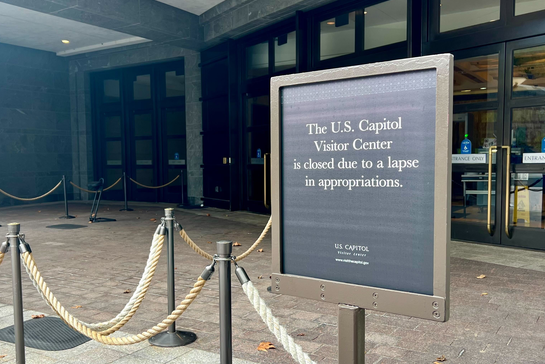
WASHINGTON — In the aftermath of the longest government shutdown in American history – lasting 43 days – many industries are striving to return to normal. From air travel to food and restaurants, the shutdown has left some lingering effects. And there is a chance for another shutdown in a matter of months. Congress voted to fund the government only through Jan. 30, 2026.
During the government shutdown, Americans were forced to contend with a more arduous air travel process. TSA workers and air traffic controllers worked without pay, flights were cancelled and the FAA forced delays and ground stops at major airports. As the shutdown dragged on, the Federal Aviation Administration (FAA) and the Department of Transportation announced flight reductions at 40 key airports.
As weeks passed and the government remained shut down, funding for the Supplemental Nutrition Assistance Program (SNAP) also ran out. This meant that the nearly 42 million people who rely on SNAP throughout the United States were left scrambling. Food banks and pantries across the country struggled to keep up with the unprecedented surge in demand, as many saw lines that, in some cases, stretched down the block.
At least 670,000 federal employees were furloughed during the shutdown, while about 730,000 others were working without pay. This decreased the amount of discretionary spending many families had during the shutdown, directly affecting many small businesses and restaurants. This impact was particularly strong in the DMV – Washington, D.C., Maryland and Virginia – which is home to 19.8% of federal employees. More than 4,000 federal employees were also laid off during the shutdown, with the legal battle to bring them back still in progress.
Since the shutdown ended, the impacts to many of these areas have started to be resolved but the effects still linger.
Air Travel
A record 3.1 million travelers took to the skies the Sunday before Thanksgiving, breaking the TSA record for air travel. Airports may be operating smoothly for now, but the potential of another shutdown in early 2026 is looming over the industry.
After the shutdown ended on Nov. 13, the U.S. Senate Committee on Commerce, Science, and Transportation held a hearing on the impact of the shutdown on the air traffic control system, airline operations and training.
“The government shutdown has severely impacted our already fragile aviation industry, and recovering from its effects will take time,” said Aviation Subcommittee Chairman Jerry Moran (R-Kan.). “As we work to reopen the government, it’s critical that we address the damage done and look at the long-term effects of the shutdown.
Moran also stated that he looked forward to discussing how Congress can work to alleviate the strain on air traffic controllers and TSA agents, as well as ensure safety for passengers and sustainable operations for our airlines, general and business aviation stakeholders.
Former Governor Chris Sununu, the president and CEO of Airlines for America (A4A) – the trade association for leading U.S. airlines, including American, Delta and United – testified that protecting air safety workers from future shutdowns was crucial.
“Congress must identify and enact solutions that will ensure the FAA, TSA and CBP are insulated from the impacts of any future lapses in appropriations, ensuring their employees can continue their work uninterrupted and with pay,” Sununu said.
A proposed bipartisan bill called the Aviation Funding Solvency Act requires certain FAA activities to continue in the event of a government shutdown, ensuring that air traffic controllers and other FAA professionals responsible for managing the airspace will continue to get paid.
SNAP
During the government shutdown, funding for SNAP was halted, causing states to suspend or delay benefits. While the U.S. Department of Agriculture (USDA) eventually released partial payments through a contingency fund to avoid a complete cutoff, some food banks warned that they could not fully compensate for the reduced federal aid and faced an increase in demand.
“The truth is, food banks cannot match the scale or scope of SNAP,” the Maryland Food Bank said in a statement following the USDA announcement about the halt in SNAP funding. “To fill even a portion of the gap created by the SNAP stoppage, we’d need to quadruple the amount of food we currently distribute—an impossible task.”
Since the government shutdown ended, SNAP benefits have been restored to most recipients. However, many food banks and other organizations have found that they are still struggling to keep up with the demand for assistance.
“Even though the government shutdown is now over, we know that the disruptions to SNAP and other programs will still have a ripple effect for families,” said Feeding America, the largest hunger-relief organization in the United States, in a statement.
As some states have begun implementing programs to make up for the lapse in November’s benefits, Feeding America’s network of food banks, pantries and other meal programs has since committed to “doing everything we can to help families affected by the shutdown.”
Small businesses
The federal shutdown also had an impact on a local level. Many restaurants and small businesses saw disruptions to cash flow and operational halts due to the freezing of federal loans and contracts during the shutdown. The stop in federal funding directly affected at least 65,500 small business contractors in the United States, according to a U.S. Chamber of Commerce report, as well as indirectly affecting many others.
In Washington D.C., restaurants and businesses that rely heavily on the city’s high concentration of federal workers and tourists saw a big hit during the shutdown. As hundreds of thousands of federal workers were furloughed, working without pay, or even laid off, some restaurants in Washington reported empty lunch counters and fewer dinner reservations.
Peter Boboris, executive chef of Rania in downtown Washington, says his restaurant was affected by the shutdown, and still hasn’t recovered in weeks since the government reopened.
“Once [the shutdown layoffs] happened, it just got slower,” said Boboris. “Usually right now is the time that this place picks up. […] We’re not really a residential area, the FBI building’s right here, and I don’t want to speculate why, but I noticed once the layoffs happened we got lighter.”
Going forward, Boboris, as with many other local restaurants and businesses, hopes to see business bounce back to its pre-shutdown levels.
The shutdown only compounded the economic strain on individuals and businesses already facing rising prices, an uncertain job market and growing concerns about affordability. If Congress is unable to agree on a budget by Jan. 30, these same industries may find themselves under even further strain.